Home
Class 12
PHYSICS
The figure below depict two situations i...

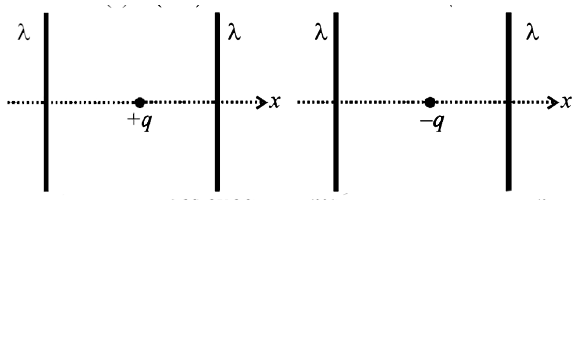
The figure below depict two situations in which two infinitely long static line charges of constant positive line charge density `lambda` are kept parallel to each other. In their resulting electric field, point charges q and `-q` are kept in equilibrium between them. The point charges are confined to move in the x direction only. If they are given a small displacement about their equilibrium positions, then the correct statement(s) is(are)

A

both charges execute simple harmonic motion.

B

both charge will continue moving in the direction of their displacement.

C

charge `+q` execute simple harmonic motion while charge `-q` continues moving in the direction of its displacement.

D

charge `-q` execute simple harmonic motion while charge `+q` continues moving in the direction of its displacement.

Text Solution

Verified by Experts

The correct Answer is:
C

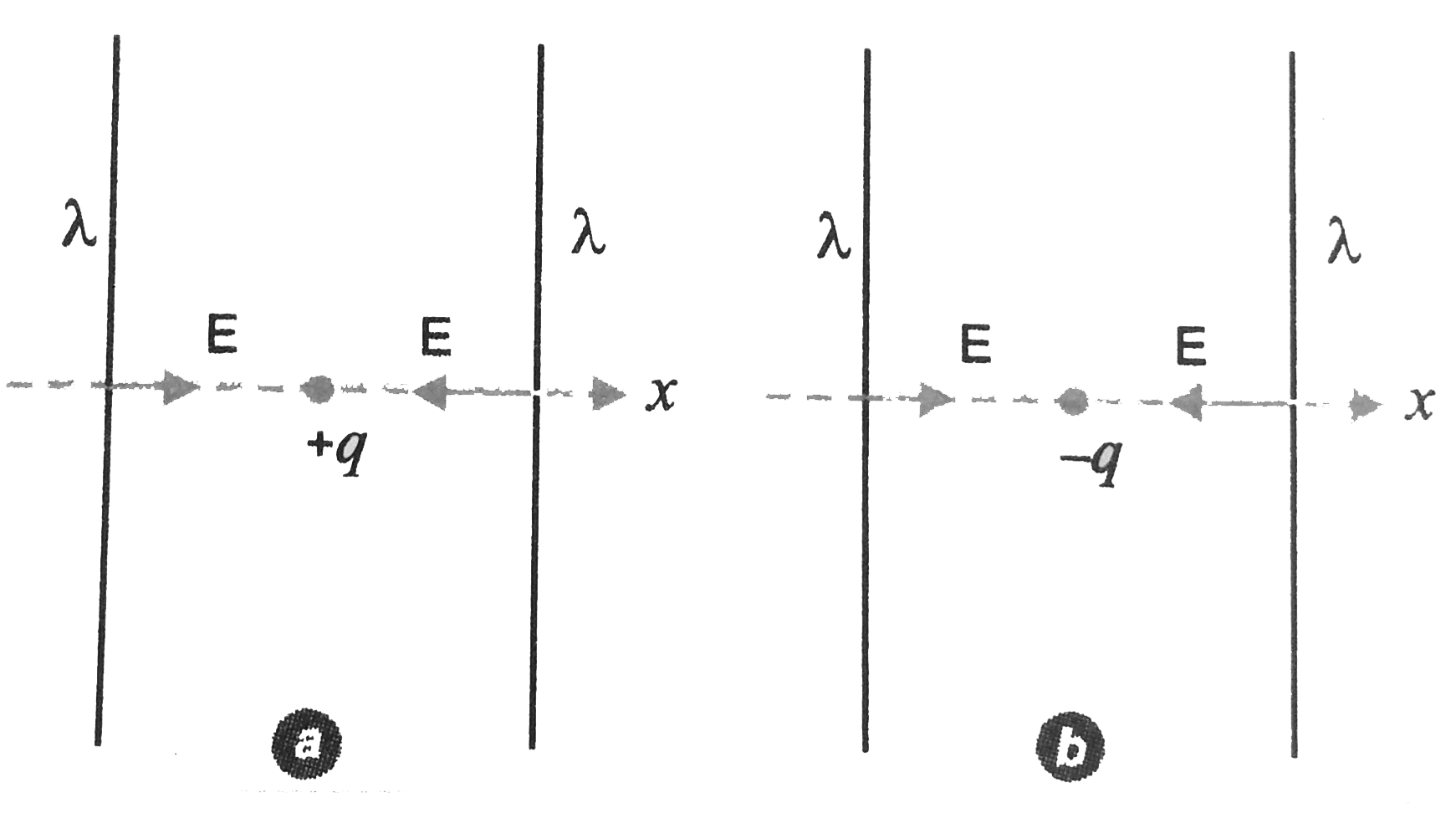
Refer to Figs. (a) and (b), when point charges `+q` and `-q` are displaced a little towards positive x-direction, then `+ q` charge will experience resisting force which will tend to bring it back to its original position. As a result of it the charge `+q` wil execute `SHM`. The charge `-q` will

experience a force in the direction of displacement, hence charge `-q` will move in that direction. Therefore, option (C) is true.
Promotional Banner

Topper's Solved these Questions

  • ELECTROSTATICS

    PRADEEP|Exercise FILL IN THE BLANKS|8 Videos
  • ELECTROSTATICS

    PRADEEP|Exercise PROBLEMS FOR PRACTICE|8 Videos
  • ELECTROSTATICS

    PRADEEP|Exercise VALUE BASED QUESTIONS|7 Videos
  • ELECTRONIC DEVICES

    PRADEEP|Exercise Fill in the Blanks|1 Videos
  • MAGNETIC EFFECT OF CURRENT AND MAGNETISM

    PRADEEP|Exercise Competition Focus (Multiple Choice Questions)|2 Videos

Similar Questions

Explore conceptually related problems

Two infinitely long thin styraight wires having uniform linear charge densities lambda and 2lambda are arranged parallel to each other at a distance r apart.The intensity of the electric field at a point midway between them is

Two charge +q and -q are kept apart.then at any point on the right beisector of line joining the two charges

An infinitely long time charge has linear charge density lamdaC//m the line charge is along the line x=0,z=2m find the electric field at point (1,1,1) m.

Two charge +aq and -q are kept apart. Then , at any point on the right bisector of line joining the two charge

Two positive point charges , each Q , are fixed at separation d . A third charge q is placed in the middle. Describe the equilibrium of the third charge.

Two point charges +9e and +e are kept 16 cm . Apart from each other. Where should a third charge q be placed between them so that the system is in equilibrium state:

Between two infinitely long wires having linear charge densities lambda and -lambda there are two points A and B shown in the figure. The amount of work done by the electric field moving a point charge q_(0) from A to B is equal to

The variation of electric field between two charge q_1 and q_2 along the line joining the charges is plotted against distance from q_1 (taking rightward direction of electric field as positive) as shown in the figure. Then the correct statement is

(i) Two infinitely long line charges each of linear charge density lambda are placed at an angle theta as shown in figure. Find out electric field intensity at a point P, which is at a distance x from point O along angle bisector of line charges. (ii) Repeat the above question if the line charge densities are lambda and -lambda . as shown in figure.

The given diagram shows two infinite line of charges having equal (in magnitude) linear charge density but with opposite sign. The direction of electric field at any point on x-axis for (xgt0) is given by the unit vector

PRADEEP-ELECTROSTATICS-Exercise
  1. Two point charges +8q and -2q are located at x=0 and x=L respectively....

    Text Solution

    |

  2. If potential (in volts) in a region is expressed as V (x, y, z) = 6xy ...

    Text Solution

    |

  3. The figure below depict two situations in which two infinitely long st...

    Text Solution

    |

  4. Poistive and negative point charges of equal magnitude are kept at (0,...

    Text Solution

    |

  5. A thin semi-circular ring of radius r has a positive charge q distribu...

    Text Solution

    |

  6. Two charges q(1) and q(2) are placed 30 cm apart, as shown in the figu...

    Text Solution

    |

  7. The point charges + q, -2q and + q are placed at point (x = 0, y = a, ...

    Text Solution

    |

  8. A thin conducting ring orf radius R is given a chareg +Q, Fig. The el...

    Text Solution

    |

  9. Let there be a spherically symmetric charge distribution with charge d...

    Text Solution

    |

  10. A thin semi-circular ring of radius r has a positive charge q distribu...

    Text Solution

    |

  11. Let P(r)=(Q)/(piR^4)r be the charge density distribution for a solid s...

    Text Solution

    |

  12. Two positive charges of magnitude q are placed at the ends of a side (...

    Text Solution

    |

  13. Conisder a thin spherical shell of radius R with centre at the origin,...

    Text Solution

    |

  14. Charges Q, 2Q and 4Q are uniformly distributed in three dielectric sol...

    Text Solution

    |

  15. The electric field in a certain region is acting radially outwards and...

    Text Solution

    |

  16. An assmebly of charges +q, -q , +q, -q….. are at positions x = 1 m, ...

    Text Solution

    |

  17. A point charge q is placed at the centre of a cube. What is the flux l...

    Text Solution

    |

  18. Three infinitely long charge sheets are placed as shown in figure. Th...

    Text Solution

    |

  19. A disc of radius a//4 having a uniformly distributed charge 6C is plac...

    Text Solution

    |

  20. An insulated sphere of radius r haas a uniform volume charge density ...

    Text Solution

    |

