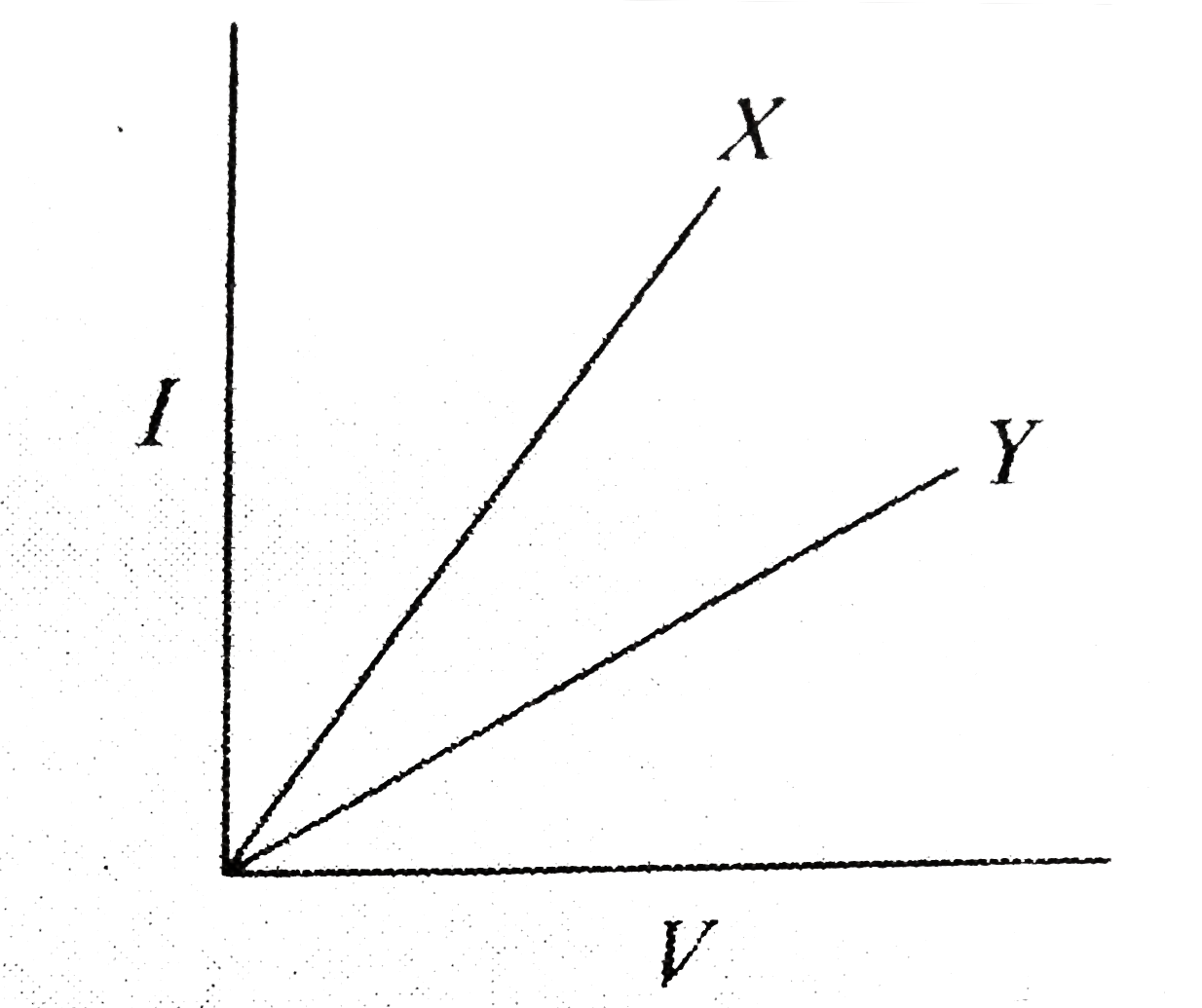
The voltage-current variations of two metallic wire X and Y at constant temperature is shown in fig. Assuming that the wires have the same length and the same diameter, explain which of the two wires will have larger resistivity.
Text Solution
Verified by Experts
Slope of I - V line for a wire represents the coductance of the wire. From graph. Slope of I - V line for wire X gt slope of I - V line for wire Y. `:.` Conductance of wire X gt conductance of wire Y. As resistance `=1/"conductance"`, so Resistance of wire X lt resistance of wire Y. `rho X l/A lt rho Y l/A or rho X lt rho Y` Thus, wire Y has larger resistivity.
Topper's Solved these Questions
CURRENT ELECTRICITY
PRADEEP|Exercise Conceptual Problems|3 Videos
CURRENT ELECTRICITY
PRADEEP|Exercise Very short Q/A|7 Videos
COMMUNICATION SYSTEMS
PRADEEP|Exercise MODEL TEST PAPER-2|9 Videos
DUAL NATURE OF RADIATION AND MATTER
PRADEEP|Exercise Exercise|191 Videos
Similar Questions
Explore conceptually related problems
The voltage-current variations of two metallic wire X and Y at constant temperature is shown in fig Assumign that the wires have the same length and the same diameter, explain which of the two wires will have larger resisitivity.
The current -voltage - variation for a wire of copper of length (L) and area (A) is shown in fig. The slope of the line will be
When two wires have current in same direction then force is
Two steel wires of the same radius have their lengths in the ratio of 1:2 . If they are stretched by the same force, then the strains produced in the two wires will be in the ratio of
Two copper wires of the same length have got different diameters a. which wire has greater resistance? b. greater specific resistance?
The current (I) and voltage (V) graphs for a given metallic wire at two different temperature (T_(1)) and (T_(2)) are shown in fig. It is concluded that
PRADEEP-CURRENT ELECTRICITY-Problems for Practice (B)