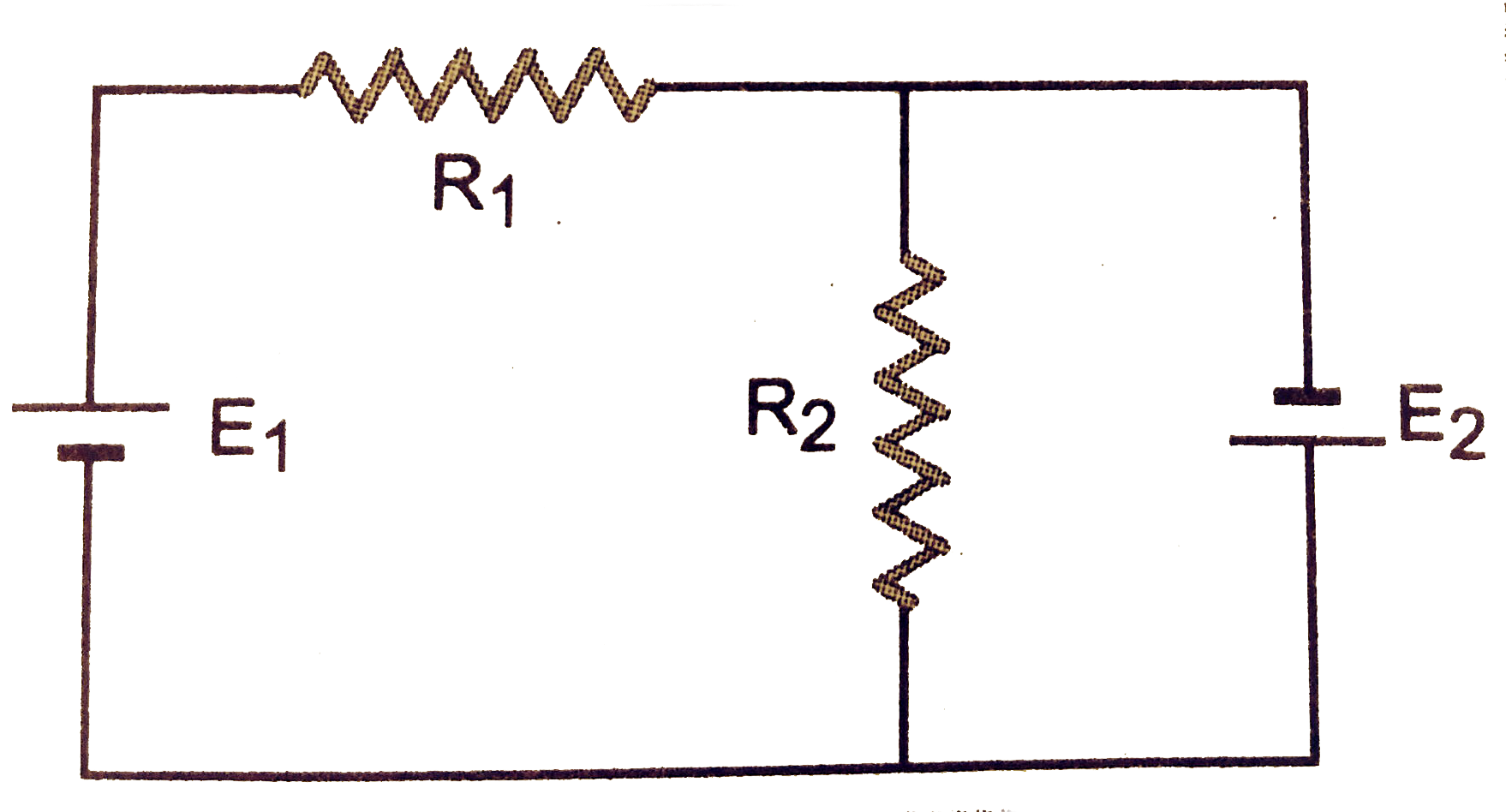
Two resistance `R_(1)` and `R_(2)` are joined as shown in figure to two batteries of emf `E_(1)` and `E_(2)`. If `E_(2)` is short circuited, what is the current through `R_(1)` ?
Text Solution
Verified by Experts
When `E_(2)` is short circuited, it means positive pole of battery `E_(2)` is connected to negative pole of battery `E_(2)`. The battery gets discharged. The resistance of the arm become zero. The current from cell `E_(1)`, flowing through `R_(1)` will not pass through `R_(2)`, but will go through the short circuited path. Therefore, `R_(2)` becomes inffective. Now current through `R_(1)` is due to emf `E_(1)` with resistance `R_(1)` in circuit, i.e., `I= E_(1)//R_(1)`
Topper's Solved these Questions
CURRENT ELECTRICITY
PRADEEP|Exercise Conceptual Problems|3 Videos
CURRENT ELECTRICITY
PRADEEP|Exercise Very short Q/A|7 Videos
COMMUNICATION SYSTEMS
PRADEEP|Exercise MODEL TEST PAPER-2|9 Videos
DUAL NATURE OF RADIATION AND MATTER
PRADEEP|Exercise Exercise|191 Videos
Similar Questions
Explore conceptually related problems
5 resistances R_(1), R_(2),R_(3),R_(4),R_(5) are joined as shown in the figure. The values of R_(1), R_(2), R_(3) and R_(4) are so adjusted that the current in the circuit does not change for any value of the resistance R_(5) . This is possible for the following relation
Three identical resistors R_(1) = R_(2) = R_(3) are connected as shown to a battery of constant e.m.f . The power dissipated is
In the labortary, the high emf of a battery is measured by using potentiometer and two resistance R_(1) and R_(2) , where R_(1) lt lt R_(2) as shown in the figure R_(1)=(100+-0.10)Omega and R_(2)=(9900+-9.90)Omega , AB=1m The voltage across R_(1) , when switches S_(1) & S_(2) are connected to point 1 and point 2 is balanced against l_(1)=(60+-0.06)cm . when the switches S_(1) and S_(2) are shifted to point 3 and point 4 as shown in the figure, the potential difference of standard E_(0)=2 volt is balanced against length l_(2)=(75+-0.075)cm . The maximum error in emf of battery E is __________ volts (upto two decimal places)
Two cells of emf E_(1) and E_(2) are joined in opposition (such that E_(1) gt E_(2) ) . If r_(1) be the internal resistances and R be the external resistance, then the terminal potential difference is
In the circuit shown in fig E_1 = 3 volts, E_2 = 2volts, E_3 = 1volt and R = r_1 = r_2= r_3= 1 ohm. (i) Find the potential difference between the points A and B and the currents through each branch. (ii) If r_2 is short circuited and the point A is connected to point B, find the current through E_1, E_2, E_3 and the resistor R.
In the circuit in figure E_1=3V, E_2=2V, E_3=1V and R=r_1-r_2-r_3=1Omega a. Find the potential differece between the points A and B and the currents through each branch. b. If r_2 is short circuited and the point A is connected to point B , find the currents through E_1,E_2, E_3 and the resistor R
In the circuit shown in figure-3.344 if battery is ideal , then time after which current in R_(3) becomes (1/e) time that of maximum current through it is :
Assertion:- To cells of unequal emf E_(1) and E_(2) having internal resistances r_(1) and r_(3) are connected as shown in figure. Then the potential difference across any cell cannot be zero. Reason:- If two cells having nonzero internal resistance and unequal emf are connected across each other as shown, then the current in the circuit cannot be zero.
PRADEEP-CURRENT ELECTRICITY-Problems for Practice (B)