Home
Class 12
PHYSICS
A number of indentical cells, n, each of...

A number of indentical cells, n, each of emf `epsilon`, internal resistance r, connected in series are charged by a d.c. source of emf `epsilon'` , using a resistor R.(i) Draw the circuit arrangemnet. (ii) Deduce the expression for (a) the charging current and (b) the potential difference across the combination of the cells

Text Solution

Verified by Experts

(i) The circuit arrangment for charging the cells is shows in figure
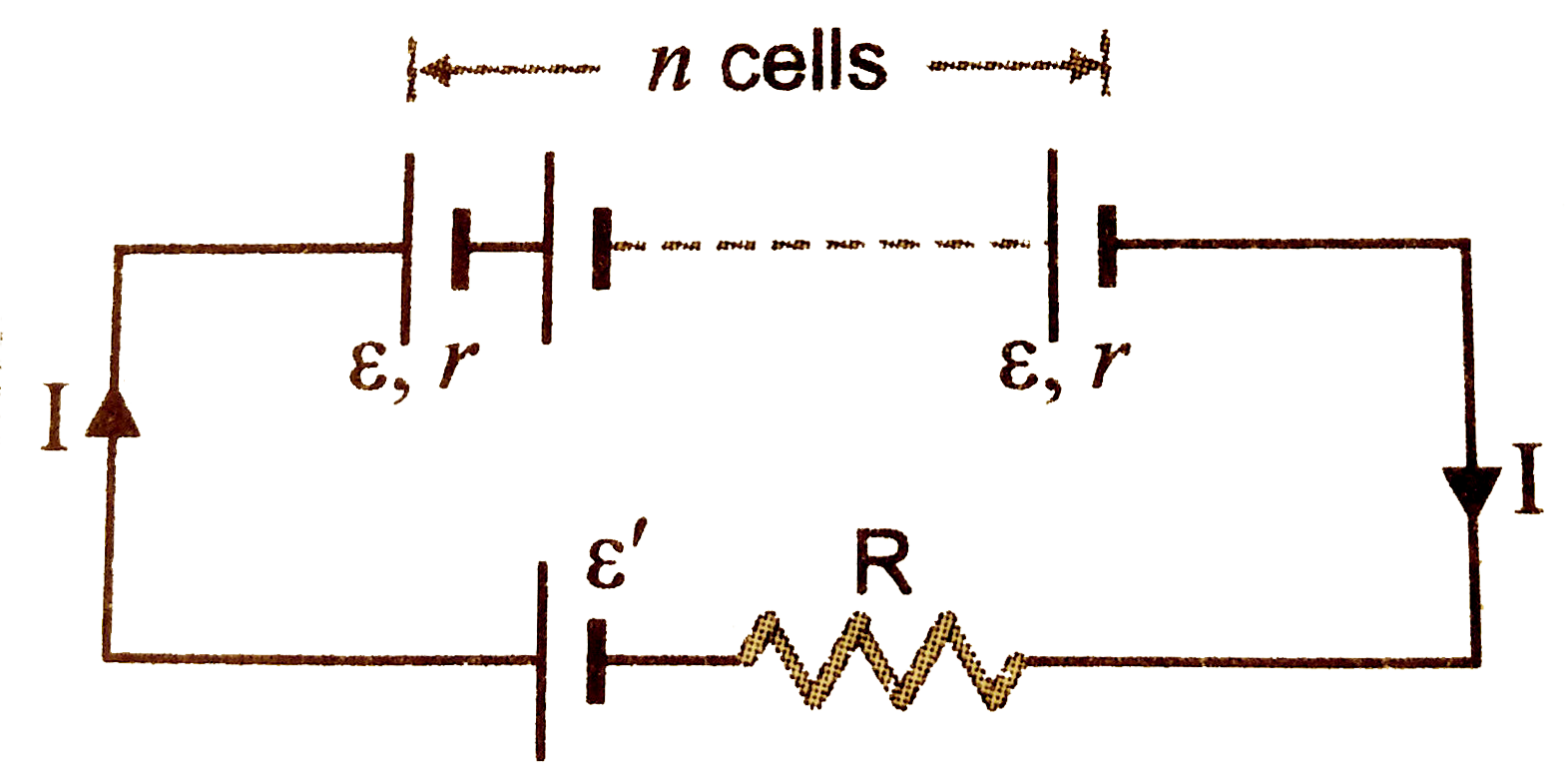
(ii) Effective emf of the circuit = `epsilon' - n epsilon`
Total resistance `= R+ nr`
Charging current `I= ("effective emf")/("total resistnance") = (epsilon' - n epsilon)/( R +nr)`
(iii) Pot. diff. across each charging cell `= epsilon + Ir`
`epsilon + ((epsilon' -n epsilon)/(R + nr)) r = (epsilon R + epsilon' r)/(R + nr)`
Pot. diff. across the series combination of n cells
`V = n (epsilon + Ir) = n ((epsilon R + epsilon'r)/(R + nr))`

Promotional Banner

Topper's Solved these Questions

  • CURRENT ELECTRICITY

    PRADEEP|Exercise Conceptual Problems|3 Videos
  • CURRENT ELECTRICITY

    PRADEEP|Exercise Very short Q/A|7 Videos
  • COMMUNICATION SYSTEMS

    PRADEEP|Exercise MODEL TEST PAPER-2|9 Videos
  • DUAL NATURE OF RADIATION AND MATTER

    PRADEEP|Exercise Exercise|191 Videos

Similar Questions

Explore conceptually related problems

A cell of emf epsilon and internal resistance r is charged by a current I, then

n-identical cells each of emf E and internal resistance r are connected in series. Find the expression for current in the circuit given below

n identical cells each of emfe and internal resistance r are joined in series so as to form a closed circuit. The P.D. across any one cell is

n identical cells, each of emf E and internal resistance r, are joined in series to form a closed circuit. Find the potential difference across any one cell.

n identical cells, each of emf epsilon and internal resistance r, are joined in series to form a closed cirucit. One cell A is joined with reversed polarity. The potential difference across any one cell is

n identical cells each of e.m.f. E and internal resistance r are connected in series. An external resistance R is connected in series to this combination. The current through R is

In a arrangement, 3n cells of emf epsilon and internal resistance r are connected in series. Out of 3n cells polarity of n cells is reversed. Current in the circuit is

Four cells, each of emf E and internal resistance r, are connected in series across an external resistance reverse. Then, the current in the external circuit is

Two cells , each of emf E and internal resistance r , are connected in parallel across a resistor R . The power delivered to the resistor is maximum if R is equal to
