Let ABCDFGHK be the open cube formed by joining eleven equal wires each of resistance `2 Omega`
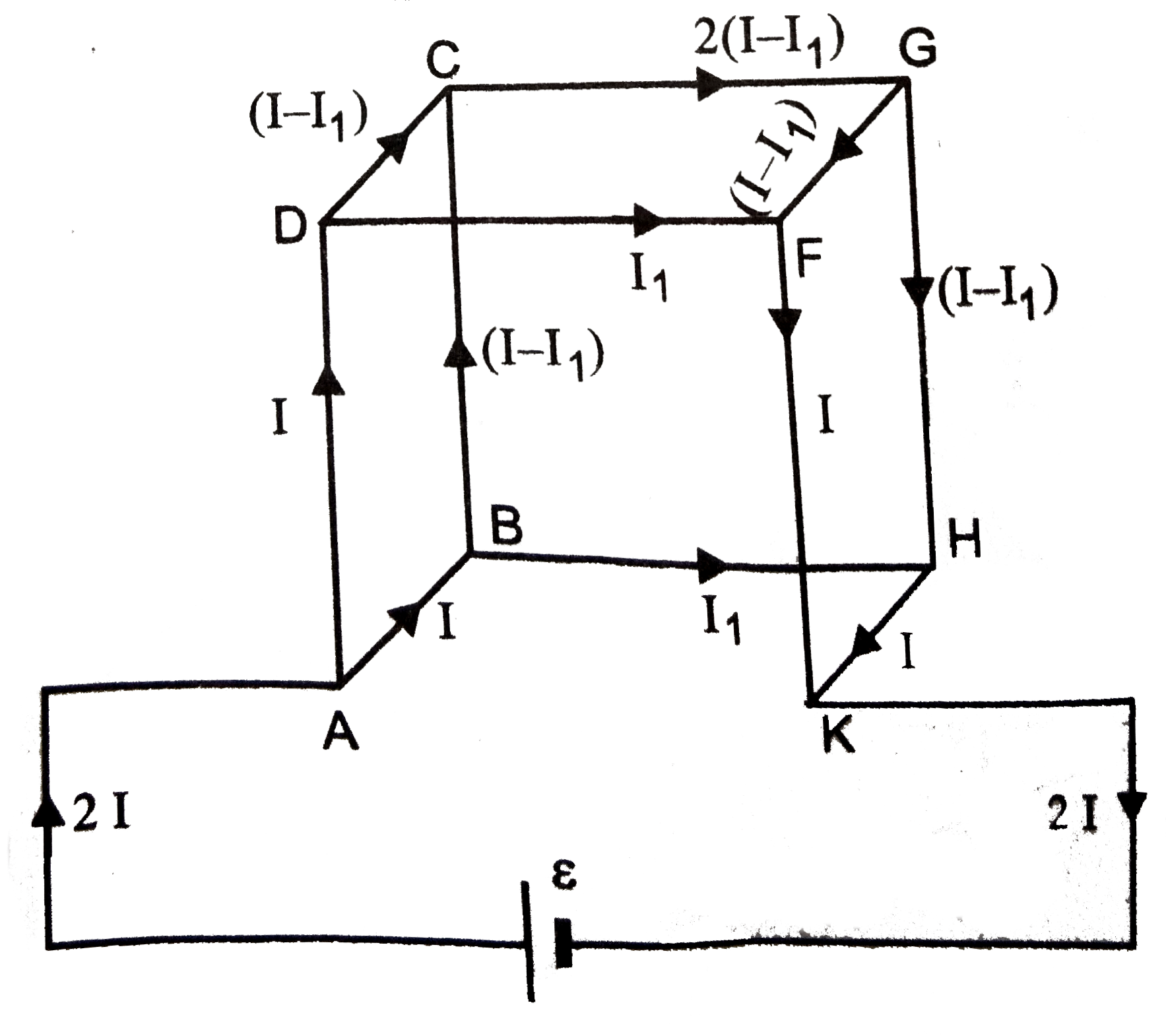
Let the current from the cell of emf `epsilon` enter the cube at corner A and after passing through all the wires leave at K, the other end of the open edge of the cube.
For the sake of convenience, let us suppose that the total current is 2I. At A, this current is divided into two parts : I along AB and I AD. This is beacuse the resistances of the two paths are equal. At the points B and D, each part of current is further divided into two uneqaul parts. The distribution of current in the various arms of skeleton cube is shown according to Kirchhoff's first rule. The current leaving the cube at K is again 2 I. Let R be the equivalent resistance of skeleton cube between edges A and K.
From Ohm's law, `epsilon = 2 I R`
Applying Kirchhoff's second rule to mesh `epsilon` ABHK`epsilon` , we have
`epsilon = 2 xx I + 2xx I_(1) + 2 xx I`
or `epsilon= 4 I+2I_(1)`
Applying Kirchhoff's Second rule to mesh of DFGCD, we have
`2 I_(1) - 2 (I -I_(1)) -2 xx 2 (I - I_(1)) - 2 (I-I_(1))=0`
`2 I_(1) - 2I + 2 I_(1) - 4 I + 4 I_(1) + 2 I + 2I_(1)=0`
or `10_(1)-8I=0 or 8 I = 10 I_(1)`
or `I_(1) = 8/10 I = 4/5 I`
From (ii) and (iii),
`epsilon = 4 I + 2 ((4)/(5)I) = (28 I)/5`
From (i) and (iv),
`2 Ir = (28I)/5 or R = 28/(5xx2)= 2.8 Omega`


