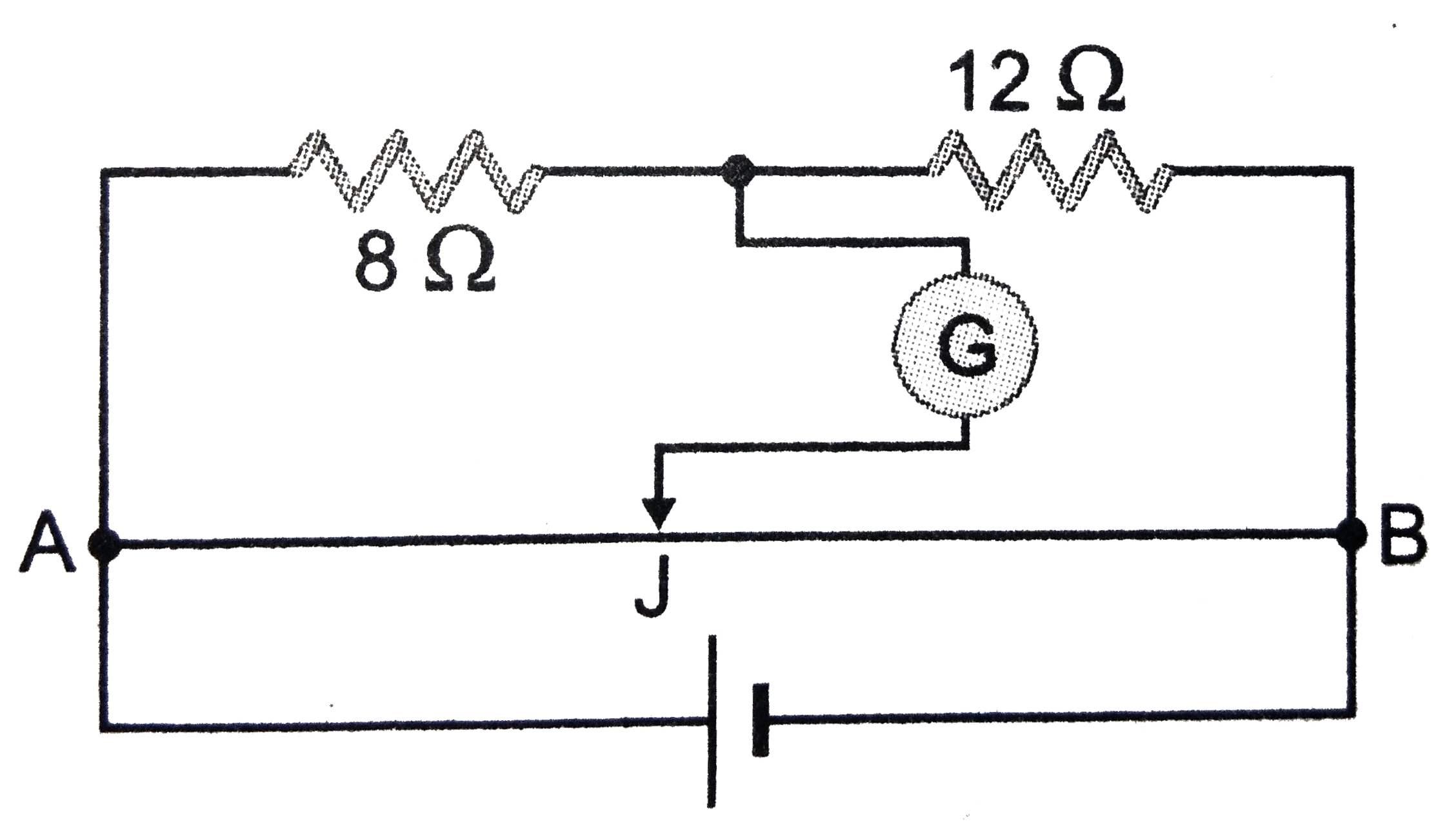
Let the free end of galvanometer be connected in wire AB at point D, then galvanometer shows no defelection. Let length of wire from A to D be x, where x=0 at end A of wire. Let `R_(1)` be the resistance of left part part (i.e., AD) of wire of length `x_(1)` and `R_(2)` be the resistance of right part (i.e., DB) of wire of length `( 1 - x_(1)`
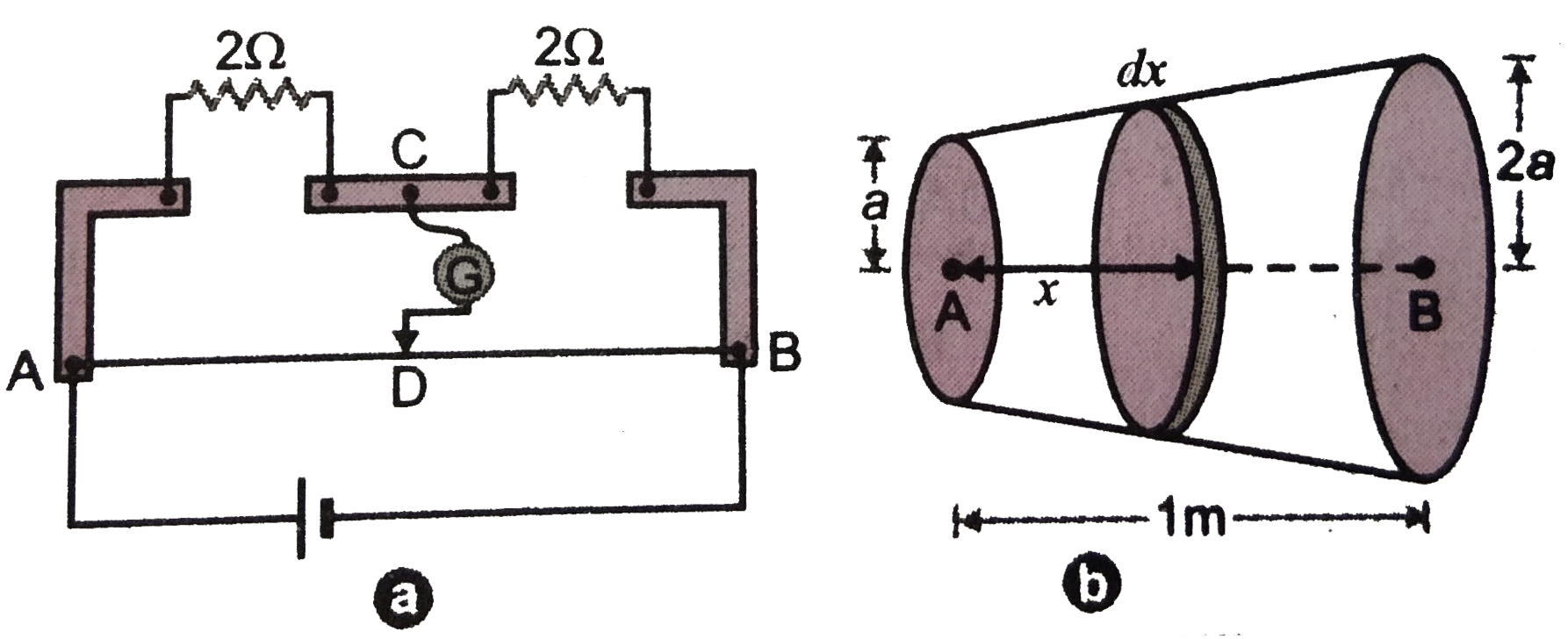
Consider an element of wire of thickness dx at a distance x from end A of wire. Its radius be `a_(x)`, then
`a_(x)=[a+((2a-a))/(1)x]=a(1-x)`
Resistance of this element is
`dR = (rho dx)/(pi a_(x)^(2))=(rho dx)/(pia^(2)(1+x)^(2))`
`:. R_(1)= underset(0)overset(x_(1))(int)(rho dx)/(pi a^(2)(1+x)^(2))=(rho)/(pi a^(2))[1-(1)/(1+x_(1))]`
and `R_(2)=underset(x_(1))overset(1)(int)(rho dx)/(pia^(2)(1+x)^(2))=(rho)/(pia^(2))[(1)/(1+x_(1))-(1)/(1+1)]`
For no deflection in galvanometer
`(R_(1))/(R_(2))=(2)/(2) or R_(1)=R_(2)`
`:. (rho)/(pia^(2))[1-(1)/(1+x_(1))]=(rho)/(pia^(2))[(1)/(1+x_(1))-(1)/(1+1)]`
On solving, `x_(1) = (1)/(3) m = 33.33 cm`