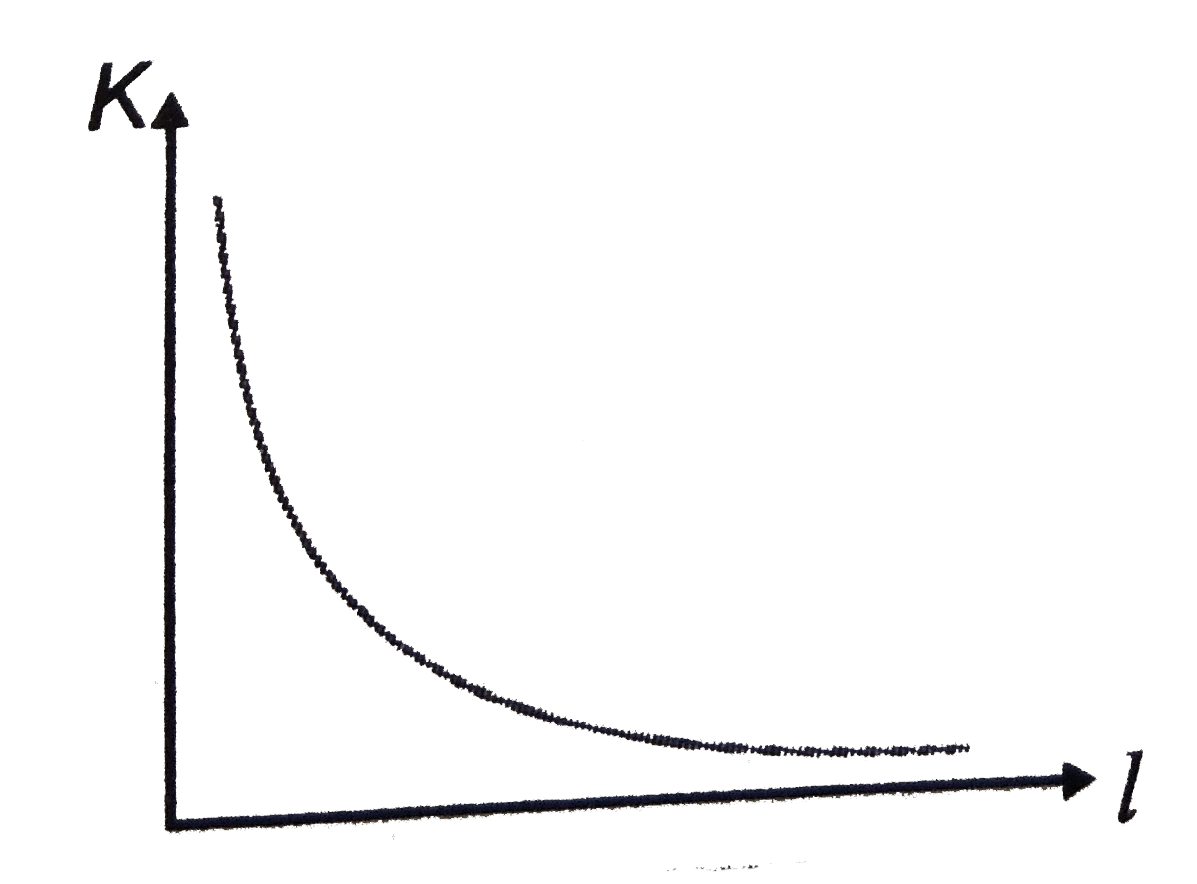
In a potentiometer experiment, if the area of cross-section of the wire increases uniformly from one end to another, draw a graph showing how potential gradient would vary as the length of the wire increases from one end.
Text Solution
Verified by Experts
Potential gradient, `K=V/l = (IR)/l = I/l = (rho l)/A = (I rho)/A` or ` K prop 1/A` Thus the variaton of K versus `l` when A increases from one end to another is of the type.
Topper's Solved these Questions
CURRENT ELECTRICITY
PRADEEP|Exercise Conceptual Problems|3 Videos
CURRENT ELECTRICITY
PRADEEP|Exercise Very short Q/A|7 Videos
COMMUNICATION SYSTEMS
PRADEEP|Exercise MODEL TEST PAPER-2|9 Videos
DUAL NATURE OF RADIATION AND MATTER
PRADEEP|Exercise Exercise|191 Videos
Similar Questions
Explore conceptually related problems
The mass of an uniform ladder of length l increases uniformly from one end A to the other end B, find the position of the centre of mass from end A.
If the radius of a potentiometer wire is increased four times, keeping its length constant, then the value of its potential gradient will become
If the resistivity of a potentiometer wire be rho and area of cross-section be A , then what will be potential gradient along the wire
The specific resistance and area of cross section of the potentiometer wire are rho' and A respectively. If a current i passes through the wire, its potential gradient will be
A wire whose cross-sectional area is incereasing linearly from its one end to the other, is connected across a battery of V volts. Which of the following quantities remain constant in the wire ?
If the diameter of the cross-section of a wire is decreased by 5% ,how much percent will the length increased if volume remains the same.
If the diameter of cross-section of a wire is decreased by 5% how much percent will the length be increased so that the volume remains the same?
As is the cross sectional area and rho is the specific resistance of a potentiometer wire. If I is the current passing through the potentiometer wire, then the potential gradient along the length of the wire is given by
PRADEEP-CURRENT ELECTRICITY-Problems for Practice (B)