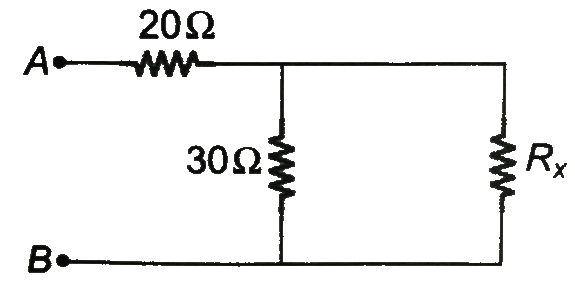
A circuit shown in the figure has resistances `20 Omega` and `30 Omega`. At what value of resistance `R_x` will the thermal power generated in it be practically independent of small variations of that resistance? The voltage between points `A` and `B` is supposed to be constant in this case.
Text Solution
Verified by Experts
Let V be the potential difference applied across across A and B. Let `I,I_(1),I_(2)` be the currents through `R_(1),R_(2)` and `R_(x)` respectively. Here `R_(2)` and `R_(x)` are connected in parallel, their effective resistance is `R_(P) = (R_(2) R_(x))/(R_(2) + R_(x))` Total resistance between A and B is `R_(1) = (R_(2) R_(x))/(R_(2) + R_(x))` Current through the circuit, `I = V/(R_(1) + (R_(2) R_(x))/(R_(2) + R_(x)))` Potential difference across C and D `V_(G//D) I R_(P) = I = V/(R_(1) + (R_(2) R_(x))/(R_(2) + R_(x))) xx (R_(2) R_(x))/(R_(2) + R_(x))` `(VR_(2)R_(x))/(R_(1) (R_(2) + R_(x)) + R_(2)R_(x))` Current through resistance `R_(x)` will be `I_(2) = V_(CD)/R_(x) = (VR_(2))/(R_(1) (R_(2) + R_(x)) + R_(2)R_(x))` `= (VR_(2))/(R_(1) (R_(2) + R_(x)) + R_(2)R_(x))` Thermal power generated in resistance `R_(x)` will be `P = I_(2)^(2) R_(x) = (V^(2)R_(2)^(2)R_(x))/[R_(1)R_(2)+(R_(1) + R_(2))+R_(x)]^(2)` For P to be independent of `R_(x),dP/dR_(x) = 0` So, `d/dR_(x) [ (V^(2)R_(2)^(2)R_(x))/[R_(1)R_(2)+(R_(1) + R_(2))+R_(x)]^(2) ] = 0` On simplifying, we get `R_(1)R_(2) - (R_(1) + R_(2)) R_(x) = 0 or R_(x) = R_(1)R_(2)/(R_(1) + R_(2))` `:. R_(x) = (20 xx 30)/(20 + 30) = 12 Omega`
Topper's Solved these Questions
CURRENT ELECTRICITY
PRADEEP|Exercise Conceptual Problems|3 Videos
CURRENT ELECTRICITY
PRADEEP|Exercise Very short Q/A|7 Videos
COMMUNICATION SYSTEMS
PRADEEP|Exercise MODEL TEST PAPER-2|9 Videos
DUAL NATURE OF RADIATION AND MATTER
PRADEEP|Exercise Exercise|191 Videos
Similar Questions
Explore conceptually related problems
A circuit shown in Fig, has resistances R_(1) = 20 Omega and R_(2) = 30 Omega . At what value of the resitanace R_(x) will the thermal power generated in it practically independent of small variations of that resistance? The voltage between the points A and B is supposed to be constant in this case
In a circuit shown in figure if the internal resistance of the sources are negligible then at what value of resistance R will the thermal power generated in it be the maximum. What is its value in ohms ?
In the circuit shown in figure the total resistance between points A and B is R_0 . The value of resistance R is
In a circuit shown in figure if the internal resistances of the sources are negligible then at what value of resistance R will the thermal power generated in it will be the maximum. What is the value of maximum power?
In the circuit shown in figure, the emfs of batteries are E_1 , and E_2 which have internal resistances R_1 , and R_2 . At what value of the resistance R will the thermal power generated in it be the highest? What it is?
In the circuit shown in the figure, the current flowing in 2 Omega resistance
In the circuit shown in figure, power developed across 1 Omega, 2 Omega and 3 Omega resistance are in the ratio of
In the circuit shown in figure, each resistance is Net resistance between points A and B is
PRADEEP-CURRENT ELECTRICITY-Problems for Practice (B)