Home
Class 12
PHYSICS
Let there be n resistors R(1) . . . R(...

Let there be n resistors `R_(1) . . . R_(n)` with `R_(max)=max(R_(1) . . . . R_(n))` and `R_("min")=min{R_(1) . . . R_(n)}`. Show that when they are connected in parallel the resultant resistance `R_(p)=R_("min")` and when they are connected in series, the resultant resistance `R_(S) gt R_(max)`. Interpret the result physically.

Text Solution

Verified by Experts

Let `R_(max)` and `R_(min)` be the maximum value and minimum value of the given `n` unequal resistors. When `n` resistors are connected in parallel, the effective resistance `R_(p)` is
`1/R_(p) = 1/R_(1) + 1/R_(2) +…+1/R_(n) :. R_(min)/R_(p) = R_(min)/R_(1) + R_(min)/R_(2) +...+R_(min)/R_(n)`
As `R_(p)` is less than the minimum resistance `R_(min)`, so `R_(min)/R_(p) gt 1` OR `R_(min) gt R_(p) or R_(p) lt R_(min)`
When `n` resistors are in series, then `R_(s) = R_(1)+R_(2) +...+ R_(n)`
As `R_(s)` is greater than the max. resistance `R_(max) :. R_(s) gt R_(max)`
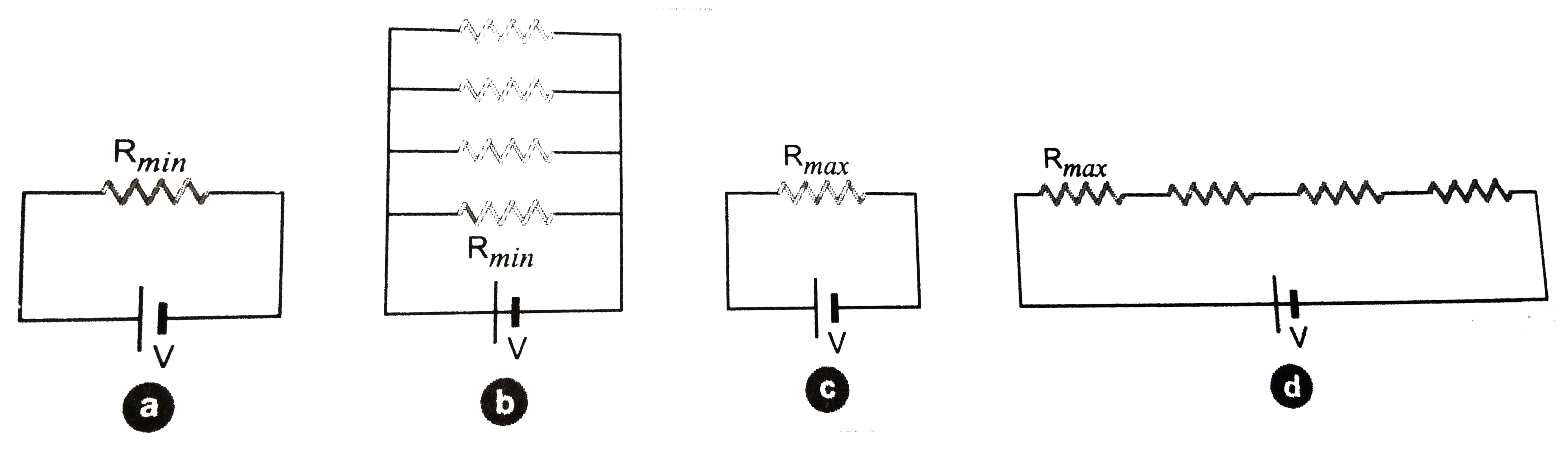
In Fig., due to one resistor of resistance `R_(min)`, there is only one route for the current in circuit. When `n` resistors are in parallel, Fig there are additional `(n-1)` routes for the current in circuit. Therefore `R_(min) gt R_(p) or R_(p) lt R_(min)`.
In Fig. 2(EP).10(c) and (d), due to one resistor of resistance `R_(max)`, the current in circuit is more than the current due to the `n` resistors in series of effective resistance `R_(s)`. So `R_(s) gt R_(max)`.
Promotional Banner

Topper's Solved these Questions

  • CURRENT ELECTRICITY

    PRADEEP|Exercise Conceptual Problems|3 Videos
  • CURRENT ELECTRICITY

    PRADEEP|Exercise Very short Q/A|7 Videos
  • COMMUNICATION SYSTEMS

    PRADEEP|Exercise MODEL TEST PAPER-2|9 Videos
  • DUAL NATURE OF RADIATION AND MATTER

    PRADEEP|Exercise Exercise|191 Videos

Similar Questions

Explore conceptually related problems

If resistors of resistance R_(1) and R_(2) are connected in parallel,then resultant resistance is "

The resultant resistance of n wires each of resistance r ohms is R, when they are connected in parallel. When these n resistances are connected in series, the resultant resistance will be

The resultant resistance of n wires each of resistance r ohms is R ,when they are connected in parallel.When these n resistances are connected in series,the resultant resistance will be

The resistors of resistances R_(1)=100pm3" ohm and R"_(2)=200pm 4ohm are connected in series. The equivalent resistance of the series combination is

Two resistors of resistance R_1 and R_2 having R_1>R_2 are connected in parallel. For equivalent resistance R, the correct statement is

There are n similar conductors each of resistance R . The resultant resistance comes out to be x when connected in parallel. If they are connected in series, the resistance comes out to be

Two resistors of resistances R_(1)=(300+-3) Omega and R_(2)=(500+-4) Omega are connected in series. The equivalent resistance of the series combination is

Two resistors of resistance R_(1) and R_(2) having R_(1) gt R_(2) are connected in parallel. For equivalent resistance R, the correct statement is

The resultant resistance value of n resistance each of r ohms and connected is series is X. When those n , resistance are connected in parallel , the resultant values is .

When two resistors of resistances R_1 and R_2 are connected in parallel, the net resistance is 3 Omega . When connected in series, its value is 16 Omega . Calculate the values of R_1 and R_2 .

