Home
Class 12
PHYSICS
Two similar balls, each of mass m and ch...

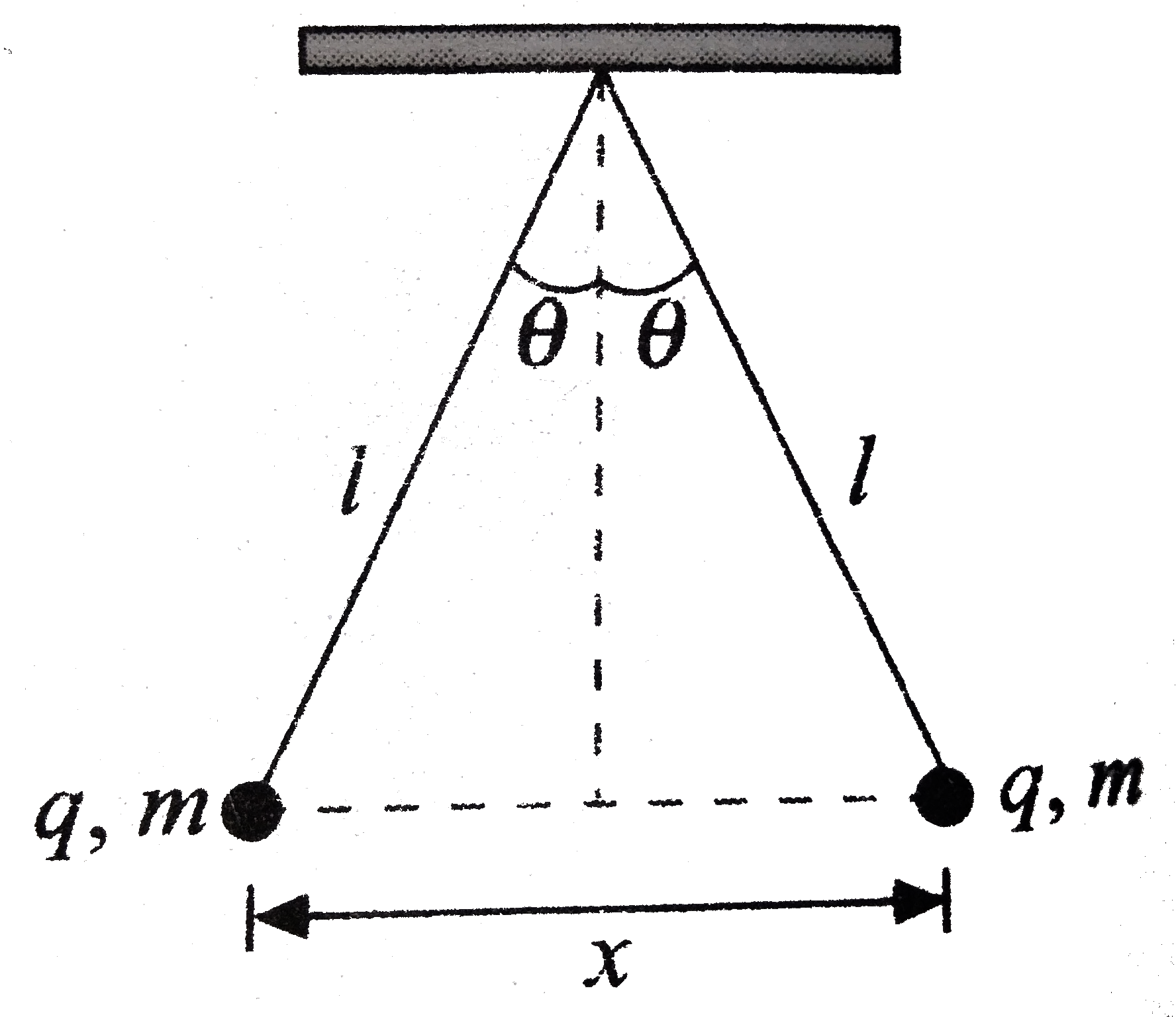
Two similar balls, each of mass m and charge q, are hung from a common point by two silk threads, each of length l. Prove that separation between the ball is `x=[(q^(2)l)/(2 pi epsilon_(0)mg)]^(1//3)`, if `theta` is small
Find the rate `(dq)/(dt)` with which the charge should leak off each sphere if the velocity of approach varies as `v=a//sqrt(x)`, where a is a constant.

Text Solution

Verified by Experts

Let the balls be deciated by an angle `theta`, from the vertical when separtion between tehm equals `x`.
Appliying Newton's seconf law of motion for any one of the sphere, we get ,
`T cos theta = mg` (1)
and `T sin theta = F_(s)` (2)
From teh Eqs. (1) and (2)
`tan theta = (F_(e))/(mg)` (3)
But from the figure
`tan theta = (x)/(2 sqrt( l^(2) - ((x)/(2))^(2))) = (x)/(2l)` as `x lt lt l` (4)
From Eqs. (3) and (4)
`F_(e) = (mg x)/(2l)` or `(q^(2))/(4pi epsilon_(0) x^(2)) = (mg x)/(2l)`
Thus `q^(2) = (2pi epsilon _(0) x^(3)) = (l)` (5)
Differentiating Eqs. (5) with respect to time
`2q (dq)/(dt) = (2pi in_(0) mg)/(l) 3x^(2) (dx)/(dt)`
According to the problem `(dx)/(dt) = v = a//sqrt(x)` (approch velocity is `(dx)/(dt)`)
so, `((2pi epsilon_(0) mg)/(l) x^(3))^(1//2) (dq)/(dt) = (3pi epsilon_(0) mg)/(l) x^(3) (a)/(sqrt(x))`
Hence, `(dq)/(dt) = (3)/(2)a sqrt((2pi epsilon_(0) mg)/(l))`
Promotional Banner

Topper's Solved these Questions

  • ELECTRODYNAMICS

    IE IRODOV, LA SENA & SS KROTOV|Exercise Conductors And Dielectrics In An Electric Field|47 Videos
  • ELECTRODYNAMICS

    IE IRODOV, LA SENA & SS KROTOV|Exercise Electric Capacitance - Energy Of An Electric Field|46 Videos
  • ELECTRICITY AND MAGNETISM

    IE IRODOV, LA SENA & SS KROTOV|Exercise All Questions|6 Videos
  • ELECTROMAGNETISM

    IE IRODOV, LA SENA & SS KROTOV|Exercise All Questions|24 Videos

Similar Questions

Explore conceptually related problems

Two indentical pith balls, each carrying charge q, are suspended from a common point by two strings of equal length l. Find the mass of each ball if the angle between the strings is 2theta in equilibrium.

Two identical tennis balls each having mass 'm' and charge 'q' are suspended from a fixed point by threads of length 'l'. What is the equilibrium separation when each thread makes a small angle 'theta' with the vertical ?

2 small spheres each of mass m and carrying +q coulomb, are suspended by massles insulating threads, each of length l. Prove that q^(2)=(4mgl^(2) sin^(2) theta tan theta )4 pi epsilon_(0) , where theta is angle made of strings with the vertical at equilibrium.

Two small spheres, each having a mass of 20 g, are suspended form a common point by two insulating strings of length 40 cm each. The spheres are identically charged and the speration between the balls at equilibrium is found to be 4 cm . Find the charge on each sphere.

Two pith ball of mass 0.5 each are suspended from a common point O by means of silk threads, each of length 20 cm. When the balls are given equal and similar charges, they repel each other so that the two threads make an angle of 60^(@) with each-other. Determine the charge on each ball.

Two identical small bodies each of mass m and charge q are suspended from two strings each of length l from a fixed point. This whole system is taken into an orbiting artificial satellite, then find the tensio in strings

Three small balls, each of mass 10 gm are suspended separately from common point. by silk threads, each one meter long. The balls are identically charged and hang at the corners of an equilateral triangle of side 0.1. metre. Find the charge on each ball?

IE IRODOV, LA SENA & SS KROTOV-ELECTRODYNAMICS-Motion Of Charged Particle In Magnetic Field
  1. Two similar balls, each of mass m and charge q, are hung from a common...

    Text Solution

    |

  2. At the moment t = 0 on electron leaves one plate of a parallel-plate ...

    Text Solution

    |

  3. A proton accelarted by a potential differnce V gets into the unifrom...

    Text Solution

    |

  4. A particle with specific charge q//m moves rectilinerarly due to an ...

    Text Solution

    |

  5. An electron starts moving in a unifrom electric fied of strength E ...

    Text Solution

    |

  6. Determine the accelration of a relativistic electron moving along ...

    Text Solution

    |

  7. At the moment t = 0 a relativsitic proton files with a velocity v(...

    Text Solution

    |

  8. A proton accelarted by a potential differnce V = 500 kV fieles throug...

    Text Solution

    |

  9. A charged particle moves along a circle of radius r = 100 mm in a u...

    Text Solution

    |

  10. A relativistic particle with charge q and rest mass m, moves along a...

    Text Solution

    |

  11. Up to what values of kinetic energy does the period of revolution of ...

    Text Solution

    |

  12. An electron accelerated by a potnetial difference V = 1.0 kV moves i...

    Text Solution

    |

  13. A slightly divergent beam of non-relatistic charged particles accele...

    Text Solution

    |

  14. A non-relativistic electron originates at a point A lying on the axi...

    Text Solution

    |

  15. From the surface of a round wire of radius a carrying a direct cur...

    Text Solution

    |

  16. A non-relativistic charged particle files through the electric field o...

    Text Solution

    |

  17. Unifrom electric and magnetic fields with strength E and induction B...

    Text Solution

    |

  18. A narrow beam of identical ions with specific charge q//m, possessin...

    Text Solution

    |

  19. A non-relativistic protons beam passes without diviation through t...

    Text Solution

    |

  20. Non-relativistic protons move rectinearly in the region of space whe...

    Text Solution

    |

  21. A beam of non-relatitivistic chagred particles moves without deviatio...

    Text Solution

    |

