Home
Class 12
PHYSICS
Two this parallel threads carry a unifor...

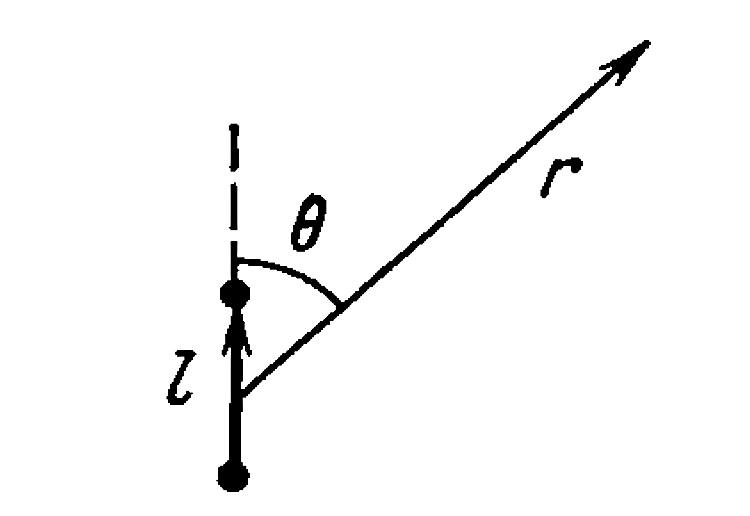
Two this parallel threads carry a uniform charge with linear densities `lamnda` and `-lambda` . The distance between the threads is equal to `l`. Find the potential of the electric field and the magnitude of its strength vector at the distance `r gt gt l` at the angle `theta` to the vector 1 (fig).

Text Solution

Verified by Experts

Let `p` be a point, at distance `r gt gt l` and at an angle to `theta` the vector `vec(l)` (Fig).
Thus `vec(E)` at `P = (lambda)/(2pi epsilon_(0)) (vec(r)+(vec(l))/(2))/(|vec(r)+(vec(l))/(2)|^(2))-(lambda)/(2pi epsilon_(0))(vec(r)-(vec(l))/(2))/(|vec(r)-(vec(l))/(2)|^(2))`
`= (lambda)/(2pi epsilon_(0)) [(vec(r) + vec(l)//2)/(r^(2) + (l^(2))/(4) + r l cos theta) - (vec(r) - vec(l)//2)/(r^(2) + (l^(2))/(4) - r l cos theta)]`
`= (lambda)/(2pi epsilon_(0)) ((vec(l))/(r^(2)) - (2l vec(r))/(r^(3)) cos theta)`
Hence `E = |vec(E)| = (lambda l)/(2pi epsilon_(0) r^(2)), r gt gt 1`
Also, `varphi = (lambda)/(2pi epsilon_(0))` In `|vec(r ) + vec(l)//2| - (lambda)/(2pi epsilon_(0))` In `|vec(r ) - vec(l)//2|`
`= (lambda)/(4pi epsilon_(0))` In `(r^(2) + r l cos theta + l^(2)//4)/(r^(2) - r l cos theta + l^(2)//4) = (lambda l cos theta)/(2pi epsilon_(0) r), r gt gt l`
Promotional Banner

Topper's Solved these Questions

  • ELECTRODYNAMICS

    IE IRODOV, LA SENA & SS KROTOV|Exercise Conductors And Dielectrics In An Electric Field|47 Videos
  • ELECTRODYNAMICS

    IE IRODOV, LA SENA & SS KROTOV|Exercise Electric Capacitance - Energy Of An Electric Field|46 Videos
  • ELECTRICITY AND MAGNETISM

    IE IRODOV, LA SENA & SS KROTOV|Exercise All Questions|6 Videos
  • ELECTROMAGNETISM

    IE IRODOV, LA SENA & SS KROTOV|Exercise All Questions|24 Videos

Similar Questions

Explore conceptually related problems

Two parallel infinite line charges with linear charge densities +lambda C//m and -lambda C/m are placed at a distance of 2R in free space. What is the electric field mid-way between the two line charges?

Each of the two long parallel threads carries a uniform charge lambda per unit length. The threads are separated by a distance l . Find the maximum magnitude of the electric firld strength in the symmetry plane of theis system located between the threads.

Two infinitely long thin styraight wires having uniform linear charge densities lambda and 2lambda are arranged parallel to each other at a distance r apart.The intensity of the electric field at a point midway between them is

A thin infinitely long thread carrying a charge lambda per unit length is oriented parallel to the infinite conducting plane. The distance between the thread and the plane is equal to l . Find : (a) the moducles of the vector of the force acting on a unit length of the thread , (b) the disribution of surface chagre density sigma (x) over the plane, where x is the distance form the plane perpendicular to the conducting surface and passing through the thread.

Two point charges q and -q are separated by the distance 2l . Find the flux of the electric field strength vector across a circle of radius R .

A very long straight thread is oriented at right angles to an infinite conducting plane, its end is separated from the plane by a distance l . The thread carries a uniform charge of linear density lambda . Suppose the point O is the trace of the thread on the plane . FInd the surface density of the induced charge on the plane (a) at point O . (b) as a function of a distance r from the point O .

A thread carrying a unifrom charge lambda per unit length has the configuration shown in fig, Assuming a curvature radius R to be considerably less than the length of the thread, find the magnitude fo the electric field strength at the point O . ,

The magnetic field due to current in a straight wire segment of length L at a point on its perpendicular bisector at a distance r ( r gt gt L)

IE IRODOV, LA SENA & SS KROTOV-ELECTRODYNAMICS-Motion Of Charged Particle In Magnetic Field
  1. Two this parallel threads carry a uniform charge with linear densitie...

    Text Solution

    |

  2. At the moment t = 0 on electron leaves one plate of a parallel-plate ...

    Text Solution

    |

  3. A proton accelarted by a potential differnce V gets into the unifrom...

    Text Solution

    |

  4. A particle with specific charge q//m moves rectilinerarly due to an ...

    Text Solution

    |

  5. An electron starts moving in a unifrom electric fied of strength E ...

    Text Solution

    |

  6. Determine the accelration of a relativistic electron moving along ...

    Text Solution

    |

  7. At the moment t = 0 a relativsitic proton files with a velocity v(...

    Text Solution

    |

  8. A proton accelarted by a potential differnce V = 500 kV fieles throug...

    Text Solution

    |

  9. A charged particle moves along a circle of radius r = 100 mm in a u...

    Text Solution

    |

  10. A relativistic particle with charge q and rest mass m, moves along a...

    Text Solution

    |

  11. Up to what values of kinetic energy does the period of revolution of ...

    Text Solution

    |

  12. An electron accelerated by a potnetial difference V = 1.0 kV moves i...

    Text Solution

    |

  13. A slightly divergent beam of non-relatistic charged particles accele...

    Text Solution

    |

  14. A non-relativistic electron originates at a point A lying on the axi...

    Text Solution

    |

  15. From the surface of a round wire of radius a carrying a direct cur...

    Text Solution

    |

  16. A non-relativistic charged particle files through the electric field o...

    Text Solution

    |

  17. Unifrom electric and magnetic fields with strength E and induction B...

    Text Solution

    |

  18. A narrow beam of identical ions with specific charge q//m, possessin...

    Text Solution

    |

  19. A non-relativistic protons beam passes without diviation through t...

    Text Solution

    |

  20. Non-relativistic protons move rectinearly in the region of space whe...

    Text Solution

    |

  21. A beam of non-relatitivistic chagred particles moves without deviatio...

    Text Solution

    |

