Home
Class 12
PHYSICS
Two coaxial rings, each of radius R, mad...

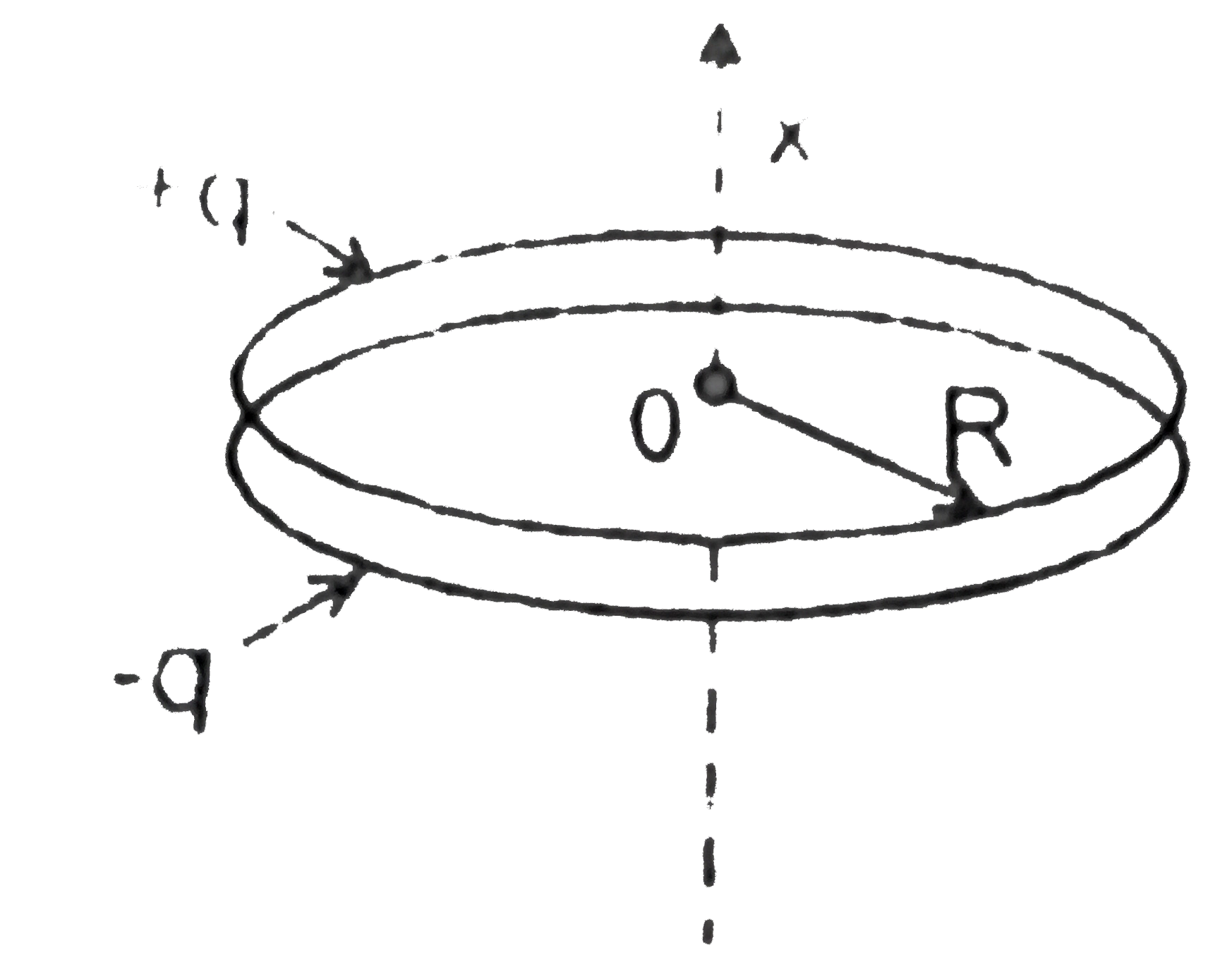
Two coaxial rings, each of radius R, made of thin wire are separated by a small distance `l(l lt lt R)` and carry the charges `q` and `-q`. Find the electric field potential and strength at the axis of the system as a function of the x coordinate (see figure). Investigate these functions at `|x| gt gt R`

Text Solution

Verified by Experts

The potentail can be calculated by superposition. Choice the plate of the upper ring as `x = l//2` and that of the lower ring as `x = -l//2`.
Then `varphi = (q)/(4pi epsilon_(0) [R^(2) + (x - //2)^(2)]^(1//2)) - (q)/(4pi epsilon_(0) [R^(2) + (x + //2)^(2)]^(1//2))`
`= (q)/(4pi epsilon_(0) [R^(2) + x^(2) - lx]^(1//2)) - (q)/(4pi epsilon_(0) [R^(2) + x^(2) + lx]^(1//2))`
`= (q)/(4pi epsilon_(0) (R^(2) + x^(2))^(1//2)) (1 + (lx)/(2 (R^(2) + x^(2)))) - = (q)/(4pi epsilon_(0) (R^(2) + x^(2))^(1//2)) (1 - (lx)/(2 (R^(2) + x^(2))))`
`= (q lx)/(4pi epsilon_(0) (R^(2) + x^(2))^(3//2))`
For `|x| gt gt r, varphi = (q l)/(4pi x^(2))`
The electric feild is `E = - (del varphi)/(del x)`
`= - (ql)/(4pi epsilon_(0) (R^(2) + x^(2))^(3//2)) + (3)/(2) (ql)/((R^(2) + x^(2))^(5//2) 4pi epsilon_(0)) xx 2x = (ql (2 x^(2) - R^(2)))/(4pi epsilon_(0) (R^(2) + x^(2))^(5//2))`
For `|x| gt gt R, E~~(ql)/(2pi epsilon_(0) x^(3))`. The plot is as given in the book.
Promotional Banner

Topper's Solved these Questions

  • ELECTRODYNAMICS

    IE IRODOV, LA SENA & SS KROTOV|Exercise Conductors And Dielectrics In An Electric Field|47 Videos
  • ELECTRODYNAMICS

    IE IRODOV, LA SENA & SS KROTOV|Exercise Electric Capacitance - Energy Of An Electric Field|46 Videos
  • ELECTRICITY AND MAGNETISM

    IE IRODOV, LA SENA & SS KROTOV|Exercise All Questions|6 Videos
  • ELECTROMAGNETISM

    IE IRODOV, LA SENA & SS KROTOV|Exercise All Questions|24 Videos

Similar Questions

Explore conceptually related problems

Two coaxial rings, eacg of radius R, made of thin wire are separated by a small distabce l(l lt lt R) and carry the charges q and -q . Find the electric field potential and strength at the axis of the system as a function of the x coordinate (see figure). Investigate these functions at |x| gt gt R

A very thin round plate of radius R carrying a uniform surface charge density sigma is located in vacumm. Find the electric field potentail and strength along the plate's axis as a function of a distance l from its centre. Investigation the obtained expression of l rarr 0 and l gt gt R .

A thin nonconducting ring of radius R has a linear charge density lambda = lambda_(0) cos varphi , where lambda_(0) is a constant , phi is the azimutahl angle. Find the magnitude of the electric field strength (a) at the centre of the ring , (b) on the axis of the ring as a function of the distance x from its centre. Investegation the obtained function at x gt gt R .

Two point charges q and -q are separated by the distance 2l . Find the flux of the electric field strength vector across a circle of radius R .

Two infinite planes sepated by a distance l carrying a uniform surface charge of densities sigma and -sigma . The planes have round coaxial holes of radius R , with l lt lt R . Taking the origin O and the x cordinates axis as shown in the figure, find the potentail of the electric field and the projection of its strength vector E_(x) on the area of the system as functions of the x cordiante. Draw the appoximate plot varphi (x) .

Two thin wire rings each having a radius R are placed at a distance d apart with their axes coiciding. The charges on the two rings are +q and -q . The potential difference between the centres of the two rings is

A charge Q is uniformly on a ring of radius R . Find the electric potential on the axis of ring at distance x from the centre of the ring. Sketch variation of potential with respect to x .

The maximum electric field intensity on the axis of a uniformly charged ring of charge q and radius R will be

IE IRODOV, LA SENA & SS KROTOV-ELECTRODYNAMICS-Motion Of Charged Particle In Magnetic Field
  1. Two coaxial rings, each of radius R, made of thin wire are separated b...

    Text Solution

    |

  2. At the moment t = 0 on electron leaves one plate of a parallel-plate ...

    Text Solution

    |

  3. A proton accelarted by a potential differnce V gets into the unifrom...

    Text Solution

    |

  4. A particle with specific charge q//m moves rectilinerarly due to an ...

    Text Solution

    |

  5. An electron starts moving in a unifrom electric fied of strength E ...

    Text Solution

    |

  6. Determine the accelration of a relativistic electron moving along ...

    Text Solution

    |

  7. At the moment t = 0 a relativsitic proton files with a velocity v(...

    Text Solution

    |

  8. A proton accelarted by a potential differnce V = 500 kV fieles throug...

    Text Solution

    |

  9. A charged particle moves along a circle of radius r = 100 mm in a u...

    Text Solution

    |

  10. A relativistic particle with charge q and rest mass m, moves along a...

    Text Solution

    |

  11. Up to what values of kinetic energy does the period of revolution of ...

    Text Solution

    |

  12. An electron accelerated by a potnetial difference V = 1.0 kV moves i...

    Text Solution

    |

  13. A slightly divergent beam of non-relatistic charged particles accele...

    Text Solution

    |

  14. A non-relativistic electron originates at a point A lying on the axi...

    Text Solution

    |

  15. From the surface of a round wire of radius a carrying a direct cur...

    Text Solution

    |

  16. A non-relativistic charged particle files through the electric field o...

    Text Solution

    |

  17. Unifrom electric and magnetic fields with strength E and induction B...

    Text Solution

    |

  18. A narrow beam of identical ions with specific charge q//m, possessin...

    Text Solution

    |

  19. A non-relativistic protons beam passes without diviation through t...

    Text Solution

    |

  20. Non-relativistic protons move rectinearly in the region of space whe...

    Text Solution

    |

  21. A beam of non-relatitivistic chagred particles moves without deviatio...

    Text Solution

    |
