

Home
Class 11
PHYSICS
A particle of mass 1 kg is moving with a...

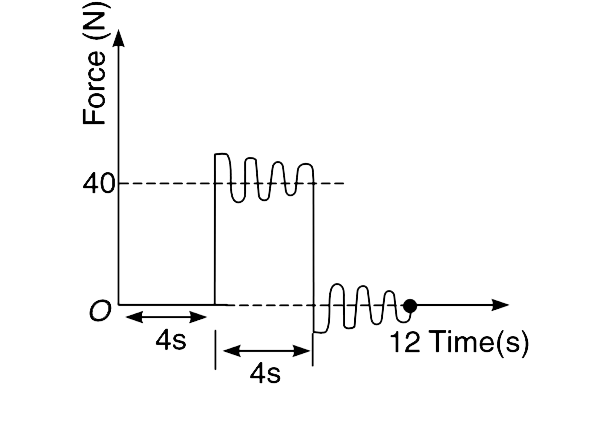
A particle of mass `1 kg` is moving with a velocity of 200 m/s. An impulsive force of 4 s duration acts on the particle in a direction opposite to its motion. The force fluctuates a little bit around 40 N magnitude and then it dies out in next 4s showing small fluctuations. An oscilloscope records the force as shown. The two oscillating components in the graph are identical except that one is mirror image of the other. Find the magnitude of velocity of particle after the force stops acting.

Promotional Banner

Similar Questions

Explore conceptually related problems

A particle of mass 1 kg has a velocity of 2m//s . A constant force of 2N acts on the particle for 1s in a direction perpendicular to its initial velocity. Find the velocity and displacement of the particle at the end of 1 s.

A particle of mass 1 kg has a velocity of 2m//s . A constant force of 2N acts on the particle for 1s in a direction perpendicular to its initial velocity. Find the velocity and displacement of the particle at the end of 1 s.

A body of mass (1)/(4) kg moving with velocity 12 m//s is stopped by applying a force of 0.6 N. Then impulse is :-

A body of mass (1)/(4) kg moving with velocity 12 m//s is stopped by applying a force of 0.6 N. Then impulse is :-

A body of mass 10kg is moving with a constant velocity of 10m//s . When a constant force acts for 4 seconds on it, it moves with a velocity 2m//sec in the opposite direction. The acceleration produced in it is

A particle of mass 2 kg moving with a velocity of 3 m//s is acted upon by a force which changes its direction of motion by an angle of 90^(@) without changing its speed. What is the magnitude of impulse experienced by the particle?

A particle of mass 2 kg moving with a velocity of 3 m//s is acted upon by a force which changes its direction of motion by an angle of 90^(@) without changing its speed. What is the magnitude of impulse experienced by the particle?

A body of mass 4 kg is moving with momentum of 8 kg m s^(-1) . A force of 0.2 N acts on it in the direction of motion of the body for 10 s. The increase in kinetic energy is

A body of mass 4 kg is moving with momentum of 8 kg m s^(-1) . A force of 0.2 N acts on it in the direction of motion of the body for 10 s. The increase in kinetic energy is