

Home
Class 11
PHYSICS
A ring of mass M hangs from a thread and...

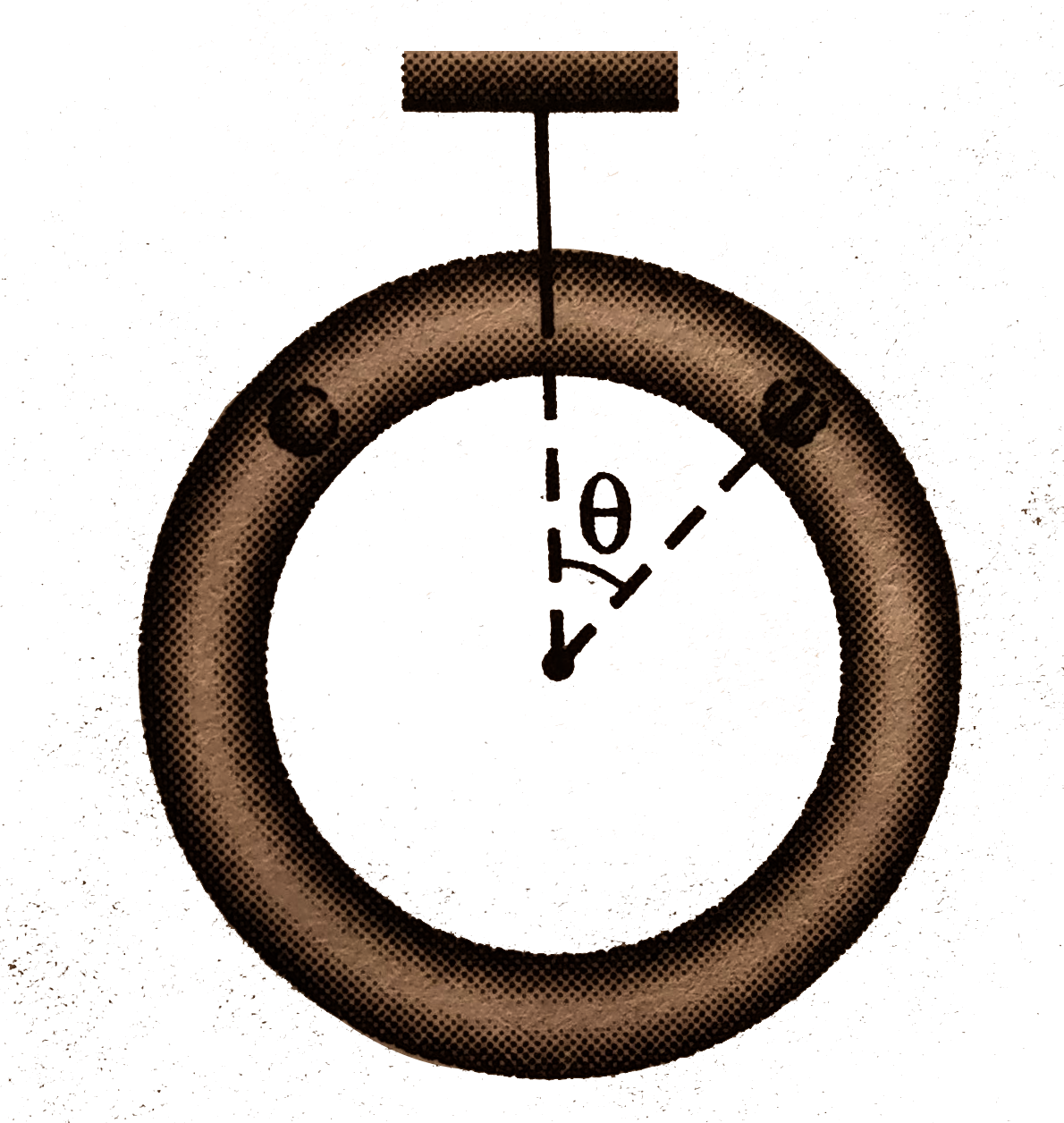
A ring of mass `M` hangs from a thread and two beads of mass `m` slides on it without friction. The beads are released simultaneously from the top of the ring and slides down in opposite sides. Show that the ring will start to rise, if `mgt(3M)/(2)` . ltbr.

Promotional Banner

Similar Questions

Explore conceptually related problems

A massless ring hangs from a thread and two beads of mass m slide it without friction. The beads are released simultaneously from the top of the ring and slide down along possible sides. Find the angle from vertical at which the ring will start to rise.

Fig. 3E.47 (a) shows a circular ring of mass M that hangs in a vertical plane. Two beads of mass m are released simultaneously from the top of the ring in opposite directions. There is no frictional force between the bead and the ring. Show that the ring will starts to rise if m gt (3M)/(2) . If m = 2M, at what angle theta from vertical this happends ? (a)

A cylinder and a ring of same mass M and radius R are placed on the top of a rough inclined plane of inclination theta . Both are released simultaneously from the same height h. When these bodies roll down to the foot of the inclined plane, then

A ring of radius R lies in vertical plane. A bead of mass 'm' can move along the ring without friction. Initially the bead is at rest the bottom most point on ring. The minimum horizontal speed v with which the ring must be pulled such that the bead completes the vertical circle.

A ring of radius R lies in vertical plane. A bead of mass 'm' can move along the ring without friction. Initially the bead is at rest the bottom most point on ring. The minimum horizontal speed v with which the ring must be pulled such that the bead completes the vertical circle.

A ring of radius R lies in vertical plane. A bead of mass 'm' can move along the ring without friction. Initially the bead is at rest the bottom most point on ring. The minimum horizontal speed v with which the ring must be pulled such that the bead completes the vertical circle.

A and B are two identical rings released from the top of an inclined plane . A slides down and B rolls down. Then which reaches the bottom first ?

A particle of mass m is rigidly attached at A to a ring of mass 3m and radius r . The system is released from rest and rolls without sliding. The angular acceleration of ring just after release is

A particle of mass m is rigidly attached at A to a ring of mass 3m and radius r . The system is released from rest and rolls without sliding. The angular acceleration of ring just after release is