

Home
Class 11
PHYSICS
A solid cylinder with r= 0.1 m and mass ...

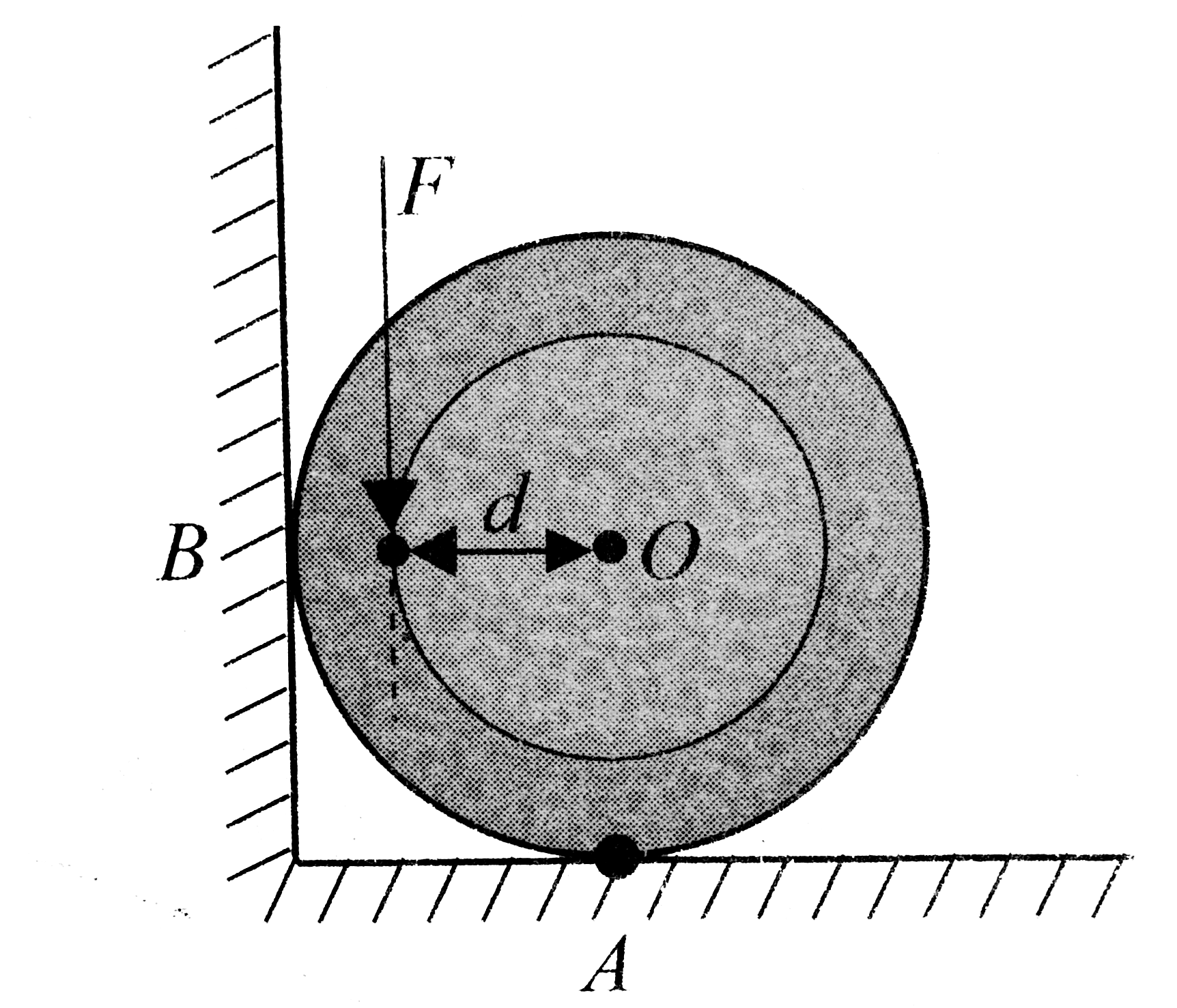
A solid cylinder with `r= 0.1 m` and mass `M = 2 kg` is placed such that it is in contact with the vertical and a horizontal surface as shown in Fig. The coefficient of friction is `mu = (1//3)` for both the surfaces. Find the distance (in `CM`) from the centre of the cylinder at .which a force `F = 40 N` should be applied vertically so that the cylinder just starts rotating in anticlockwise direction.

Promotional Banner

Similar Questions

Explore conceptually related problems

A block of mass 1 kg is held at rest against a rough vertical surface by pushing by a force F horizontally. The coefficient of friction is 0.5. When

A block of mass 1 kg is held at rest against a rough vertical surface by pushing by a force F horizontally. The coefficient of friction is 0.5. When

A block of mass 1 kg is held at rest against a rough vertical surface by pushing by a force F horizontally. The coefficient of friction is 0.5. When

A force F accelerates a block of mass m on horizontal surface. The coefficient of friction between the contact surface is . The acceleration of m will be -

A horizontal force of 129.4 N is applied on a 10 kg block which rests on a horizontal surface. If the coefficient of friction is 0.3, the acceleration should be

Two blocks of masses 3kg and 2kg are placed beside each other in contact with each other on a rough horizontal surface. A horizontal force of 20N is applied on 3kg. The coefficient of friction between blocks and the surface is 0.1 and g = 10ms^(-2) . The force of contact between the two blocks is

Two blocks of masses 1 kg and 2 kg are placed in contact on a smooth horizontal surface as shown in fig. A horizontal force of 6N is applied d(a) on a 1-kg block. Find the force of interaction of the blocks. .

Two blocks of masses 1 kg and 2 kg are placed in contact on a smooth horizontal surface as shown in fig. A horizontal force of 6N is applied d(a) on a 1-kg block. Find the force of interaction of the blocks. .