

Home
Class 11
PHYSICS
Two balls with masses m(1) =1kg and m(2)...

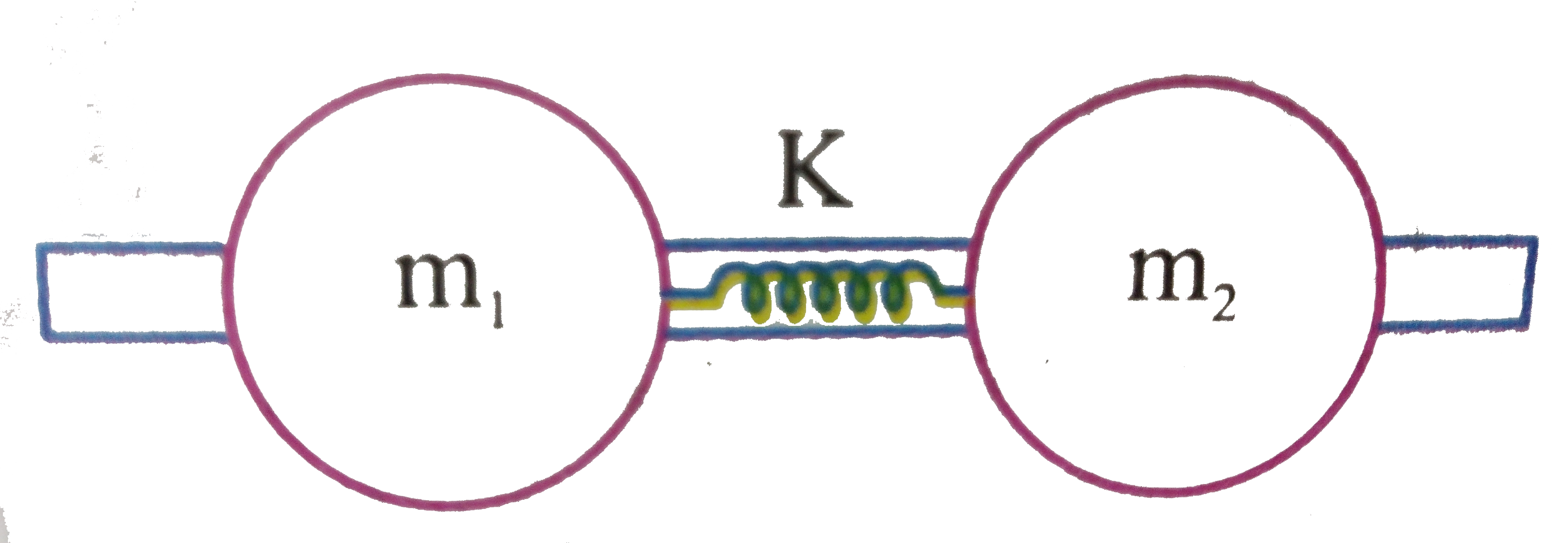
Two balls with masses `m_(1) =1kg` and `m_(2) = 2kg` are slipped on a thin smooth horizontal rod as shown. The balls are interconnected by a light spring of stiffess `K = 24N//m`. The left hand ball `(m_(1))` is imparted the initial velocity `12cm//s` towards second ball. the amplitude of oscillations made by the arrangement is............

Promotional Banner

Similar Questions

Explore conceptually related problems

Two balls with masses m_(1)=1.0 kg and m_(2)=2.0 kg are slipped on a thin smooth horizontal rod ( figure ) . The balls are interconnected by a light spring of stiffness x=24 N//m . The left- hand ball is imparted the initial velocity v_(1)=12 cm//s . Find : (a) the oscillation frequency of the system in the process of motion, (b) the energy and the amplitude of oscillations

Two blocks of masses m_1 =1kg and m_2 = 2kg are connected by a spring of spring constant k = 24 N/m and placed on a frictionless horizontal surface. The block m_(1) is imparted an initial velocity v_(0) = 12cm/s to the right. The amplitude of oscillation is

Two bodies with masses m_(1) = 1kg and m_(2) = 2kg are connected by a spring of force constant k=24Nm^(-1) . The left ball is imparted an initial velocity v_(0) =12 cm/s. Find (a) the frequency of the oscillations (b) the energy and the amplitude of the osciallations.

Two blocks of masses m_(1) =1kg and m_(2) = 2kg are connected by a spring of spring constant k = 24 N/m and placed on a frictionless horizontal surface. The block m_(1) is imparted an initial velocity v_(0) = 12cm/s to the right. The amplitude of osciallation is

A ball of mass m=1kg strikes a smooth horizontal floor as shown in figure. The impulse exerted on the floor is

A ball of mass m=1kg strikes a smooth horizontal floor as shown in figure. The impulse exerted on the floor is

Two balls A & B of mass m_(1) and m_(2) are kept on a horizontal smooth surface. A is given a velocity towards B so that they perform head on collision

The blocks ov mass m_(1)=1kg and m_(2)=2kg are connected by an ideal spring, rest on a rough horizontal surface. The spring is unstressed. The spring constant of spring is K=2N//m . The coefficient of friction between blocks and horizontal surface is mu=(1)/(2) . Now the left block is imparted a velocity u towards right as shown. The largest value of u( in m//s) such that the block of mass m_(2) never moves is ( Take g=10m//s^(2))

The blocks ov mass m_(1)kg and m_(2)=2kg are connected by an ideal spring, rest on a rough horizontal surface. The spring is unstressed. The spring constant of spring is K=2N//m . The coefficient of friction between blocks and horizontal surface is mu=(1)/(2) . Now the left block is imparted a velocity u towards right as shown. The largest value of u( in m//s) such that the block of mass m_(2) never moves is ( Take g=10m//s^(2))