

Home
Class 12
PHYSICS
The prism shown in figure has a refracti...

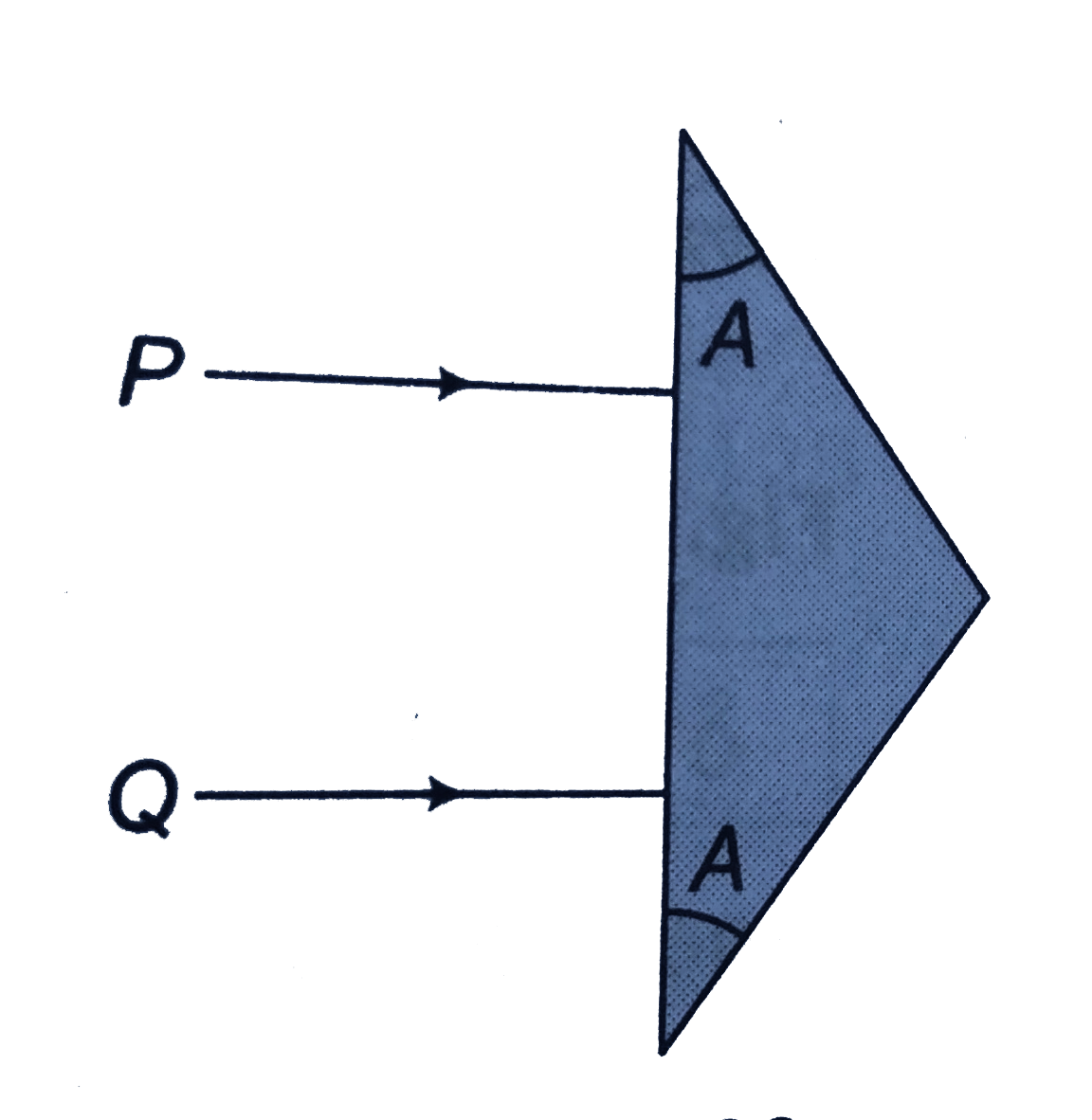
The prism shown in figure has a refractive index of `1.60` and the angles A are `30^@.` Two light rays P and Q are parallel as they enter the prism. What is the angle between them after they emerge? `[sin^-1(0.8)=53^@]`

Promotional Banner

Similar Questions

Explore conceptually related problems

Two parallel light rays are incident at one surface of a prism of refractive index 1.5 . What is the angle between the rays as they emerge? sin^-1(0.75)=48.5^@

An isosceles prism of angle 120degree has a refractive index 1.44. Two parallel monochromatic rays enter the prism parallel to each other in air as shown. The rays emerge from the opposite faces

An isosceles prism of angle 120degree has a refractive index 1.44. Two parallel monochromatic rays enter the prism parallel to each other in air as shown. The rays emerge from the opposite faces

A glass prism has a refractive angle of 90^(@) and a refractive index of 1.5. A ray is incident at an angle of 30^(@) . The ray emerges from an adjacent face at an angle of

A glass prism has a refractive angle of 90^(@) and a refractive index of 1.5. A ray is incident at an angle of 30^(@) . The ray emerges from an adjacent face at an angle of

A monochromatic ray of light strikes one face of a prism at an angle of 60^(@) and the angle of refraction is 30^(@) . The refracting angle of the prism is 60^(@) . What is the angle of emergence ?

An isosceles prism of angle 120^(@) has a refractive index of 1.44. Two parallel monochromatic rays enter the prism paralled to each other in air as shown. The rays emerging from the opposite faces

A ray of light is incident on a prism whose refractive index is 1.52 at an angle of 40^(@) . If the angle of emergence is 60^(@) , calculate the angle of the prism.