

Home
Class 12
MATHS
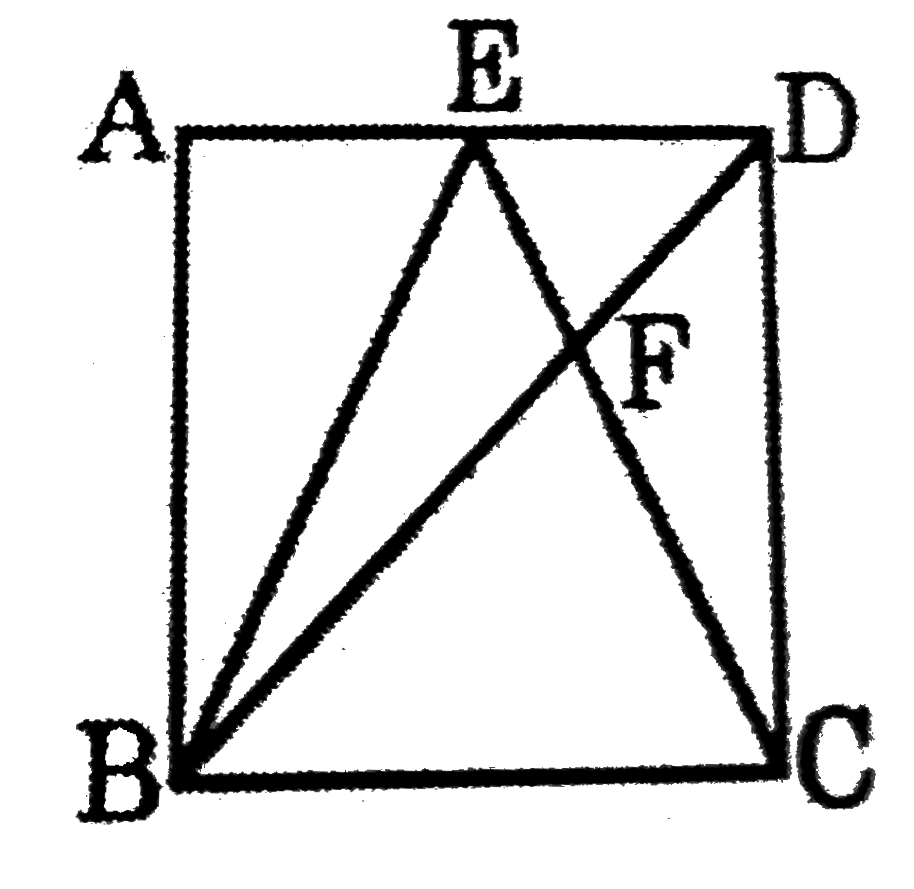
ABCD is a square and E is mid point of A...

ABCD is a square and E is mid point of AD. If area of square is given by `A_(1)`.

Promotional Banner

Similar Questions

Explore conceptually related problems

ABCD is a square . W is the mid point of AB side of square is 16 cm. Find the radius of circle in figure

ABCD is a square , E is a point on AB such that BE=17 cm. The area of triangle ADE is 84 cm^(2) . What is the area of square ?

ABCD is a quadrillateral, with AD parallel to BC (see figure). E is a point between A and D such that BE represents the height of ABCD and E is the midpoint of AD. If the area of triangle ABE is 12.5 square inches, what is the area of ABCD?

In the figure, ABCD is a square. E and Fare midpoints of AD and BC respectively. The ratio of areas of Delta GAB and Delta HAB

A B C D is a square. E is the mid-point of B C and F is the mid-point of C D . The ratio of the area of triangle A E F to the area of the square A B C D is (a) 1 : 2 (b) 1 : 3 (c) 1 : 4 (d) 3 : 8

ABCD is a square M is the mid point of AB . PQbotCM . PQ meets AD at P and CB at Q prove that CP=CQ

Let ABCD is a unit square and each side of the square is divided in the ratio alpha : (1-alpha) (0 lt alpha lt 1) . These points are connected to obtain another square. The sides of new square are divided in the ratio alpha : (1-alpha) and points are joined to obtain another square. The process is continued idefinitely. Let a_(n) denote the length of side and A_(n) the area of the n^(th) square The value of alpha for which side of n^(th) square equal to the diagonal of (n+1)^(th) square is

Let ABCD is a unit square and each side of the square is divided in the ratio alpha : (1-alpha) (0 lt alpha lt 1) . These points are connected to obtain another square. The sides of new square are divided in the ratio alpha : (1-alpha) and points are joined to obtain another square. The process is continued idefinitely. Let a_(n) denote the length of side and A_(n) the area of the n^(th) square The value of alpha for which side of n^(th) square equal to the diagonal of (n+1)^(th) square is

ABCD is a square. M is the mid-point of AB and N is the mid-point of BC. DM and AN are joined and they meet at O, then which of the following is correct ?