Home
Class 12
CHEMISTRY
Among the following molecule (i)XeO(3)...

Among the following molecule
`(i)XeO_(3)(ii)XeOF_(4)(iii)XeF_(6)`
Those having same number of lone pairs on `Xe` are

A

`(i) and (ii)` only

B

`(i) and (iii)` only

C

`(ii) and (iii)` only

D

`(i),(ii) and (iii)`

Text Solution

Verified by Experts

The correct Answer is:
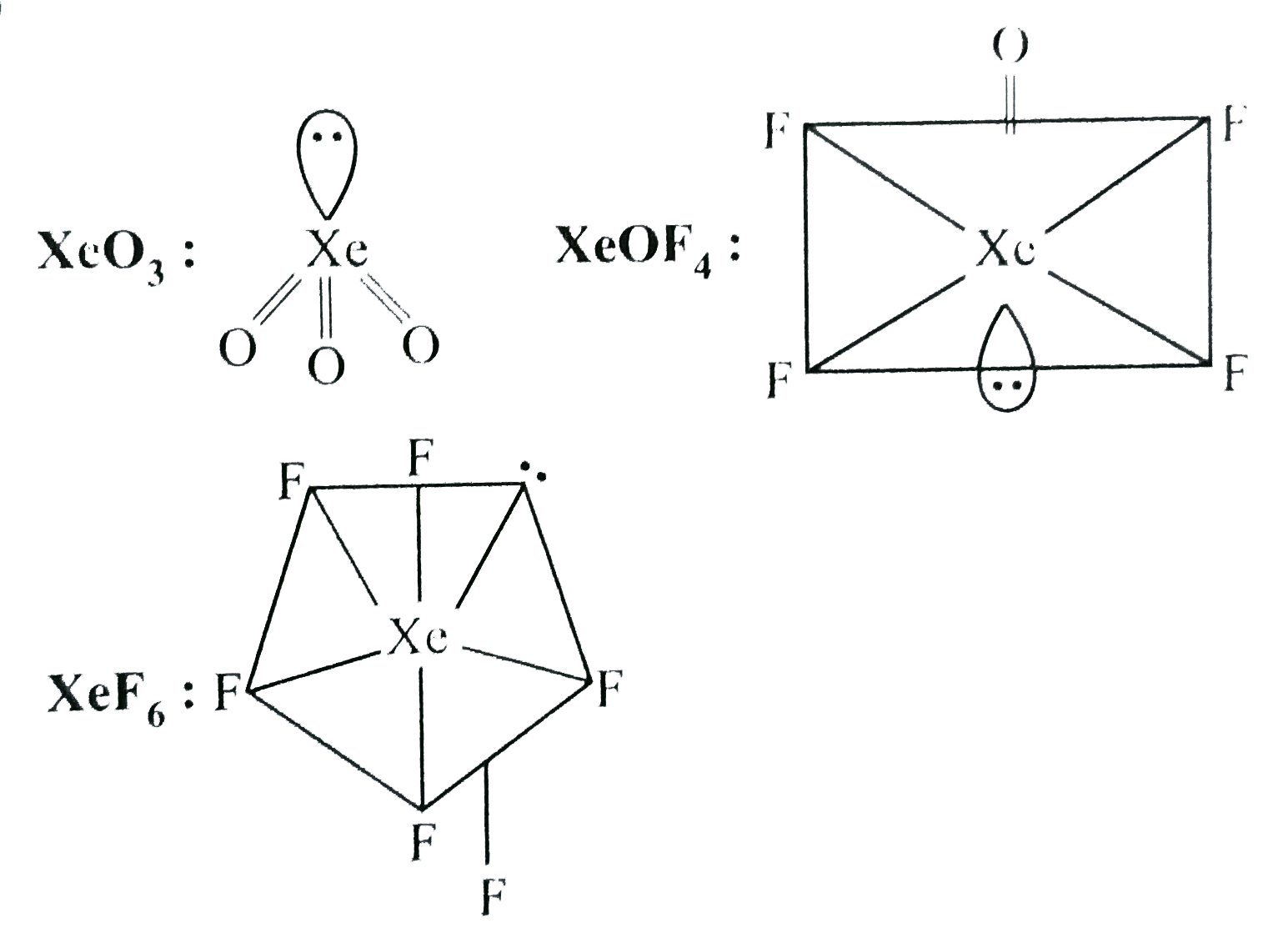
D

Promotional Banner

Topper's Solved these Questions

  • P BLOCK ELEMENTS ( GROUP 15,16,17,18)

    A2Z|Exercise Section D - Chapter End Test|30 Videos
  • P BLOCK ELEMENTS ( GROUP 15,16,17,18)

    A2Z|Exercise Group 17 (Halogen Family)|22 Videos
  • ORGANIC COMPOUNDS CONTAINING NITROGEN

    A2Z|Exercise Section D - Chapter End Test|30 Videos
  • SOLID STATE

    A2Z|Exercise Section D - Chapter End Test|30 Videos

Similar Questions

Explore conceptually related problems

Among the following molecules, (i)XeO_(3)(ii)XeOF_(4)(iii)XeF_(6) those having same number of lone pairs on Xe are:

Among the following molecules (i) XeO_(3) (ii) XeOF_(4) (iii) XeF_(6) those having same number of lone pairs on Xe are

Out of (i) XeO_(3)(ii) XeOF_(4) and (iii) XeF_(6) the molecules having same number of lone pairs on Xe are

Out of (i)XeO_(3)(ii)XeO_(2)F_(2) and (iii)XeO_(4) , the molecules having same number of lone pairs are

The approximate shape of a molecule can often be predicted by using what is called the valence-shell electron-pair repulsion (VSEPR) model. Electrons in bonds and in lone pairs can be thought of a ''charge cloud'' that repel one another nad stay as far apart as possible, thus causing molecules to assume specific shapes. The repulsive interactions of electron pairs decrease in the order: Lone pair - Lone pair gt Lone pair - Bond pair gt Bond pair - Bond pair These repulsive effects result in deviations from idealised shapes and alteration in bond angles in molecules. Among the following molecules. (P) XeO_(3)" (Q)"XeOF_(4) (R) XeO_(2)F_(2)" (S)"XeF_(5) Those having different molecular geometry but same number of lone pairs on Xe are :

The ratio of total number of lone pairs in XeF_2 and XeF_4 are:

