A
B
C
D
Text Solution
Verified by Experts
The correct Answer is:



Topper's Solved these Questions
COORDINATION COMPOUNDS
A2Z|Exercise AIIMS Questions|17 VideosCOORDINATION COMPOUNDS
A2Z|Exercise Assertion-Reasoning Questions|5 VideosCOORDINATION COMPOUNDS
A2Z|Exercise Section B - Assertion Reasoning|15 VideosCHEMICAL KINETICS
A2Z|Exercise Section D - Chapter End Test|30 VideosELECTROCHEMISTRY
A2Z|Exercise Section D - Chapter End Test|30 Videos
Similar Questions
Explore conceptually related problems
A2Z-COORDINATION COMPOUNDS-AIPMT/NEET Questions
- Which of the following complex ion(s) is/are not expected to absorb vi...
Text Solution
|
- Which of the following does not have optical isomer?
Text Solution
|
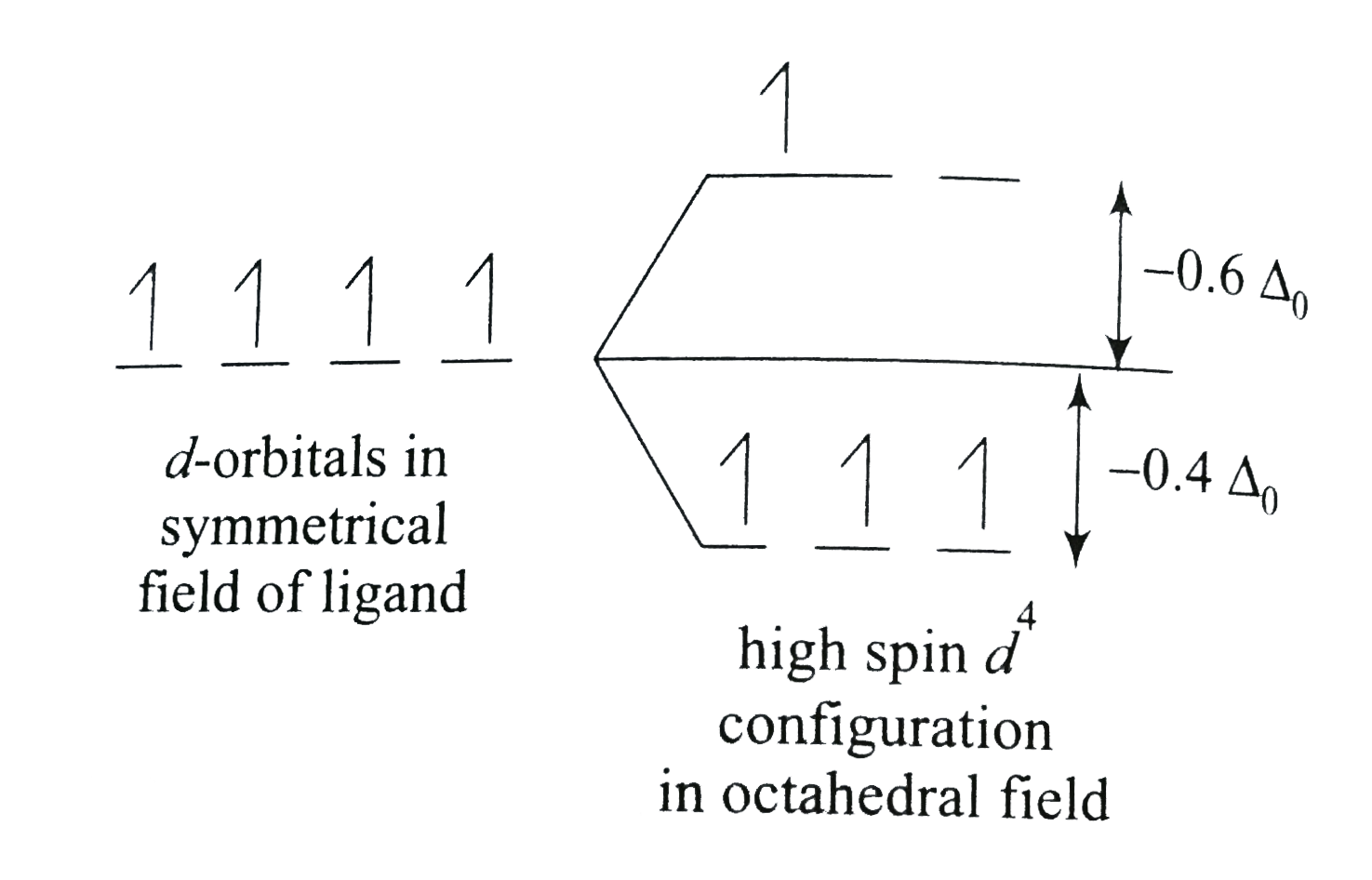
- Crystal field stabilization energy for high spin d^4 octahedral comple...
Text Solution
|
- Which of the following complex ion is not expected to absorb visible l...
Text Solution
|
- The complex, [Pt(py)(NH3)BrCl] will have how many geometrical isomers?
Text Solution
|
- [Co(HN(3))(6)][Cr(CN)(6)] and [Cr(NH(3))(6)][Co(CN)(6)] are .
Text Solution
|
- The d-electron configurations of Cr^(2+), Mn^(2+), Fe^(2+) and Co^(2+)...
Text Solution
|
- Of the following complex ions, which is diamagnetic in natures?
Text Solution
|
- Which one of the following is an outer orbital complex and exhibits pa...
Text Solution
|
- Low spin complex of d^6-cation in an octahedral field will have the fo...
Text Solution
|
- A magnetic moment of 1.73 B.M. will be shown by one among the followin...
Text Solution
|
- An excess of AgNO3 is added to 100mL of a 0.01M solution of dichlorote...
Text Solution
|
- Among the following complexes, the one which shows zero crystal field ...
Text Solution
|
- The complex used as an anticancer agent is
Text Solution
|
- Cobalt (III) chloride forms several octahedral complexes with amonia. ...
Text Solution
|
- Which of these statements about [Co(CN)6]^(3-) is true?
Text Solution
|
- The IUPAC name of the coordination compound K3[Fe(CN)6] is:
Text Solution
|
- Both [Ni(CO)4] and [Ni (CN)4]^(2-) are diamagnetic The hybridisation...
Text Solution
|
- The sum of coordination number and oxidation number of the metal M in ...
Text Solution
|
- What is the co-ordination number of the metal in [Co(en)2Cl2]^+?
Text Solution
|