
Home
Class 11
CHEMISTRY
Ph -ch(2)-ch=ch(2)overset(dil H(2)SO(4))...

`Ph -ch_(2)-ch=ch_(2)overset(dil H_(2)SO_(4))rarrX,`
Identify product `'X'` is `:`

A

`Ph-CH_(2)-CH_(2)-CH_(2)-OH`

B

C

D

`Ph-CH_(2)-OH`

Text Solution

AI Generated Solution

The correct Answer is:

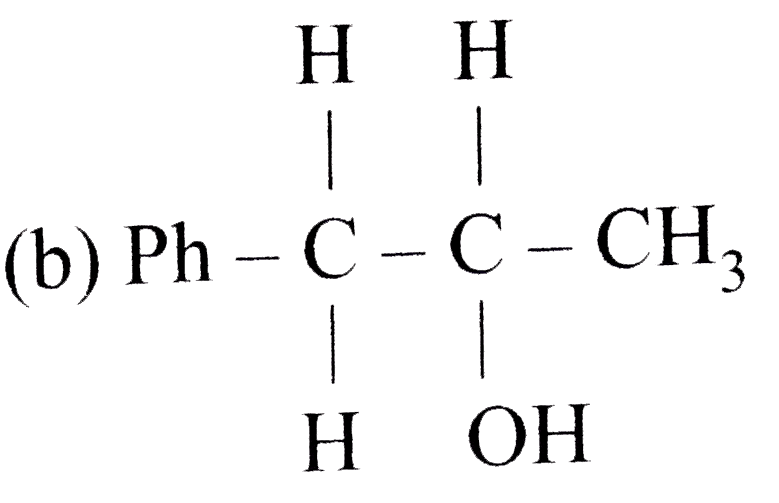
To solve the question regarding the reaction of the compound \( \text{Ph-CH}_2\text{-CH}=\text{CH}_2 \) with dilute \( \text{H}_2\text{SO}_4 \), we will follow these steps: ### Step 1: Identify the Compound The compound given is \( \text{Ph-CH}_2\text{-CH}=\text{CH}_2 \), which consists of a phenyl group attached to a propene structure. ### Step 2: Understand the Reaction Conditions The reaction is carried out in the presence of dilute sulfuric acid (\( \text{H}_2\text{SO}_4 \)). Dilute sulfuric acid acts as an acid catalyst and can protonate the alkene, leading to the formation of a carbocation. ### Step 3: Protonation of the Alkene In the presence of dilute \( \text{H}_2\text{SO}_4 \), the double bond in the alkene will undergo protonation. The double bond between \( \text{CH} \) and \( \text{CH}_2 \) will break, and a proton (\( \text{H}^+ \)) from the acid will add to one of the carbon atoms of the double bond, forming a carbocation. ### Step 4: Formation of Carbocation The protonation leads to the formation of a more stable carbocation. The structure after protonation will be \( \text{Ph-CH}_2\text{-C}^+(H)\text{-CH}_3 \) (where \( C^+ \) is the positively charged carbon). ### Step 5: Nucleophilic Attack by Water Next, the hydroxide ion (\( \text{OH}^- \)) from the dissociation of sulfuric acid will act as a nucleophile and attack the carbocation. This will lead to the formation of an alcohol. ### Step 6: Final Product Formation The final product after the nucleophilic attack will be \( \text{Ph-CH}_2\text{-CH(OH)-CH}_3 \). This compound is an alcohol, specifically phenylpropan-2-ol. ### Conclusion Thus, the product \( X \) formed from the reaction of \( \text{Ph-CH}_2\text{-CH}=\text{CH}_2 \) with dilute \( \text{H}_2\text{SO}_4 \) is phenylpropan-2-ol. ### Final Answer The product \( X \) is \( \text{Ph-CH}_2\text{-CH(OH)-CH}_3 \). ---

To solve the question regarding the reaction of the compound \( \text{Ph-CH}_2\text{-CH}=\text{CH}_2 \) with dilute \( \text{H}_2\text{SO}_4 \), we will follow these steps: ### Step 1: Identify the Compound The compound given is \( \text{Ph-CH}_2\text{-CH}=\text{CH}_2 \), which consists of a phenyl group attached to a propene structure. ### Step 2: Understand the Reaction Conditions The reaction is carried out in the presence of dilute sulfuric acid (\( \text{H}_2\text{SO}_4 \)). Dilute sulfuric acid acts as an acid catalyst and can protonate the alkene, leading to the formation of a carbocation. ...
Promotional Banner

Topper's Solved these Questions

  • HYDROCARBONS

    A2Z|Exercise Method of Preparation of Alkynes|59 Videos
  • HYDROCARBONS

    A2Z|Exercise Benzene|23 Videos
  • HYDROCARBONS

    A2Z|Exercise Chemical Properties Of Alkanes|97 Videos
  • ENVIRONMENTAL CHEMISTRY

    A2Z|Exercise Section D - Chapter End Test|30 Videos
  • HYDROGEN

    A2Z|Exercise Section D - Chapter End Test|30 Videos

Similar Questions

Explore conceptually related problems

Ph-CH_2-CH=CH_2overset(dil. H_2SO_4)rarrA,A is

Consider the following sequence of reactions CH_(2)=CH_(2)overset(PhCO_(3)H)underset(CH_(2)Cl_(2))(rarr)Aoverset(dil.H_(2)SO_(4))(rarr)B The product (B) is

CH_(3)CH_(2)CH_(2)C -= CH overset (BH_(3),THF)rarroverset(H_(2)O //OH^(-))rarr'X' Identify the product 'X':

CH_(3)COCH_(2)COOC_(2)H_(5)overset(NaBH_(4))rarrX The product X is

Ph-CH=CH=Ph underset(CCI_(4))overset(CI_(2))rarr X overset(2NaNH_(2))rarrYoverset(H_(2),Pd-CaCO_(3))rarrZ Identify product (Z) of the reaction.

Ph-C-=C-CH_(3)underset(HgSO_(4))overset(H_(2)O, H_(2)SO_(4))rarrP Major product 'P' will be:

CH_(3)-underset(OH)underset(|)(CH)-CH_(2)-CH_(3)overset(conc.H_(2)SO_(4))rarr Product(I)+Product(II) What is not true regarding the products?

CH_(3)-CH_(2)-overset(cdotcdot)underset(cdotcdot)O-CH=CH_(2)overset(H_(2)O//H_(2)SO_(4))rarr The products//s formed in the reaction is//are:
