

Home
Class 11
PHYSICS
The angular displacement of the rod is d...

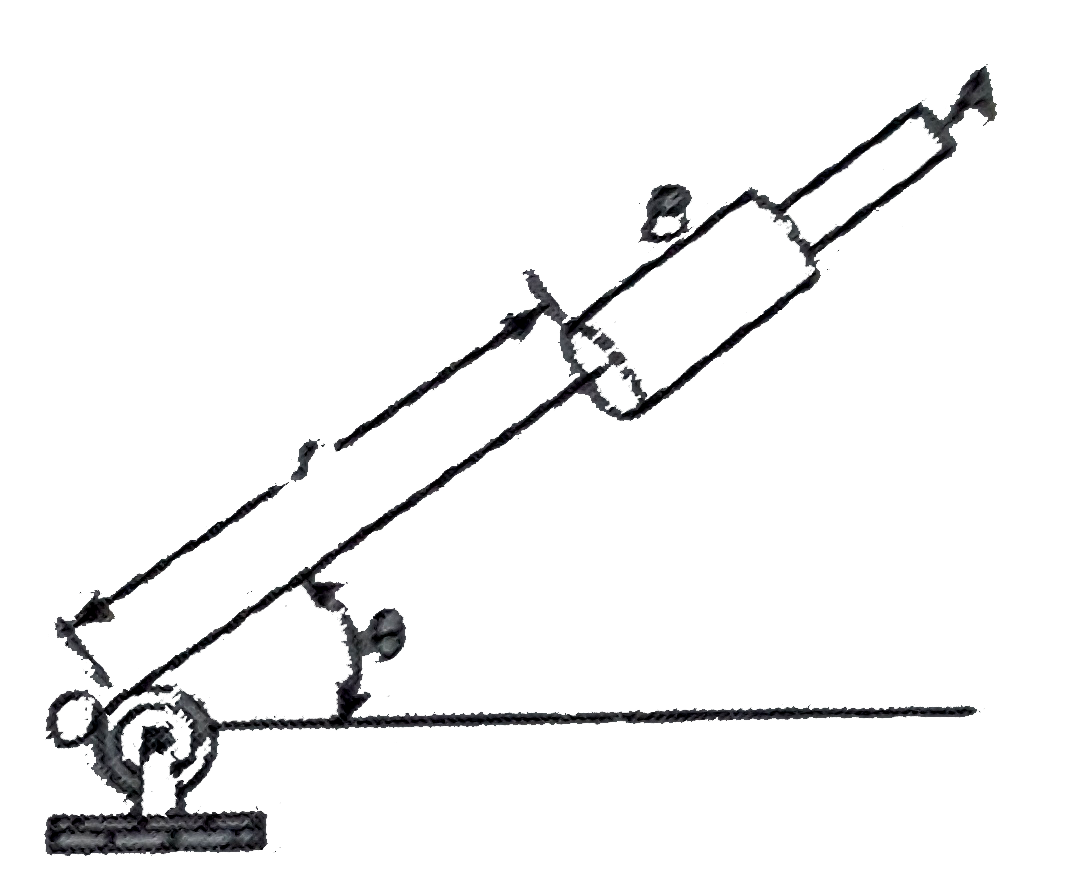
The angular displacement of the rod is defied a s`0=(3)/(20) t^(2)` where `theta` is in radian and t is in second. The collar B slides along the rod in such a way that its distance from O is `r=0.9-0.12t^(2)` where r is in metre and t is secnd The velocity of collar at `theta=30^(@)` is

Promotional Banner

Similar Questions

Explore conceptually related problems

A 3m long arm OA rotates in a plane such that 0 = 0.5 t2 where is the angle with x-axis in radian and t is in second. A slider collar B slides along the arm in such a way that its distance from the hinge O is given by r = 3 - 0.412 where r is in meters. Find the speed of the collar at t = 18:- A B В

The angular displacement of a particle performing circular motion is theta = (t^3)/60 - t/4 where theta is in radian and 't' is in seconds. Then the acceleration of the particle at the end 10 s will be

The displacement of a particle moving in a circular path is given by theta = 3 t^(2) + 0.8 , where theta is in radian and t is in seconds . The angular velocity of the particle at t=3 sec . Is

A car moves along a straight line whose equation of motion is given by s=12t+3t^(2)-2t^(3) where s is in metres and t is in seconds. The velocity of the car at start will be :-

A car moves along a straight line whose equation of motion is given by s=12t+3t^(2)-2t^(3) where s is in metres and t is in seconds. The velocity of the car at start will be :-

A car moves along a straight line whose equation of motion is given by s=12t+3t^(2)-2t^(3) where s is in metres and t is in seconds. The velocity of the car at start will be :-

The angular displacement of a particle performing circular motion is theta=(t^(4))/(60)-(t)/(4) where theta is radian and 't' is in seconds. Then the acceleration of a particle at the end of 10 s will be

The angular displacement of a particle performing circular motion is theta=(t^(3))/(60)-(t)/(4) where theta is in radian and 't' is in second .Then the angular velocity and angular acceleraion of a particle at the end of 5 s will be

The angular displacement of a particle performing circular motion is theta = (t^3)/60 - t/4 where theta is in radian and 't' is in seconds. Then the angular velocity and angular accleration of the particle at the end of 5 s will be

The angular displacement of a particle is given by theta = t^3 + 2t +1 , where t is time in seconds. Its angular acceleration at t=2s is