

Home
Class 12
PHYSICS
Two small beads having positive charges ...

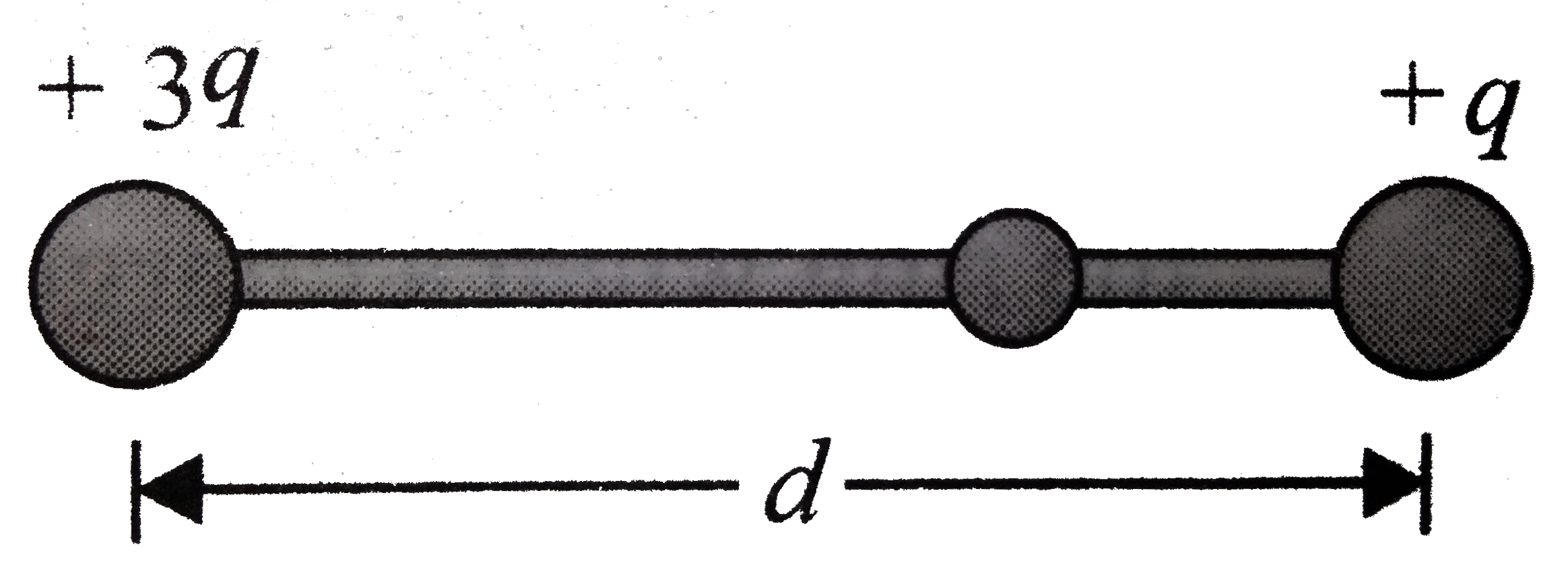
Two small beads having positive charges 3q and q are fixed at the opposite ends of a horizontal, insulating rod, extending from the origein to the point x=d as shown in fig. A third small charged bead is free to slide on the rod. At what position is the third bead in equilibrium? Can it be in stable eqyilibrium ?

Promotional Banner

Similar Questions

Explore conceptually related problems

Two small beads having positive charges 3q and q are fixed at the opposite ends of a horizontal, insulating rod, extending from the origin to the point x=d as shown in fig. A third small charged bead is free to slide on the rod. At what position is the third bead in equilibrium? Can it be in stable equilibrium ?

Two charges each of +q coulomb are placed along line. A third charge -q is placed between them. At what position will the system be in equilibrium ?

Two charges each of +Q units are placed along a line. A third charge - q I placed between them. At what position and for what value of q, will the system be in equilibrium?

Two fixed point charges + 4q and + q are separated by a distance d. Where should the third point charge be placed for it to be in equilibrium?

In the shown figure two beads slide along a smooth horizontal rod as shown in figure. The relation between v and v_(0) in the shown position will be

Two free point charges +q and +4q are placed apart a distance x . A third charge is so placed that all the three charges are in equilibrium. Then

Two free point charges +q and +4q are placed apart a distance x. A third charge is so placed that all the three charges are in equilibrium. Then

Two fixed charges +4q and +q are at a distance 3 m apart. At what point between the charge, a third charge +q must be placed to keep it in equilibrium ?

Two equal negative charges are fixed at points and on y-axis. A positive charge Q is released from rest at the point on the x-axis. The charge Q will:

A two point charges 4q and -q are fixed on the x - axis x=-d/2 and x = d/2 , respectively. If a third point charge 'q' is taken from the origin to x = d along the semicircle as shown in the figure, the energy of the charge will