Home
Class 12
PHYSICS
A linear harmonic oscillator starts from...

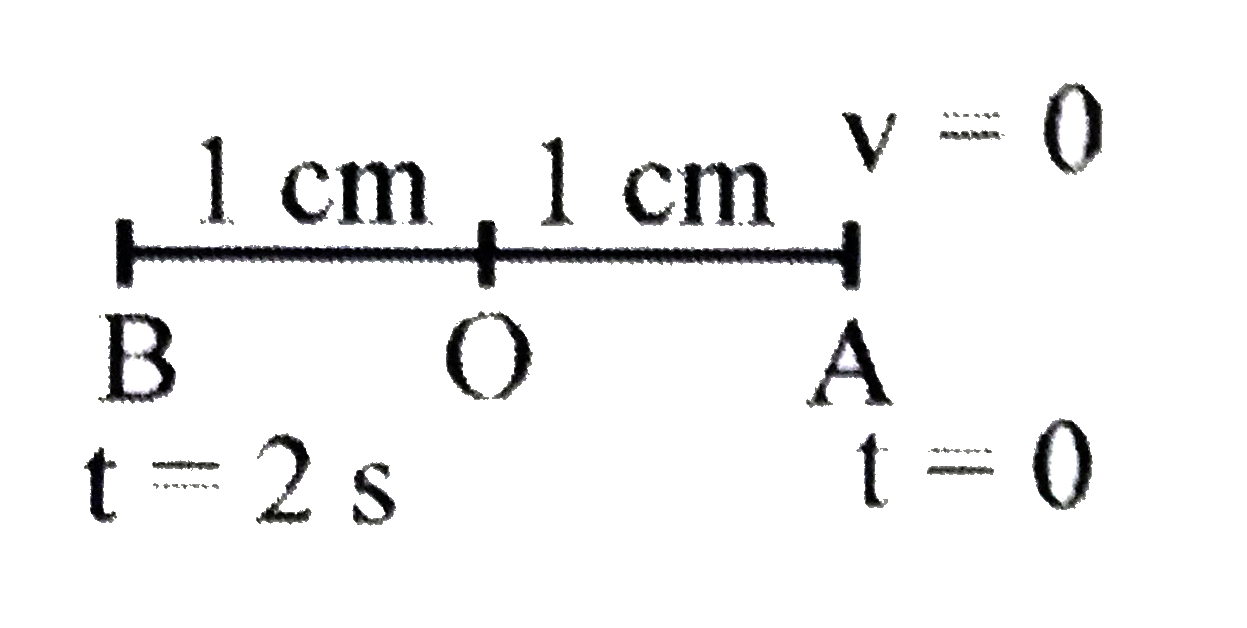
A linear harmonic oscillator starts from rest at time t=0. After time t=2 seconds, it again comes to rest, at a dis"tan"ce of 2 cm. The amplitude and period of the harmonic oscillator are given by

A

2 cm, 2 seconds

B

1 cm, 4 seconds

C

2 cm, 4 seconds

D

1 cm, 2 seconds

Text Solution

Verified by Experts

The correct Answer is:
B


The S.H.M. particle starts from rest, i.e. it is at the extreme position (A) at time t=0 and after t=2s, it again comes to rest at a dis"tan"ce of 2 cm (i.e. at B) so that the dis"tan"ce AB=2cm
`therefore` Amplitude =1 cm and period `=2xx2=4 s`
Promotional Banner

Topper's Solved these Questions

  • MAGNETISM

    MARVEL PUBLICATION|Exercise TEST YOUR GRASP|15 Videos
  • ROTATIONAL MOTION

    MARVEL PUBLICATION|Exercise TEST YOUR GRASP - 3|8 Videos

Similar Questions

Explore conceptually related problems

A linear harmonic oscillator of force constant 10^(6) N//m and amplitude 2 cm has

A particle starts from rest and has velocity kt after time t. The distance travelled in time t is-

For a linear harmonic oscillator, period is pi second and amplitude is 5 cm. The velocity of the oscillator, when it is at a dis"tan"ce of 1 cm from the extreme position is

A simple harmonic motino has amplitude A and time period T. The maxmum velocity will be

A simple harmonic oscillation is represented by the equation, y = 0.40 sin ( 440 t + 0.61) Here y and t are in m and s respectively. What are the values of time period of oscillations?

A particle starts from rest with a time varying acceleration a=(2t-4) . Here t is in second and a in m//s^(2) The velocity time graph of the particle is

A particle starts from rest with a time varying acceleration a=(2t-4) . Here t is in second and a in m//s^(2) Particle comes to rest after a time t= ………… second

A simple harmonic oscillator has a period T and energy E. the amplitude of the oscillator is doubled. Choose the correct answer.

A simple harmonic oscillation is represented by the equation. y=0.40sin(440t+0.61) Here y and t are in m are s respectively. What are the values of (i) amplitude (ii) angular frequency (iii) frequency of oscillations (iv) time period of oscillations and (v) initial phase?

MARVEL PUBLICATION-OSCILLATIONS-MCQ
  1. A body of mass 1 gram executes a linear S.H.M. of period 1.57 s. If it...

    Text Solution

    |

  2. The displacement of a particle performing a S.H.M is given by x=0.25 "...

    Text Solution

    |

  3. A linear harmonic oscillator starts from rest at time t=0. After time ...

    Text Solution

    |

  4. The displacment of particle performing a linear S.H.M. is given by x=5...

    Text Solution

    |

  5. A particle performs a linear S.H.M. of period 3 second. The time taken...

    Text Solution

    |

  6. The acceleration of a particle performing a linear S.H.M. is 16 cm//s^...

    Text Solution

    |

  7. A particle performs a S.H.M. of amplitude 10 cm and period 12s. What i...

    Text Solution

    |

  8. A particle executes a linear S.H.M. of amplitude A and period T. It st...

    Text Solution

    |

  9. The maximum speed of a particle performing a linear S.H.M. is 0.16 m/s...

    Text Solution

    |

  10. The maximum displacement of a particle executing a linear S.H.M. is 5 ...

    Text Solution

    |

  11. The displacement at an ins"tan"t t, of a particle executing a linear S...

    Text Solution

    |

  12. The amplitude of oscillation of a particle executing a linear S.H.M. i...

    Text Solution

    |

  13. The acceleration of a particle performing a S.H.M. is 0.12 m//s^(2), w...

    Text Solution

    |

  14. The velocity of a particle executing a S.H.M. of frequency 10 oscillat...

    Text Solution

    |

  15. The maximum acceleration of a body moving is SHM is a(0) and maximum v...

    Text Solution

    |

  16. What is the displacement of a SHM particle of amplitude 3 cm, where it...

    Text Solution

    |

  17. The equation of displacement of a particle performing a S.H.M. is x=0....

    Text Solution

    |

  18. The displacement of a linear simple harmonic oscillator is given by y ...

    Text Solution

    |

  19. The ins"tan""tan"cous acceleration (a) of a particle executing a linea...

    Text Solution

    |

  20. The maximum velocity of a linear simple harmonic oscillator represente...

    Text Solution

    |

