

Home
Class 12
PHYSICS
Two particles execute SHM of same amplit...

Two particles execute SHM of same amplitude and frequency on parallel lines. They pass one another when moving in opposite directions each time their displacement is one third their amplitude. What is the phase difference between them?

A

`90^(@)`

B

`30^(@)`

C

`120^(@)`

D

`60^(@)`

Text Solution

Verified by Experts

The correct Answer is:
C


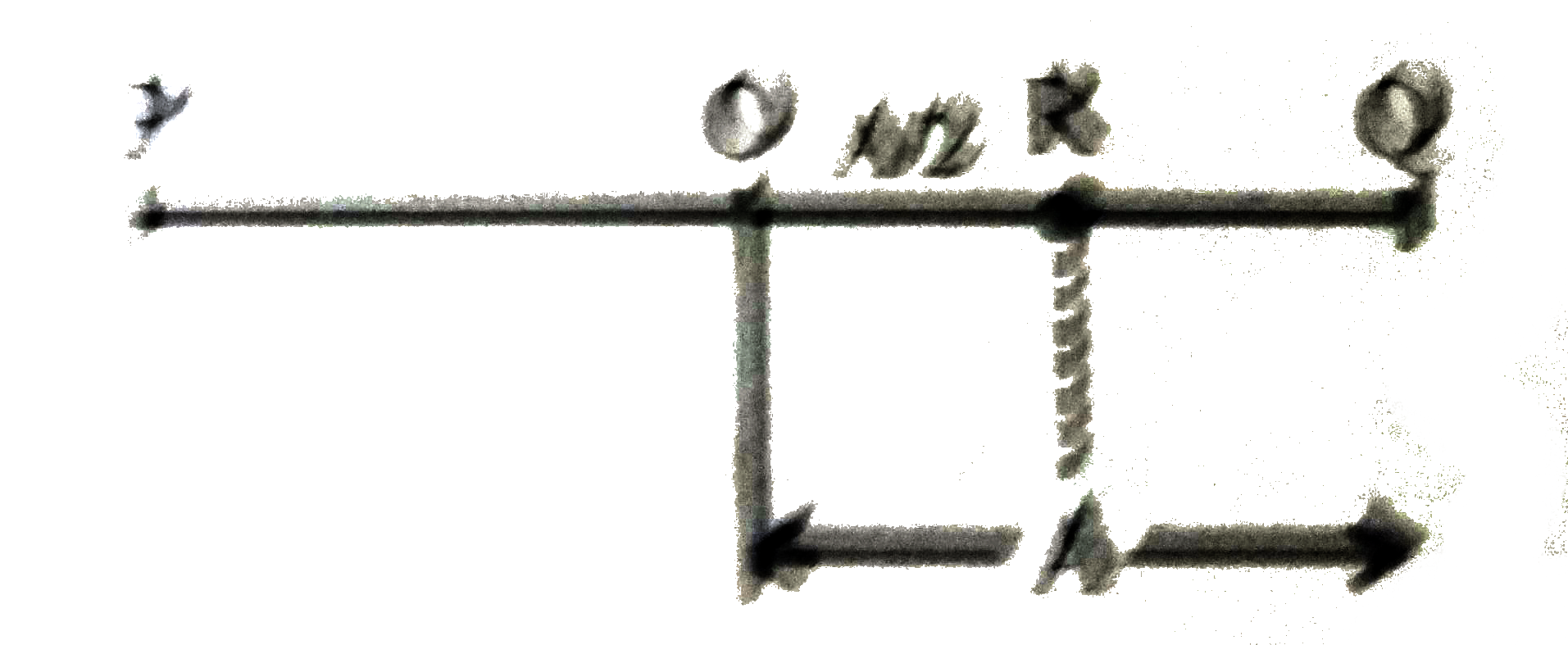
Let `x = A "sin" (omega t + alpha)` be the equation of S.H.M. and it is given that `x=(A)/(2)`
`therefore (A)/(2)=A "sin" (omega t+ alpha) therefore "sin" (omega t+alpha)=(1)/(2)`
`therefore (omega t+ alpha)=(pi)/(6)`
The particles is going from O to Q and is at R.
The other particle crosses the first particle at R, but it is the opposite direction and it is going towards O.
`because "sin" (180-theta)="sin" theta or "sin" (pi-theta)= "sin" theta`
`therefore` The other angle will be `(pi-(pi)/(6))=(5pi)/(6)`
`therefore` The phase difference
` =(5pi)/(6)-(pi)/(6)=(4pi)/(6)=(2pi)/(3)=120^(@)`
Promotional Banner

Topper's Solved these Questions

  • MAGNETISM

    MARVEL PUBLICATION|Exercise TEST YOUR GRASP|15 Videos
  • ROTATIONAL MOTION

    MARVEL PUBLICATION|Exercise TEST YOUR GRASP - 3|8 Videos

Similar Questions

Explore conceptually related problems

Two particles executes S.H.M. of the same amplitude and frequency along the same straight line. They pass one another when going in opposite directions, each time their displacement is root three by two times amplitude. The phase difference between them is

Two particles execute simple harmonic motion of the same amplitude and frequency along close parallel lines. They pass each other moving in opposite directions each time their displacement is half their amplitude. Their phase difference is

Two particles execute SHMs of the same amplitude and frequency along the same straight ling. They cross one another when going in opposite direction. What is th ephase difference between them when their displacements are half of their amplitudes ?

Two particles are oscillating along two close parallel straight lines side by side, with the same frequency and amplitudes. They pass each other, moving in opposite directions when their displacement is half of the amplitude. The phase difference is:-

The phase difference between two particle executing SHM of the same amplitude and frequency along same straight line while pessing one another when going in apposition direction with equal displacement from then respectively straing about is is 2pi//3 if the prass if one particle is pi//6 find the displecement at this instant amplitude is A

Two particles are in SHM with the same amplitude and frequency along the same line and about the same point. If the maximum separation between them is sqrt(3) times their amplitude, the phase difference between them is (2pi)/n . Find value of n

A particle of mass m executes SHM with amplitude A and frequency n. The average energy in one time period is

Two particles executing SHM of same frequency, meet at x= +A//2 , while moving in opposite direction . Phase difference between the particles is

MARVEL PUBLICATION-OSCILLATIONS-MCQ
  1. What is the minimum phase difference between two S.H.M.s given by x(2)...

    Text Solution

    |

  2. The displacement of a particle in S.H.M. is given by x= B "sin" (omega...

    Text Solution

    |

  3. Two particles execute SHM of same amplitude and frequency on parallel ...

    Text Solution

    |

  4. What is the minimum phase difference between two simple harmonic oscil...

    Text Solution

    |

  5. The force constant of a linear harmonic oscillator is 10 N/m. If is P....

    Text Solution

    |

  6. A body executes SHM with an amplitude a. At what displacement from the...

    Text Solution

    |

  7. For a particle performing a S.H.M. the potential and kinetic energies ...

    Text Solution

    |

  8. When the displacment in S.H.M. is half the amplitude, the ratio of pot...

    Text Solution

    |

  9. A particle executes a linear S.H.M. of amplitude A. At what dis"tan"ce...

    Text Solution

    |

  10. When a long spring is stretched by 1 cm, the potential energy stored i...

    Text Solution

    |

  11. For a particle executing S.H.M., the kinetic energy K is given K = K(0...

    Text Solution

    |

  12. When the displacement of a linear harmonic oscillator is 1//3 of its a...

    Text Solution

    |

  13. The potential energies of a linear harmonic oscillator at the mean pos...

    Text Solution

    |

  14. A spring of spring constant 5xx10^(3) N//m is stretched by 4 cm from i...

    Text Solution

    |

  15. The maximum potential energy of a simple harmonic oscilator is U("max"...

    Text Solution

    |

  16. When the displacement of a particle in S.H.M. is 0.2m, its Potential e...

    Text Solution

    |

  17. The total energy of a particle in linear S.H.M. is 20 J. What is its k...

    Text Solution

    |

  18. The P.E. of a linear harmonic oscillator is 4J, when its displacment i...

    Text Solution

    |

  19. For a particle performing a linear SHM the ratio of the frequency of o...

    Text Solution

    |

  20. A linear harmonic oscillator of force constant 10^(6) N//m and amplitu...

    Text Solution

    |