Home
Class 12
PHYSICS
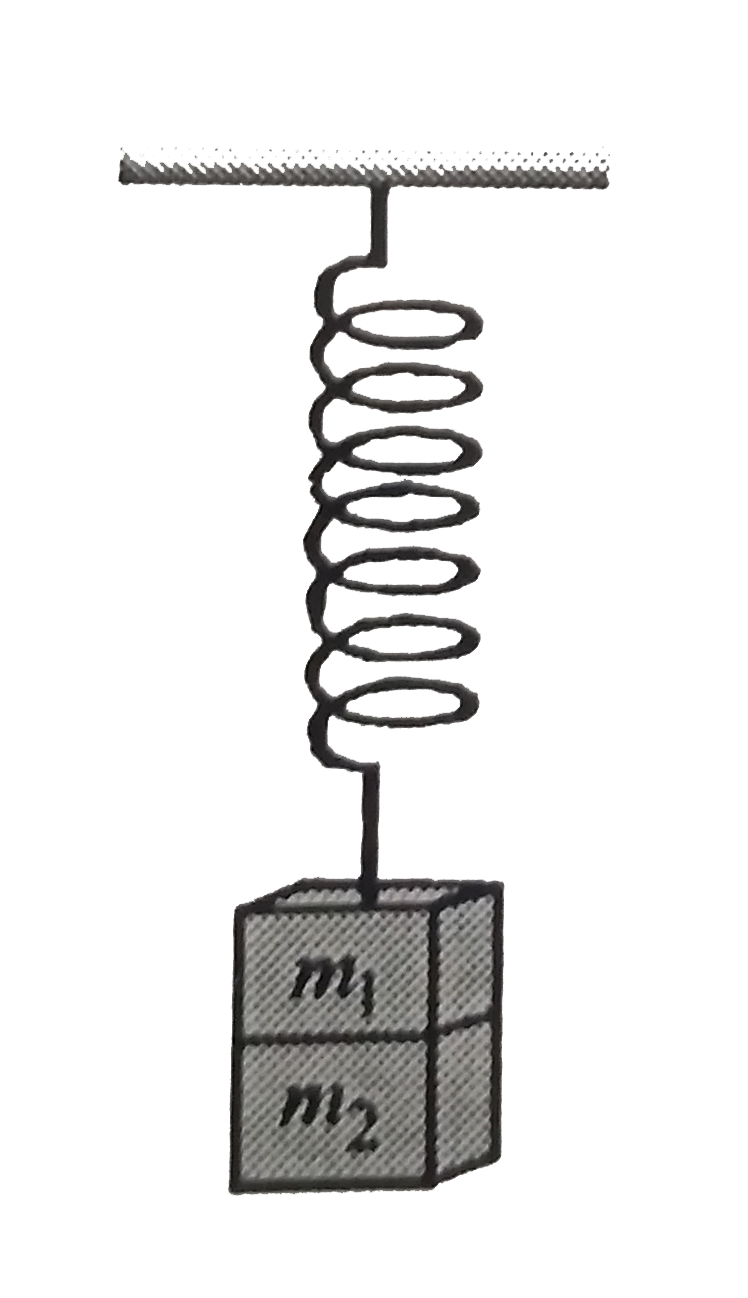
Two masses m1 and m2 are suspended toget...

Two masses m1 and m2 are suspended together by a massless spring of constant k. When the masses are in equilibrium, m1 is removed without disturbing the system. The amplitude of oscillations is

A

`(m_(2)g)/(K)`

B

`(m_(1)g)/(K)`

C

`(K)/(m_(1)g)`

D

`(K)/(m_(2)g)`

Text Solution

Verified by Experts

The correct Answer is:

B

When `m_(1)` is removed, only the mass `m_(2)` is left.
Left `x_(1)` be the extension in equilibrium, when only `m_(2)` is suspended.
Then, `Kx_(1)=m_(2)g`
`therefore x_(1)=(m_(2)g)/(K)`
Let `x_(2)` be the extension when both `m_(1) " and " m_(2)` are suspended, then
`therefore Kx_(2)=((m_(1)+m_(2))g)/(K)`
`therefore` Amplitude of oscillation,
`A=x_(2)-x_(1)=(g)/(K) [m_(1)+m_(2)-m_(2)]`
`A= (m_(1)g)/(K)`
Promotional Banner

Topper's Solved these Questions

  • MAGNETISM

    MARVEL PUBLICATION|Exercise TEST YOUR GRASP|15 Videos
  • ROTATIONAL MOTION

    MARVEL PUBLICATION|Exercise TEST YOUR GRASP - 3|8 Videos

Similar Questions

Explore conceptually related problems

Two masses m 1 and m 2 are suspended together by a massless spring of constant K . When the masses are in equilibrium, m 1 is removed without disturbing the system. The amplitude of oscillations is

Two masses M and m are suspended together by massless spring of force constant -k. When the masses are in equilibrium, M is removed without disturbing the system. The amplitude of oscillations.

Two masses m_(1) and m_(2) are suspended together by a massless spring of constant K. When the masses are in equilibrium, m_(1) is removed without disturbing the system. Then the angular frequency of oscillation of m_(2) is -

Two masses 8 kg 4 kg are suspended together by a massless spring of spring constant 1000 Nm^(-1) . When the masses are in equilibrium 8 kg is removed without disturbing the system . The amplitude of oscillation is

Two masses m_(1) = 1kg and m_(2) = 0.5 kg are suspended together by a massless spring of spring constant 12.5 Nm^(-1) . When masses are in equilibrium m_(1) is removed without disturbing the system. New amplitude of oscillation will be

Two mass m_(1) and m_(2) are suspended from a massless spring of force constant k. When the masses are in equilibrium, m_(1) is removed without disturbing the system. Find the angular frequency and amplitude of oscillations.

Two masses m_(1) and m_(2) are suspeded togther by a massless spring of spring constnat k (Fig). When the masses are in equilibrium, m_(1) is removed. Frequency and amplitude of oscillation of m_(2) are

Two masses m_(1) and m_(2) are suspended from a spring of spring constant 'k'. When the masses are in equilibrium, m_(1) is gently removed. The angular frequency and amplitude of oscillation of m_(2) will be respectively

Two masses m_(1)=1.0 kg and m_(2)=0.5 kg are suspended together by a massless spring of force constant, k=12.5 Nm^(-1) . When they are in equillibrium position, m_(1) is gently removed. Calculate the angular frequency and the amplitude of oscillation of m_(2) . Given g=10 ms^(-2) .

MARVEL PUBLICATION-OSCILLATIONS-MCQ
  1. Two springs of force constants K(1) " and " K(2) are connected to a ma...

    Text Solution

    |

  2. A block A of mass m is placed on a frictionless horizontal surface. An...

    Text Solution

    |

  3. Two masses m1 and m2 are suspended together by a massless spring of co...

    Text Solution

    |

  4. A block (B) is attached to two unstriched sprig S(1) and S(2) with spr...

    Text Solution

    |

  5. A wooden block performs SHM on a frictionless surface with frequency, ...

    Text Solution

    |

  6. Two similar springs P and Q have spring constant K(P) and K(Q) such th...

    Text Solution

    |

  7. A mass m is suspended separately by two different spring of spring con...

    Text Solution

    |

  8. The graph shown was obtained from experimental measurements of the per...

    Text Solution

    |

  9. The displacement-time graph of a particle executing simple harmonic mo...

    Text Solution

    |

  10. The graph of l against T for a simple pendulum is

    Text Solution

    |

  11. The period (T) of a simple pendulum is measured for different length (...

    Text Solution

    |

  12. For a particle executing simple harmonic motion, the displacement x is...

    Text Solution

    |

  13. Figure shows the displacement time graphs of two simple harmonic motio...

    Text Solution

    |

  14. A particle executing linear SHM has velocities v(1) " and " v(2) at di...

    Text Solution

    |

  15. If the metal bob of a simple pendulum is replaced by a wooden bob, the...

    Text Solution

    |

  16. Two particles perform linear simple harmonic motion along the same pat...

    Text Solution

    |

  17. The average displacement over a period of SHM is (A = amplitude of SH...

    Text Solution

    |

  18. A particle executing SHM. The phase difference between acceleration an...

    Text Solution

    |

  19. Two springs have their force constants K(1) and K(2) and they are stre...

    Text Solution

    |

  20. A mass m(1) connected to a horizontal spring performs a S.H.M. with an...

    Text Solution

    |
