

Home
Class 12
PHYSICS
The graph shown was obtained from experi...

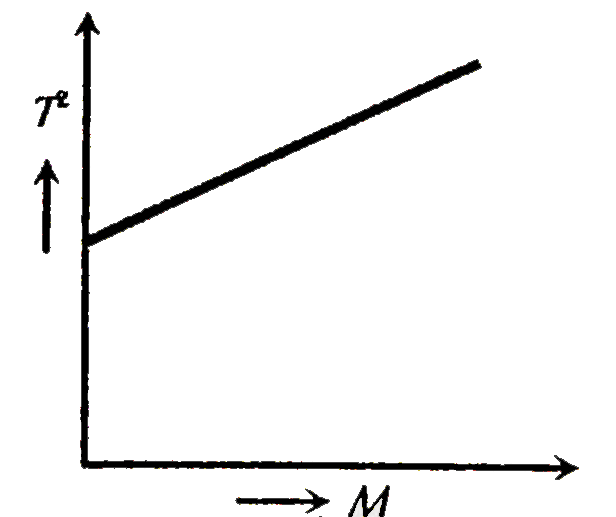
The graph shown was obtained from experimental measurements of the period of oscillations T for different masses M placed in the scale pan on the lower end of the spring balance. The most likely reason for the line not passing through the origin is that the

A

Stopclock was not regulated

B

Spring did not obey Hook's law

C

Mass of the pan was not taken into account

D

Amplitude of the oscillations was too large

Text Solution

Verified by Experts

The correct Answer is:
C

For the oscillating mass, `T=2pi sqrt((M)/(K))`
`therefore T^(2)=(4pi^(2)M)/(K) therefore T^(2) prop M`
`therefore` The graph of `T^(2)` against M is a straight line and if `M=0, T^(2)=0` and it should pass through the origin. But it is not pas"sin"g through the origin. This means that `M ne 0` or the mass of the pan was not taken into account.
Promotional Banner

Topper's Solved these Questions

  • MAGNETISM

    MARVEL PUBLICATION|Exercise TEST YOUR GRASP|15 Videos
  • ROTATIONAL MOTION

    MARVEL PUBLICATION|Exercise TEST YOUR GRASP - 3|8 Videos

Similar Questions

Explore conceptually related problems

The graph between period of oscillation (T) and mass attached (m) to a spring will be

The period of oscillation of a mass M suspended from a spring of spring constant K is T. the time period of oscillation of combined blocks is

The period of oscillation of mass M suspended from a spring of negligible mass is T. If along with it another mass M is also suspended, the period of oscillation will now be

A light pulley is suspended at the lower end of a spring of constant k_(1) , as shown in figure. An inextensible string passes over the pulley. At one end of string a mass m is suspended, the other end of the string is attached to another spring of constant k_(2) . The other ends of both the springs are attached to rigid supports, as shown. Neglecting masses of springs and any friction, find the time period of small oscillations of mass m about equilibrium position.

A vertical spring has a time period of oscillations of T_(1) with a load m_(1) at its end. Its time period is T_(2) when the load is replaced by another of mass m_(2) . The force constant of the spring is

One mass m is suspended from a spring. Time period of oscilation is T. now if spring is divided into n pieces & these are joined in parallel order then time period of oscillation if same mass is suspended.

MARVEL PUBLICATION-OSCILLATIONS-MCQ
  1. Two similar springs P and Q have spring constant K(P) and K(Q) such th...

    Text Solution

    |

  2. A mass m is suspended separately by two different spring of spring con...

    Text Solution

    |

  3. The graph shown was obtained from experimental measurements of the per...

    Text Solution

    |

  4. The displacement-time graph of a particle executing simple harmonic mo...

    Text Solution

    |

  5. The graph of l against T for a simple pendulum is

    Text Solution

    |

  6. The period (T) of a simple pendulum is measured for different length (...

    Text Solution

    |

  7. For a particle executing simple harmonic motion, the displacement x is...

    Text Solution

    |

  8. Figure shows the displacement time graphs of two simple harmonic motio...

    Text Solution

    |

  9. A particle executing linear SHM has velocities v(1) " and " v(2) at di...

    Text Solution

    |

  10. If the metal bob of a simple pendulum is replaced by a wooden bob, the...

    Text Solution

    |

  11. Two particles perform linear simple harmonic motion along the same pat...

    Text Solution

    |

  12. The average displacement over a period of SHM is (A = amplitude of SH...

    Text Solution

    |

  13. A particle executing SHM. The phase difference between acceleration an...

    Text Solution

    |

  14. Two springs have their force constants K(1) and K(2) and they are stre...

    Text Solution

    |

  15. A mass m(1) connected to a horizontal spring performs a S.H.M. with an...

    Text Solution

    |

  16. The bob of a simple pendulum performs SHM with period T in air and wit...

    Text Solution

    |

  17. Which of the following quantity does not change due to damping of osci...

    Text Solution

    |

  18. A simple pendulum of length l has a maximum angular displacement theta...

    Text Solution

    |

  19. A particle performing SHM starts equilibrium position and its tim...

    Text Solution

    |

  20. A particle performing SHM starting extreme position. Graphical rep...

    Text Solution

    |