Home
Class 12
PHYSICS
A train whistling at constant frequency ...

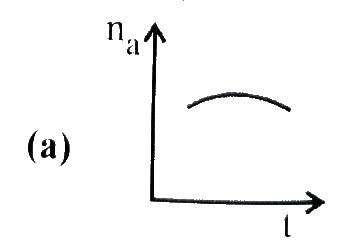
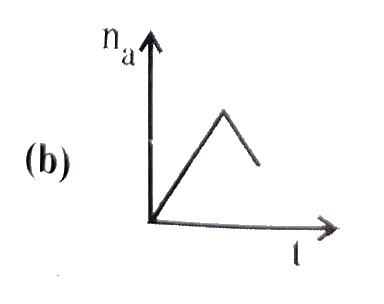
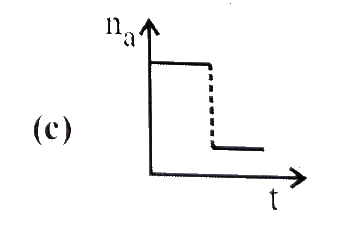
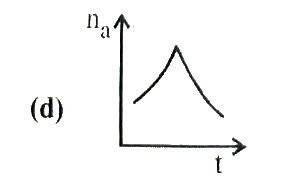
A train whistling at constant frequency is moving towards a station at a constant speed V. The train goes past a stationary observer on the station. The frequency `n^(')` of the sound as heard by the observer is plotted as a function of time t, figure. Identify the expected curve.

A

B

C

D

Text Solution

Verified by Experts

The correct Answer is:

C

This is based on Doppler effect. The observer is stationary on the platform in the station. Hence when the train approaches the observer, the apparent frequency `n_(a) gt` real frequency of the whistle. After crossing the observer, the train goes away from the observer.
Hence the apparent frequency decreases. `n_(a) lt n`
This is shown in fig (c)
Promotional Banner

Topper's Solved these Questions

  • WAVE MOTION

    MARVEL PUBLICATION|Exercise Test your grasp|15 Videos
  • SURFACE TENSION

    MARVEL PUBLICATION|Exercise MULTIPLE CHOICE QUESTIONS . (TEST YOUR GRASP )|10 Videos
  • WAVE THEORY OF LIGHT AND POLARISATION

    MARVEL PUBLICATION|Exercise TEST YOUR GRASP -10|15 Videos

Similar Questions

Explore conceptually related problems

A railway engine whistling at a constant frequency moves with a constant speed. It goes past a stationary observer standing beside the railway track. The frequency (n) of the sound heard by the observer is plotted agains time (t) . Which of the following best represents the resulting curve?

A sound source, emitting sound of constant frequency, moves with a constant speed and crosses a stationary observer. The frequency (n) of sound heard by the observer is plotted against time (t). Which of the following graphs represents the correct variation :-

An engine whistling at a constant frequency n_0 and moving with a constant velocity goes past a stationary observer. As the engine crosses him, the frequency of the sound heard by him changes by a factor f. The actual difference in the frequencies of the sound heard by him before and after the engine crosses him is

A train is moving towards a stationary observer. Which of the following curve best represents the frequency recived by observer f aas afunction of time?

A source of sound is travelling towards a stationary observer. The frequency of sound heard by the observer is 25 % more than the actual frequency. If the speed of sound is v , that of the source is

If a source of frequency n moving with velocity v crosses a stationary observer, then the change in the frequency of sound heard by the observer will be (velocity of sound = V)

a bus is moving towards and stationary observer with speed 20 m/s blows a horn of frequency 200 Hz. the frequency of sound heard by the observer is approximately ( take speed of sound 320 m/s)

MARVEL PUBLICATION-WAVE MOTION-Test your grasp
  1. A train whistling at constant frequency is moving towards a station at...

    Text Solution

    |

  2. In a sinusoidal wave, the time required by a particular particle to mo...

    Text Solution

    |

  3. A longitudinal wave in air is travelling towards the closed base of me...

    Text Solution

    |

  4. If the amplitude of a wave at a distance r from a point source is A, t...

    Text Solution

    |

  5. The equation of a progressive wave is given by y = 5 sin [pi ((t)/(5...

    Text Solution

    |

  6. A simple harmonic wave is represent by the relation y(x,t)=a(0) sin ...

    Text Solution

    |

  7. Two waves of equal amplitude when superposed, give a resultant wave ha...

    Text Solution

    |

  8. A set of 11 tuning forks is arranged in the ascending order of frequen...

    Text Solution

    |

  9. An unknown frequency x produces 8 beats per seconds with a freuquency ...

    Text Solution

    |

  10. Two sound waves of wavelength (92)/(147) m and (92)/(149)m produce 8 b...

    Text Solution

    |

  11. Wavelengths of two sound notes in air are (80)/(177)m and (80)/(175)m ...

    Text Solution

    |

  12. A whistle revolves in a circle with an angular speed of 20 rad//sec us...

    Text Solution

    |

  13. An observer moves towards a stationary source of sound, with a veloci...

    Text Solution

    |

  14. Two sources A and B are sounding notes of frequency 680 Hz. A listener...

    Text Solution

    |

  15. A man is watching two trains, one leaving and the other coming in with...

    Text Solution

    |

  16. A tuning fork A having a frequency of 300 Hz is sounded together with ...

    Text Solution

    |
