Home
Class 12
PHYSICS
Let n(1) and n(2) be the two slightly di...

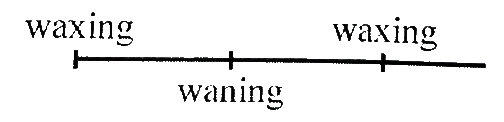
Let `n_(1) and n_(2)` be the two slightly different frequencies of two sound waves. The time interval between a waxing and the immediate next waning is

A

`(1)/(n_(1) - n_(2))`

B

`(2)/(n_(1) - n_(2))`

C

`(n_(1) n_(2))/(2)`

D

`(1)/(2(n_(1) - n_(2)))`

Text Solution

Verified by Experts

The correct Answer is:
D

In this case beats are produced
Beat frequency = No. of beats/ sec `= [n_(1) - n_(2)]`
Period of beats = Time interval between two consecutive maxima or minima of sound or period of waxing or period of waning `= (1)/(n_(1) - n_(2))`

`:.` The time interval between a waxing and waning is `(1)/(2(n_(1) -n_(2)))`
Promotional Banner

Topper's Solved these Questions

  • WAVE MOTION

    MARVEL PUBLICATION|Exercise Test your grasp|15 Videos
  • SURFACE TENSION

    MARVEL PUBLICATION|Exercise MULTIPLE CHOICE QUESTIONS . (TEST YOUR GRASP )|10 Videos
  • WAVE THEORY OF LIGHT AND POLARISATION

    MARVEL PUBLICATION|Exercise TEST YOUR GRASP -10|15 Videos

Similar Questions

Explore conceptually related problems

Let n_(1) and n_(2) be the two slightly different frequencies of two sound waves. The time interval between waxing and immediate next waning is

If the difference between the frequencies of two sound notes is 8Hz , then the time interval between successive maximum intensity, is

If beat frequency is 10 Hz, find the time interval between (i) successive waxings.

Two sound waves of slightly different frequencies propagating in the same direction produce beats due to

Two tuning forks of frequencies 100 Hz and 95 Hz are sounded together. The time interval between two consecutive minima in the resultant sound is

For destructive interference of sound waves the mathematical path difference between the two arriving waves is

For destructive interference of sound waves the mathematical phase difference between the two arriving waves is

MARVEL PUBLICATION-WAVE MOTION-Test your grasp
  1. Let n(1) and n(2) be the two slightly different frequencies of two sou...

    Text Solution

    |

  2. In a sinusoidal wave, the time required by a particular particle to mo...

    Text Solution

    |

  3. A longitudinal wave in air is travelling towards the closed base of me...

    Text Solution

    |

  4. If the amplitude of a wave at a distance r from a point source is A, t...

    Text Solution

    |

  5. The equation of a progressive wave is given by y = 5 sin [pi ((t)/(5...

    Text Solution

    |

  6. A simple harmonic wave is represent by the relation y(x,t)=a(0) sin ...

    Text Solution

    |

  7. Two waves of equal amplitude when superposed, give a resultant wave ha...

    Text Solution

    |

  8. A set of 11 tuning forks is arranged in the ascending order of frequen...

    Text Solution

    |

  9. An unknown frequency x produces 8 beats per seconds with a freuquency ...

    Text Solution

    |

  10. Two sound waves of wavelength (92)/(147) m and (92)/(149)m produce 8 b...

    Text Solution

    |

  11. Wavelengths of two sound notes in air are (80)/(177)m and (80)/(175)m ...

    Text Solution

    |

  12. A whistle revolves in a circle with an angular speed of 20 rad//sec us...

    Text Solution

    |

  13. An observer moves towards a stationary source of sound, with a veloci...

    Text Solution

    |

  14. Two sources A and B are sounding notes of frequency 680 Hz. A listener...

    Text Solution

    |

  15. A man is watching two trains, one leaving and the other coming in with...

    Text Solution

    |

  16. A tuning fork A having a frequency of 300 Hz is sounded together with ...

    Text Solution

    |

