Home
Class 12
MATHS
If a,b,c and d are any four consecutive ...

If a,b,c and d are any four consecutive
coefficients in the expansion of `(1 + x)^(n)` , then prove that
(i)` (a) /(a+ b) + (c)/(b+c) = (2b)/(b+c) `
(ii) ` ((b)/(b+c))^(2) gt (ac)/((a + b)(c + d)), "if " x gt 0 ` .

Text Solution

Verified by Experts
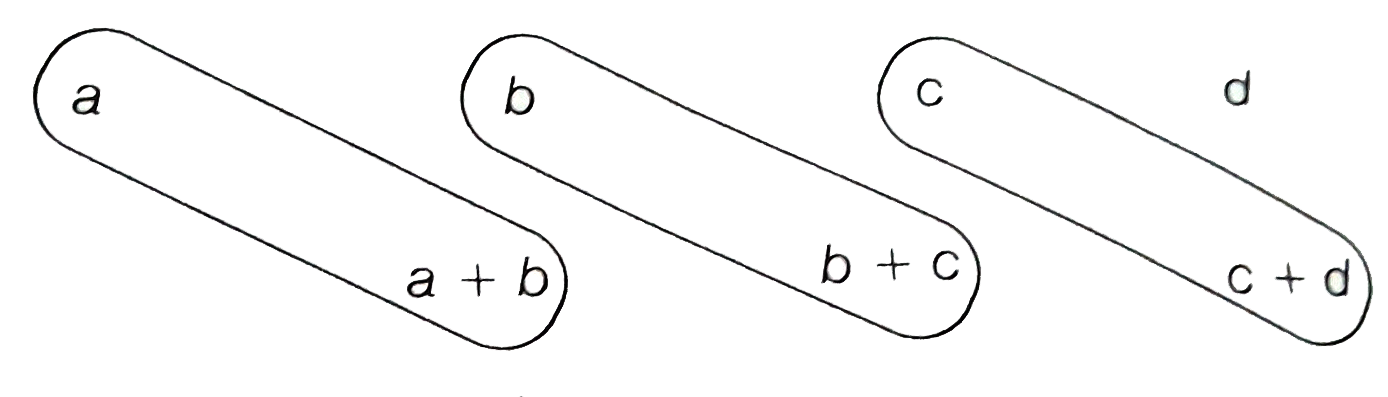
Let a,b,c and d be the coefficient of the r th,(r + 1) th
(r +2)th and (r + 3)th terms respectively , in the expansion oof ` (1 + x)^(n)` . Then
`T_(r) = T_(r-1 + 1) = ""^(n)C_(r-1) x^(r-1)`
` therefore a= ""^(n)C_(n-1)` …(i)
` because T_(r+1) = ""^(n)C_(r) x^(r)`
` therefore b = ""^(n)C_(r) ` ...(ii)
` because T_(r+2) = T_((r+ 3) +1) = ""^(n)C_(r+1) x^(r +1)`
` therefore c = ""^(n)C_(r +1)` ... (iii)
and ` T_(r +3) = T_((r + 2) + 1)=""^(n)C_(r+2) x^(r +2)`
` therefore d = ""^(n)C_(r +2) ` ...(iv)
From Equ . (i) and (ii) , we get
` a + b = ""^(n)C_(r-1) + ""^(n)C_(r) = ""^(n+1)C_(r)`
` = (n +1)/(r) . ""^(n)C_(r-1) = ((n +1)/(r))a `
` therefore (a)/(a+b) = (r)/(n +1) ` ...(v)
From Eqs. (ii) and (iii), we get
` b + c = ""^(n)C_(r +1) = ""^(n+1)C_(r+1) `
` = ((n+1)/(r+1)) ""^(n)C_(r) = ((n+1)/(r +1)) b `
` therefore (b) /(b +c) = (r +1)/(n+1) `...(vi)
From Eqs.(iii) and (iv) , we get ltbr ` c + d = ""^(n)C_(r+1) = ((n+1)/(r +2))c `
` therefore (c)/(c+ d) = (r+2)/(n+1) ` ...(vii)
From Eqs (v) , (vi) and (vii) , we get
` (a)/(a+ b) , (b)/(b +c) "and " (c)/(c +d)` are in AP
(i) ` (a)/(a + b) + (c)/(c + d) = 2 ((b)/(b + c))`
or ` (a)/(a + b) + (c)/(c + d) = (2b)/(b + c)`
(ii) `AM gt GM `
`therefore ((b)/(b + c)) gt sqrt(((a)/(a + b))((c)/(c + d))) `
` rArr ((b)/(b + c))^(2) gt (ac)/((a + b)(c + d))`
Remembering Method

`(a)/(a + b) , (b)/(b + c) " and " (c)/(c + d) ` are in AP .
Promotional Banner

Topper's Solved these Questions

  • BIONOMIAL THEOREM

    ARIHANT MATHS|Exercise JEE Type Solved Example : (Matching Type Questions )|2 Videos
  • BIONOMIAL THEOREM

    ARIHANT MATHS|Exercise Exercise For Session 1|8 Videos
  • AREA OF BOUNDED REGIONS

    ARIHANT MATHS|Exercise Exercise (Questions Asked In Previous 13 Years Exam)|23 Videos
  • CIRCLE

    ARIHANT MATHS|Exercise Exercise (Questions Asked In Previous 13 Years Exam)|16 Videos

Similar Questions

Explore conceptually related problems

if a,b,c and d are the coefficient of four consecutive terms in the expansion of (1+x)^(n) then (a)/(a+b)+(C) /(c+d)=?

If a,b,c be the three consecutive coefficients in the expansion of a power oif (1+x), prove that the index power is ( 2ac+b(a+c)/(b^2-ac))

If the four consecutive coefficients in any binomial expansion be a, b, c, d, then prove that (i) (a+b)/a , (b+c)/b , (c+d)/c are in H.P. (ii) (bc + ad) (b-c) = 2(ac^2 - b^2d)

If a. b, c and d are the coefficients of 2nd, 3rd, 4th and 5th terms respectively in the binomial expansion of (1+x)^n, then prove that a/(a+b) + c/(c+d) = 2b/(b+c)

If a,b,c,d are the coefficients of any four consecutive terms in the expansion of (1+x)^(n),n in N, such that a(b+c)(c+d)+c(a+b)(b+c)=kb(a+b)(c+d) find the value of k

If a,b,c are in HP, then prove that (a+b)/(2a-b)+(c+b)/(2c-b)gt4 .

If a,b,c,d are any four consecutive coefficients of any expanded binomial then (a+b)/(a),(b+c)/(b),(c+d)/(c) are in

If a,b,c gt 0 then (a)/( a + b + c) = (b)/( a + b + c) = (c )/(a + b + c) = ?

ARIHANT MATHS-BIONOMIAL THEOREM-Exercise (Questions Asked In Previous 13 Years Exam)
  1. If a,b,c and d are any four consecutive coefficients in the expansi...

    Text Solution

    |

  2. The value of (30 0)(30 10)-(30 1)(30 11)+(30 2)(30 12)++(30 20)(30 30)...

    Text Solution

    |

  3. If the coefficient of pth, (p+1)thand (p+2)th terms in the expansion ...

    Text Solution

    |

  4. If the coefficient of x^7 in (ax^2+1/(bx))^11 is equal to the coeffici...

    Text Solution

    |

  5. For natural numbers m ,n ,if(1-y)^m(1+y)^n=1+a1y+a2y^2+ ,a n da1=a2=10...

    Text Solution

    |

  6. In the binomial expansion of (a - b)^(n) , n ge 5 , the sum of the ...

    Text Solution

    |

  7. The sum of the series C 20()0-C 20()1+C 20()2-C 20()3+...-...+C 20()(1...

    Text Solution

    |

  8. Statement-1: sum(r =0)^(n) (r +1)""^(n)C(r) = (n +2) 2^(n-1) Stat...

    Text Solution

    |

  9. The remainder left out when 8^(2n)""(62)^(2n+1) is divided by 9 is (1)...

    Text Solution

    |

  10. For r= 0, 1,.....,10, let Ar,Br, and Crdenote, respectively, the coe...

    Text Solution

    |

  11. So, statement-1 is also true. Stetement-2 is a correct expanation fo...

    Text Solution

    |

  12. The coefficient of x^(7) in the expansion of (1-x-x^(2) + x^(3))^(6) i...

    Text Solution

    |

  13. If n is a positive integer, then (sqrt(3)+1)^(2n)-(sqrt(3)-1)^(2n) is ...

    Text Solution

    |

  14. In the expansion of ((x+1)/(x^(2/3)-x^(1/3)+1)-(x-1)/(x-x^(1/2)))^10 ...

    Text Solution

    |

  15. The coefficients of three consecutive terms of (1+x)^(n+5) are in the ...

    Text Solution

    |

  16. If the coefficients of x^(3) and x^(4) in the expansion of (1 + ax + b...

    Text Solution

    |

  17. Coefficient of x^(11) in the expansion of (1+x^2)(1+x^3)^7(1+x^4)^(12)...

    Text Solution

    |

  18. The sum of coefficients in integral powers of x in the binominal expan...

    Text Solution

    |

  19. The coefficient of x^9 in the expansion of (1+x)(16 x^2)(1+x^3)(1+x^(1...

    Text Solution

    |

  20. If the number of terms in the expansion of (1-2/x+4/(x^2))^n , x!=0, i...

    Text Solution

    |

  21. Let m be the smallest positive integer such that the coefficient of x^...

    Text Solution

    |

