

Home
Class 12
PHYSICS
Six objects are placed at the vertices o...

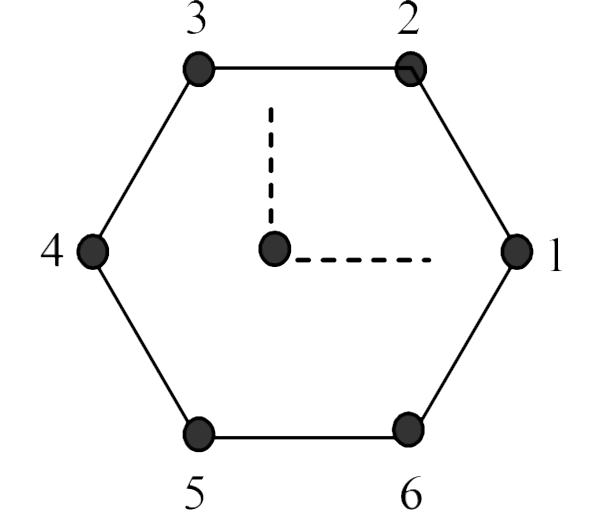
Six objects are placed at the vertices of a regular hexagon. The geometric center of the hexagon is at the origin with objects 1 and 4 on the x-axis (see figure). The mass of the `k^(th)` object is `mk = "k M "|cosq_(k)|` where i is an integer, M is a constant with dimension of mass, and `q_(k)` is the angular position of the kth verted measured from the positive x-axis in the counter-clockwise sense. If the net gravitational force on a body at the centroid vanishes, the value of i is

Promotional Banner

Similar Questions

Explore conceptually related problems

Five point charges, +q each are placed at the five vertices of a regular hexagon. The distance of the center of the hexagon from any fo the vertices is a. the electric field at the center of the hexagon is

Six negative equal charge are placed at the vertical of a regular hexagon . 6q charge is placed at the centre of the hexagon . Find the electric dipole moment of the system.

Six negative equal charge are placed at the vertical of a regular hexagon . 6q charge is placed at the centre of the hexagon . Find the electric dipole moment of the system.

Six point masses of mass m each are at the vertices of a regular hexagon of side l . Calculate the force on any of the masses.

Six point masses of mass m each are at the vertices of a regular hexagon of side l . Calculate the force on any of the masses.

Six point masses of mass m each are at the vertices of a regular hexagon of side l . Calculate the force on any of the masses.

Six point masses of mass m each are at the vertices of a regular hexagon of side l. Calculate the force on any of the masses.

Six point masses of mass m each are at the vertices of a regular hexagon of side l. Calculate the force on any of the masses.

Six point charges are placed at the vertices of a hexagon of side 1 m as shown in figure. Net electric field at the centre of the hexagon is

ABCDEF is a regular hexagon where centre O is the origin,if the position vector of A is hat i-hat j+2hat k, then bar(BC) is equal to