

Home
Class 11
PHYSICS
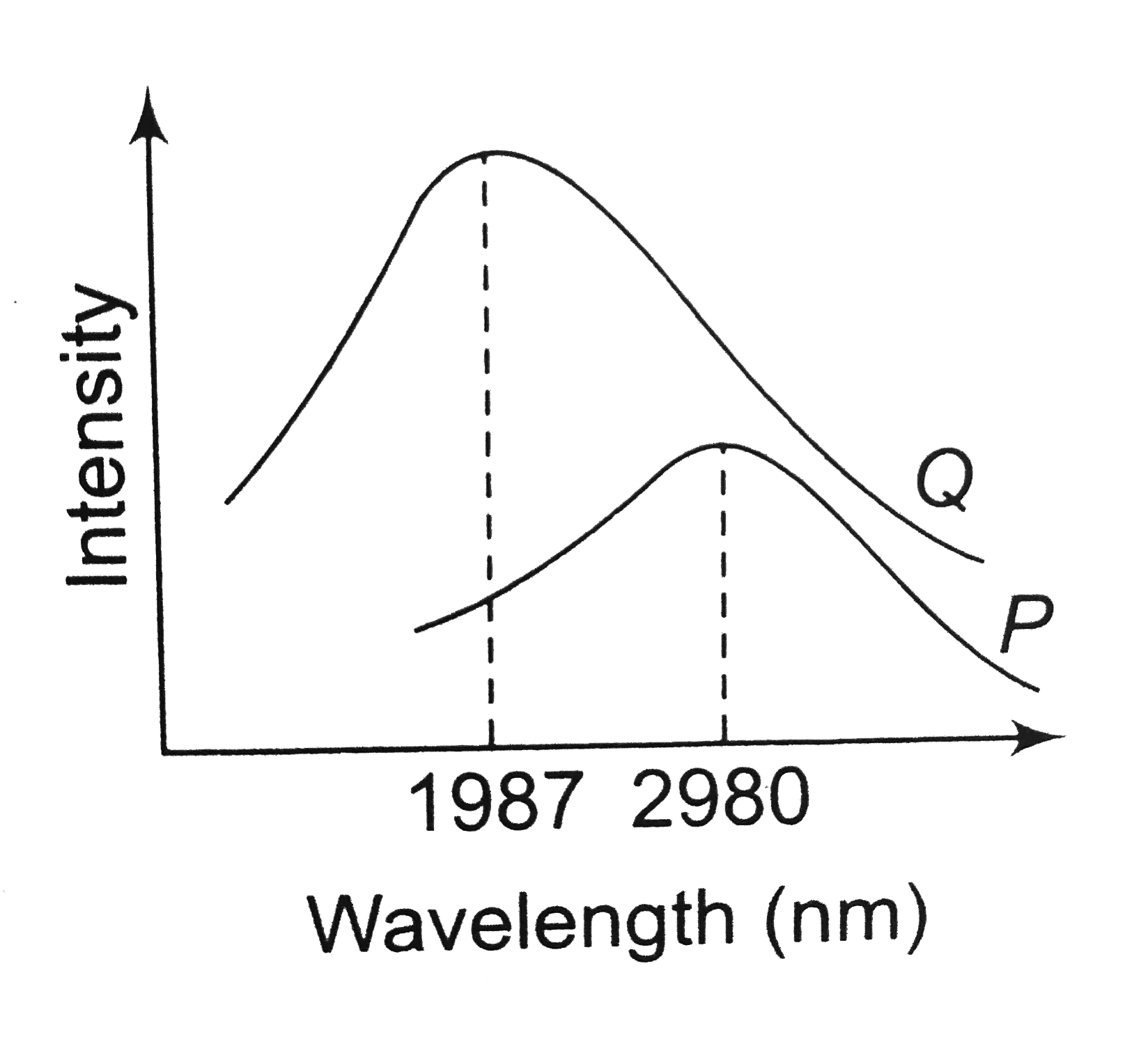
The emission spectrum of a black body at...

The emission spectrum of a black body at two different temperatures are shown by curves `P` and `Q` (as shown in figure). The ratio of the areas under the two curves `P` and `Q` will be

Promotional Banner

Similar Questions

Explore conceptually related problems

The spectrum of a black body at two temperatures 27^(@)C and 327^(@)C is shown in the figure. Let A_(1) and A_(2) be the areas under the two curves respectively. Find the value of (A_(2))/(A_(1))

The spectrum of a black body at two temperatures 27^(@)C and 327^(@)C is shown in the figure. Let A_(1) and A_(2) be the areas under the two curves respectively. Find the value of (A_(2))/(A_(1))

The displacement-time graphs of two particles P and Q are as shown in the figure. The ratio of their velocities V_P and V_Q will be

The displacement-time graphs of two particles P and Q are as shown in the figure. The ratio of their velocities V_P and V_Q will be

A charge Q is placed at the centre of the line joining two point charges +q and +q as shown in figure. The ratio of charges Q and q is

A charge Q is placed at the centre of the line joining two point charges +q and +q as shown in figure. The ratio of charges Q and q is

The adjoining diagram shows the spectral energy density distribution E_(lambda) of a black body at two different temperatures. If the areas under the curves are in the ratio 16 : 1, the value of temperature T is

The current I and voltage V curves for a given metallic wire at two different temperatures T_1 and T_2 are shown in the figure. Then ,

The spectra of a black body at temperatures 273^(@)C and 546^(@)C are shown in the figure. If A_(1) and A_(2) be area under the two curves respectively, the value of (A_(2))/(A_(1)) is

The spectra of a black body at temperatures 273^(@)C and 546^(@)C are shown in the figure. If A_(1) and A_(2) be area under the two curves respectively, the value of (A_(2))/(A_(1)) is