Home
Class 12
CHEMISTRY
Ketones are preparred by...

Ketones are preparred by

A

Clemmensen's reduction

B

Cannizzaro reaction

C

Rosenmund's reduction

D

Oppenaure's oxidation

Text Solution

Verified by Experts

The correct Answer is:
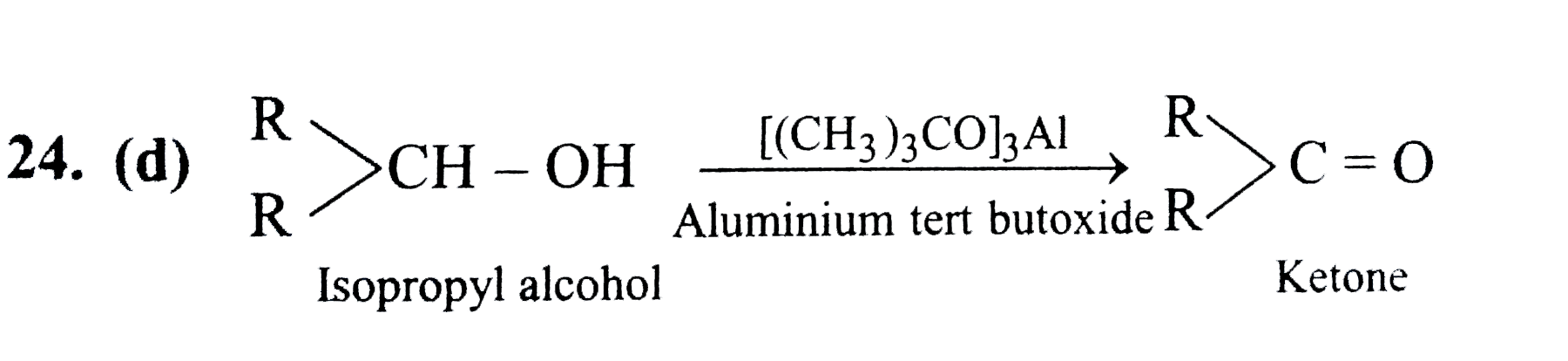
D

Promotional Banner

Topper's Solved these Questions

  • ALDEHYDES, KETONES AND CARBOXYLIC ACID

    A2Z|Exercise Oxidation And Reduction Of Carbonyl Compounds|54 Videos
  • ALDEHYDES, KETONES AND CARBOXYLIC ACID

    A2Z|Exercise Cannizaro'S Reaction|15 Videos
  • ALCOHOLS, PHENOLS AND ETHERS

    A2Z|Exercise Section D - Chapter End Test|30 Videos
  • BIOMOLECULES

    A2Z|Exercise Section D - Chapter End Test|30 Videos

Similar Questions

Explore conceptually related problems

Read the passage given below and answer the following questions: Aldehydes, ketones and carboxylic acids are few of the major classes of organic compounds containing carbonyl group. Aldehydes are prepared by dehydrogenation or controlled oxidation of primary alcohols and controlled or selective reduction of acyl halides. Ketones are prepared by oxidation of secondary alcohols and hydration of alkynes. Carboxylic acids are prepared by the oxidation of primary alcohols, aldehydes and alkenes by hydrolysis of nitriles and by treatment of Grignard reagents with carbon dioxide. Name a method by which both aldehydes and ketones can be prepared.

Read the passage given below and answer the following questions: Aldehydes, ketones and carboxylic acids are few of the major classes of organic compounds containing carbonyl group. Aldehydes are prepared by dehydrogenation or controlled oxidation of primary alcohols and controlled or selective reduction of acyl halides. Ketones are prepared by oxidation of secondary alcohols and hydration of alkynes. Carboxylic acids are prepared by the oxidation of primary alcohols, aldehydes and alkenes by hydrolysis of nitriles and by treatment of Grignard reagents with carbon dioxide. Through which of the following reactions number of carbon atoms can be increased in the chain?

Read the passage given below and answer the following questions: Aldehydes, ketones and carboxylic acids are few of the major classes of organic compounds containing carbonyl group. Aldehydes are prepared by dehydrogenation or controlled oxidation of primary alcohols and controlled or selective reduction of acyl halides. Ketones are prepared by oxidation of secondary alcohols and hydration of alkynes. Carboxylic acids are prepared by the oxidation of primary alcohols, aldehydes and alkenes by hydrolysis of nitriles and by treatment of Grignard reagents with carbon dioxide. Name the main compounds A and B formed in the following reaction: CH_3CN underset((ii) H_2O^(+) ) overset( (i) CH_3MgBr) to A overset( Zn( Hg) //conc. HCl) to B

Ketones can be prepared by :

A ketone can be prepared by which of the following processess ?

An unstable dihydroxy compounds is formed as the intermediate complex,when aldehydes and ketones are prepared from

A2Z-ALDEHYDES, KETONES AND CARBOXYLIC ACID-Section D - Chapter End Test
  1. Ketones are preparred by

    Text Solution

    |

  2. Aldehydes with alpha-H atom do not undergo disproportionation because:

    Text Solution

    |

  3. Which of the following tests would help in the distinction of HCOOH an...

    Text Solution

    |

  4. In Cannizzaro reaction, which of the following is a better hydride don...

    Text Solution

    |

  5. Mark the correct order of increasing reactivity.

    Text Solution

    |

  6. Compound (A) given below can undergo Cannizzaro reaction itself and cr...

    Text Solution

    |

  7. CH3 CH=CHCHO is oxidised to CH3 CH=CHCOOH using :

    Text Solution

    |

  8. Clemmensen's reduction will convert cyclohexanone into:

    Text Solution

    |

  9. What of the following is expected to be most highly ionised in water ?

    Text Solution

    |

  10. Ethylidene chloride is hydrolysed with aqueous NaOH. The product forme...

    Text Solution

    |

  11. The vapours of ethyl alcohol are passed over red hot copper at 573 K t...

    Text Solution

    |

  12. (CH(3))(2) CHOH overset ("Mild") underset ("oxidation"[0]) to (X) over...

    Text Solution

    |

  13. The chemical reaction of acetaldehyde and ammonia results in:

    Text Solution

    |

  14. When diethyl cadmium [(C(2)H(5))(2)Cd] is treated with acetyl chloride...

    Text Solution

    |

  15. The product formed by the reaction of acetaldehyde with excess of etha...

    Text Solution

    |

  16. Which of the following will not be formed when calcium formate is dist...

    Text Solution

    |

  17. In order to prepare acetone from acetyl chloride in one step, which of...

    Text Solution

    |

  18. Which of the following reagents can help in separating a mixture of ac...

    Text Solution

    |

  19. The reagents used to convert

    Text Solution

    |

  20. Which of the following is the stronger acid?

    Text Solution

    |

  21. Of the following which compound is an acetal ?

    Text Solution

    |

