Home
Class 12
CHEMISTRY
RNH2 reacts with C6H5SO2Cl in aqueous KO...

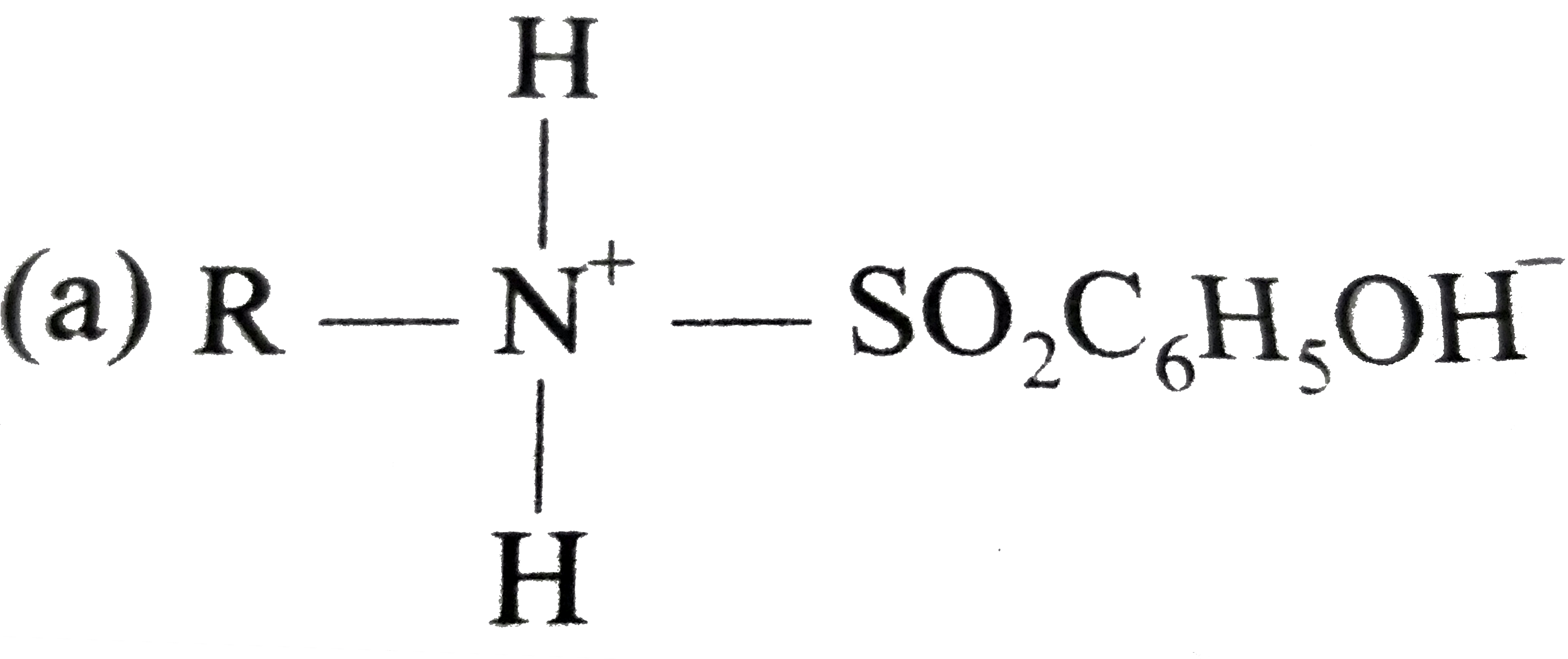
`RNH_2` reacts with `C_6H_5SO_2Cl` in aqueous `KOH` to give a clear solution. On acidification a precepitate is obtained which is due to the formation of

A

B

`R-N-SO_2C_6K_5K^(+)`

C

`R-NHSO_2C_6H_5`

D

`C_6H_5SO_2NH_2`

Text Solution

AI Generated Solution

The correct Answer is:

To solve the problem step by step, let's analyze the reaction between the primary amine (RNH₂) and benzene sulfonyl chloride (C₆H₅SO₂Cl) in the presence of aqueous KOH, followed by acidification. ### Step-by-Step Solution: 1. **Identify the Reactants**: - The primary amine is represented as RNH₂. - The reagent is benzene sulfonyl chloride, C₆H₅SO₂Cl. 2. **Reaction with Aqueous KOH**: - When RNH₂ reacts with C₆H₅SO₂Cl in the presence of aqueous KOH, a reaction occurs where the amine attacks the sulfonyl chloride. - This results in the formation of a sulfonamide (C₆H₅SO₂NHR) and hydrochloric acid (HCl) as a byproduct. - The reaction can be summarized as: \[ RNH_2 + C_6H_5SO_2Cl \rightarrow C_6H_5SO_2NHR + HCl \] 3. **Formation of a Clear Solution**: - The product formed (C₆H₅SO₂NHR) is initially soluble in the aqueous KOH solution, leading to a clear solution. 4. **Acidification**: - Upon acidification of the solution (adding an acid), the sulfonamide (C₆H₅SO₂NHR) precipitates out of the solution. - This is because the sulfonamide becomes less soluble in acidic conditions. 5. **Precipitate Formation**: - The precipitate obtained upon acidification is due to the formation of the sulfonamide, which is a white solid. - The final product can be represented as: \[ C_6H_5SO_2NHR \quad (\text{white precipitate}) \] 6. **Conclusion**: - The precipitate formed upon acidification is due to the formation of the sulfonamide (C₆H₅SO₂NHR). ### Final Answer: The precipitate obtained upon acidification is due to the formation of **C₆H₅SO₂NHR** (a sulfonamide). ---

To solve the problem step by step, let's analyze the reaction between the primary amine (RNH₂) and benzene sulfonyl chloride (C₆H₅SO₂Cl) in the presence of aqueous KOH, followed by acidification. ### Step-by-Step Solution: 1. **Identify the Reactants**: - The primary amine is represented as RNH₂. - The reagent is benzene sulfonyl chloride, C₆H₅SO₂Cl. ...
Promotional Banner

Topper's Solved these Questions

  • ORGANIC COMPOUNDS CONTAINING NITROGEN

    A2Z|Exercise Aromatic Amines And Diazonium Salts|61 Videos
  • ORGANIC COMPOUNDS CONTAINING NITROGEN

    A2Z|Exercise Nitrocyanide And Isocyanides|32 Videos
  • ORGANIC COMPOUNDS CONTAINING HALOGENS

    A2Z|Exercise Section D - Chapter End Test|30 Videos
  • P BLOCK ELEMENTS ( GROUP 15,16,17,18)

    A2Z|Exercise Section D - Chapter End Test|30 Videos

Similar Questions

Explore conceptually related problems

Hinsberg reagent is benzenesulfonyl chloride. In aqueous KOH this reacts with primary amine (RNH_(2)) to give a clear solution which on acidification gives a white on acidification gives a white precipitate, which is due to the formation of

Sodium carbonate reacts with SO_(2) in aqueous medium to give

An amine reacts with C_(6)H_(5)SO_(2)Cl and the product is soluble in alkali, amine is

The amine which reacts with p-toluenesulphonyl chloride to give a clear solution which on acidification gives insoluble compound is __________.

Potassium dichromate acts as a strong oxidising agent in the acidic medium. When heated with a metal chloride and conc. sulphuric acid, it gives orange red fumes. On passing these fumes through sodium hydroxide, it gives a yellow solution (X) and this acidified solution gives yellow precipitate (Y) with lead acetate. On heating potassium dichromate with KOH, it forms a yellow solution (Z) which on acidification changes to orange colour. Acidified solution of dichromate ion gives deep blue colour with H_2O_2 due to the formation of (P) The orange red fumes obtained on heating potassium dichromate with a metal chloride and conc. H_2SO_4 is due to the formation of

A white substance (A) reacts with dilute H_(2)SO_(4) to produce a colourless suffocating gas (B) and a colourless solution (C )/ The reaction of gas (B) with potassium iodate and starch solution produce a blue colour solution. Aqueous Solution of (A) gives a white precipitate with BaCl_(2) solution which is soluble in dilute HCl . Addition of aqueous NH_(3) or NaOH to (C ) produced first a precipitate which dissolves in excess of the respective reagent to poduced a clear solution. Similarly addition of excess of potassium ferrocyanide to (C ) produced a precipitate (D) which also dissolves in aqeous NaOH giving a clear solution. Identify (A),(B),(C ) and (D ). Write the equation of the reactions involved.

Ammonia reacts with K_(2)[HgI_(4)] in the presence of KOH solution to give a

A2Z-ORGANIC COMPOUNDS CONTAINING NITROGEN-Section D - Chapter End Test
  1. RNH2 reacts with C6H5SO2Cl in aqueous KOH to give a clear solution. On...

    Text Solution

    |

  2. Which of the following nitro compounds will show tautomerism?

    Text Solution

    |

  3. Gabriel synthesis is used for the preparation of

    Text Solution

    |

  4. The major product of the reaction is:

    Text Solution

    |

  5. Which of the following statement is correct?

    Text Solution

    |

  6. Which of the following is the weakest base?

    Text Solution

    |

  7. Only one the following amines will lose its nitrogen atom as trimehyl ...

    Text Solution

    |

  8. Which of the following cannot react with HNO2?

    Text Solution

    |

  9. In order to distinguigh between C2H5NH2 and C6H5NH2 which of the fol...

    Text Solution

    |

  10. Which of the following amines reacts most rapidly with

    Text Solution

    |

  11. Which of the following produces one mononitro and three isomeric dinit...

    Text Solution

    |

  12. The conjugate base of (CH3)2NH2^(Theta) is:

    Text Solution

    |

  13. Identify major product of following sequency of reaction:

    Text Solution

    |

  14. Primary and secondary amines are distinguished by:

    Text Solution

    |

  15. The product of the reaction of alcoholic silver nitrite with ethyl bro...

    Text Solution

    |

  16. Identify the final product of following sequence of reaction:

    Text Solution

    |

  17. Tertiary nitro compounds cannot show tautomerism becauses :

    Text Solution

    |

  18. When C6H5N2Cl is reduced with Na2SnO2, the product is:

    Text Solution

    |

  19. Identify final product of following sequence of reaction:

    Text Solution

    |

  20. Which of the following substances on treatment with P2O5 gives ethanen...

    Text Solution

    |

  21. Which of the following reagents on treatment with benzenamine in basic...

    Text Solution

    |
