

Home
Class 11
PHYSICS
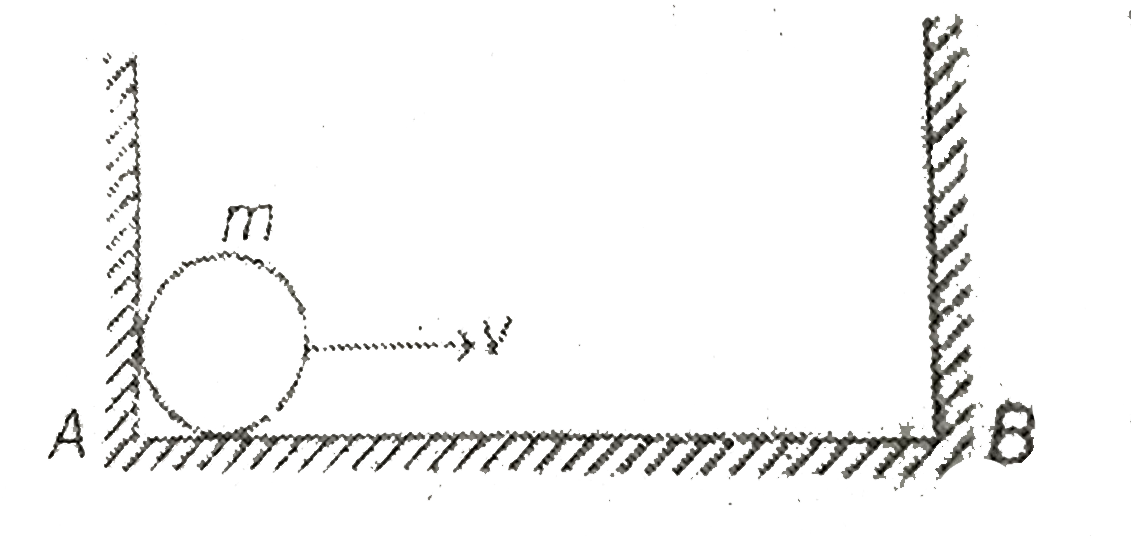
A small ball on a frictionless horizonta...

A small ball on a frictionless horizontal surface moves towards right with velocity v. It collides with the wall and returns back and continues to and fro motion. If the average speed for first to and fro motion of the ball is `((2)/(3))`v, then the coefficient of restitution of impact is

Promotional Banner

Similar Questions

Explore conceptually related problems

A man swims to and fro along the bank of a river with a velocity v relative to water. If the velocity of flow is u , the average speed of the man (for to and fro motion) is :

A ball of mass m moving with velocity v , collide with the wall elastically as shown in the figure. After impact the change in angular momentum about P is : .

A ball of mass m moving with velocity v , collide with the wall elastically as shown in the figure. After impact the change in angular momentum about P is : .

A ball collides with an inclined plane of inclination theta after falling through a distance h. if it moves horizontal just after the impact, the coefficient of restitution is

A ball collides with an inclined plane of inclination theta after falling through a distance h. if it moves horizontal just after the impact, the coefficient of restitution is

A ball is projected from the ground with speed u at an angle alpha with horizontal. It collides with a wall at a distance a from the point of projection and returns to its original position. Find the coefficient of restitution between the ball and the wall.

A ball is projected from the ground with speed u at an angle alpha with horizontal. It collides with a wall at a distance a from the point of projection and returns to its original position. Find the coefficient of restitution between the ball and the wall.

A ball A of mass 3 m is placed at a distance d from the wall on a smooth horizontal surface Another ball B of mass m moving with velocity u collides with ball A . The coefficient of restitution between the balls and the wall and between the balls is e (a) the velocity of ball B after collision is (u(3e-1))/(4) . (b) the velocity of ball B after collision is (u(2e-1))/(4) . ( c) after collision, ball A will have away by distance (d(2e-1))/((2e-1)) during the time ball B returns back to wall. (d) after collision, ball A will move away by distance (d(e-1))/((3e-1)) during the time ball B returns back to wall.

A body A moves towards a wall with velocity V . The wall also moves towards the body A with velocity V_(0) . After collision the body moves in opposite direction with velocity V^(|) which is (1+(2V_(0))/(V)) times the velocity V . The coefficient of restitution is