

Home
Class 11
PHYSICS
In the figure, the block of mass m, atta...

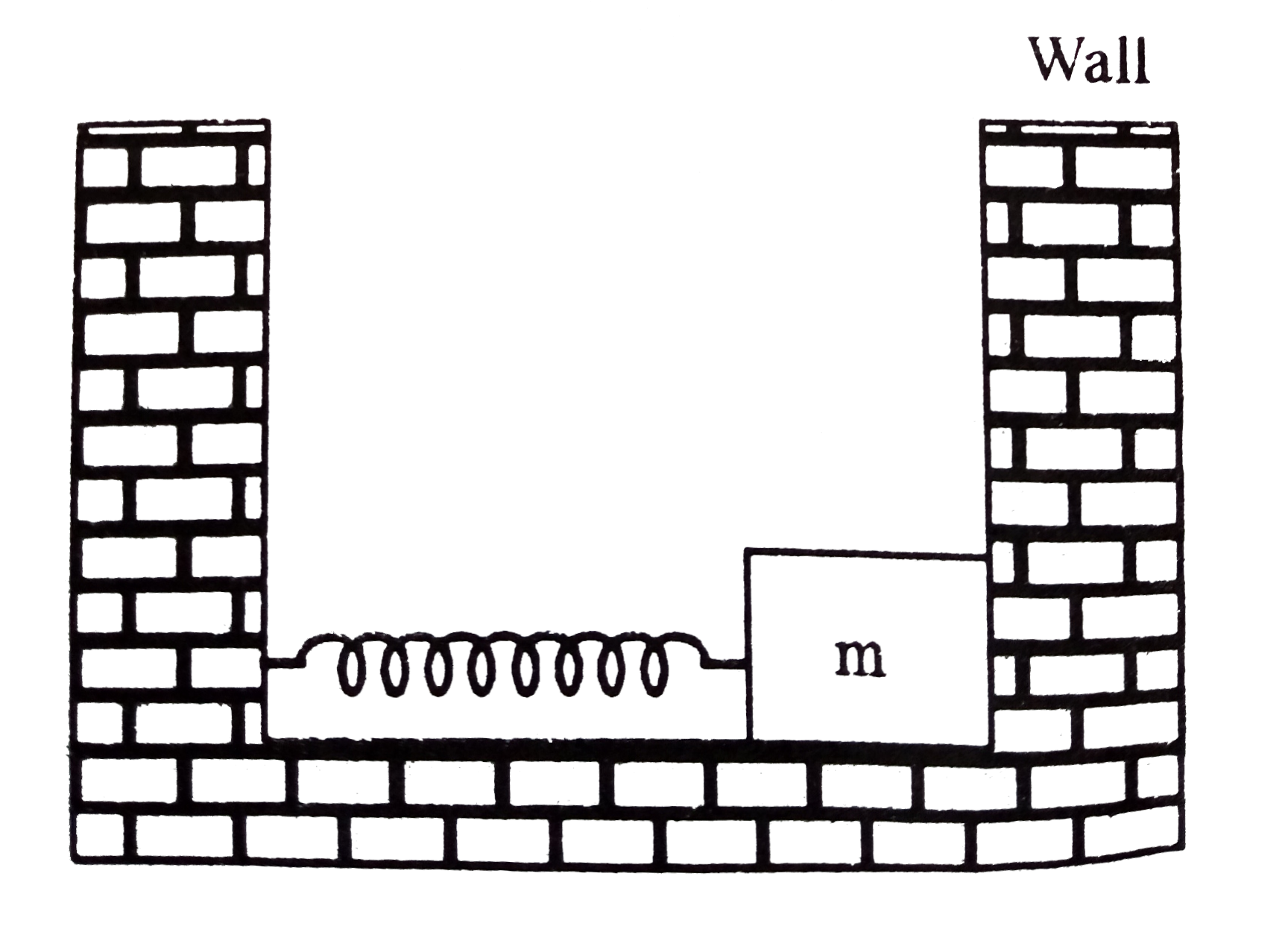
In the figure, the block of mass `m`, attached to the spring of stiffness `k` is in contact with the complete elastic wall, and the compression in the spring is `'e'`. The spring is compressed further by `'e'` by displacing the block towards left and is then released. if the collision between the block and the wall is completely elastic then the time priod of oscillations of the block will be-

Promotional Banner

Similar Questions

Explore conceptually related problems

In the figure, the block of mass m, attached to the spring of stiffness k is in correct with the completely elastic wall, and the compression in the spring is e. The spring is compressed further by e by displacing the block towards left and is then released. If the collision between the block and the wall is completely eleastic then the time period of oscillation of the block will be

In the figure, the block of mass m, attached to the spring of stiffness k is in correct with the completely elastic wall, and the compression in the spring is e. The spring is compressed further by e by displacing the block towards left and is then released. If the collision between the block and the wall is completely eleastic then the time period of oscillation of the block will be

A block of mass 100 g attached to a spring of stiffness 100 N//m is lying on a frictionless floor as shown. The block is moved to compress the spring by 10 cm and released. If the collision with the wall is elastic then find the time period of oscillations.

A block of mass 100 g attached to a spring ofstiffness 100 N//Mis lying on a frictionless floor as shown. The block is moved to compress the spring by 10 cm and released. If the collation with the wall is elastic then find the time period of oscillations.

Figure shown a block P of mass m resting on a smooth horizontal surface, attached to a spring of force constant k which is rigidly fixed on the wall on left side, shown in the figure . At a distance l to the right of the block there is a rigid wall. If block is pushed towards left so that spring is compressed by a distance 5l//3 and when released, if will starts its oscillations. If collision of block with the wall is considered to be perfectly elastic. Find the time period of oscillation of the block.

Figure shown a block P of mass m resting on a smooth horizontal surface, attached to a spring of force constant k which is rigidly fixed on the wall on left side, shown in the figure . At a distance l to the right of the block there is a rigid wall. If block is pushed towards loft so that spring is comparessed by a distance 5l//3 and when released, if will starts its oscillations. If collision of block with the wall is consdered to be perfectly elastic. Find the time period of oscillation of the block.

A block is attached to a spring and is placed on a horizontal smooth surface as shown in which spring is unstretched. Now the spring is given an initial compression 2x_(0) an block is released from rest. Collision with the wall PQ are elastic. Find the time period of motion of the block:

The block of mass m_1 shown in figure is fastened to the spring and the block of mass m_2 is placed as against it. Find the compression of the spring in the equilibrium position.

The block shown in figure is released from rest. Find out the speed of the block when the spring is compressed by 1 m