

Home
Class 12
PHYSICS
A small beads of mass ma having charge -...

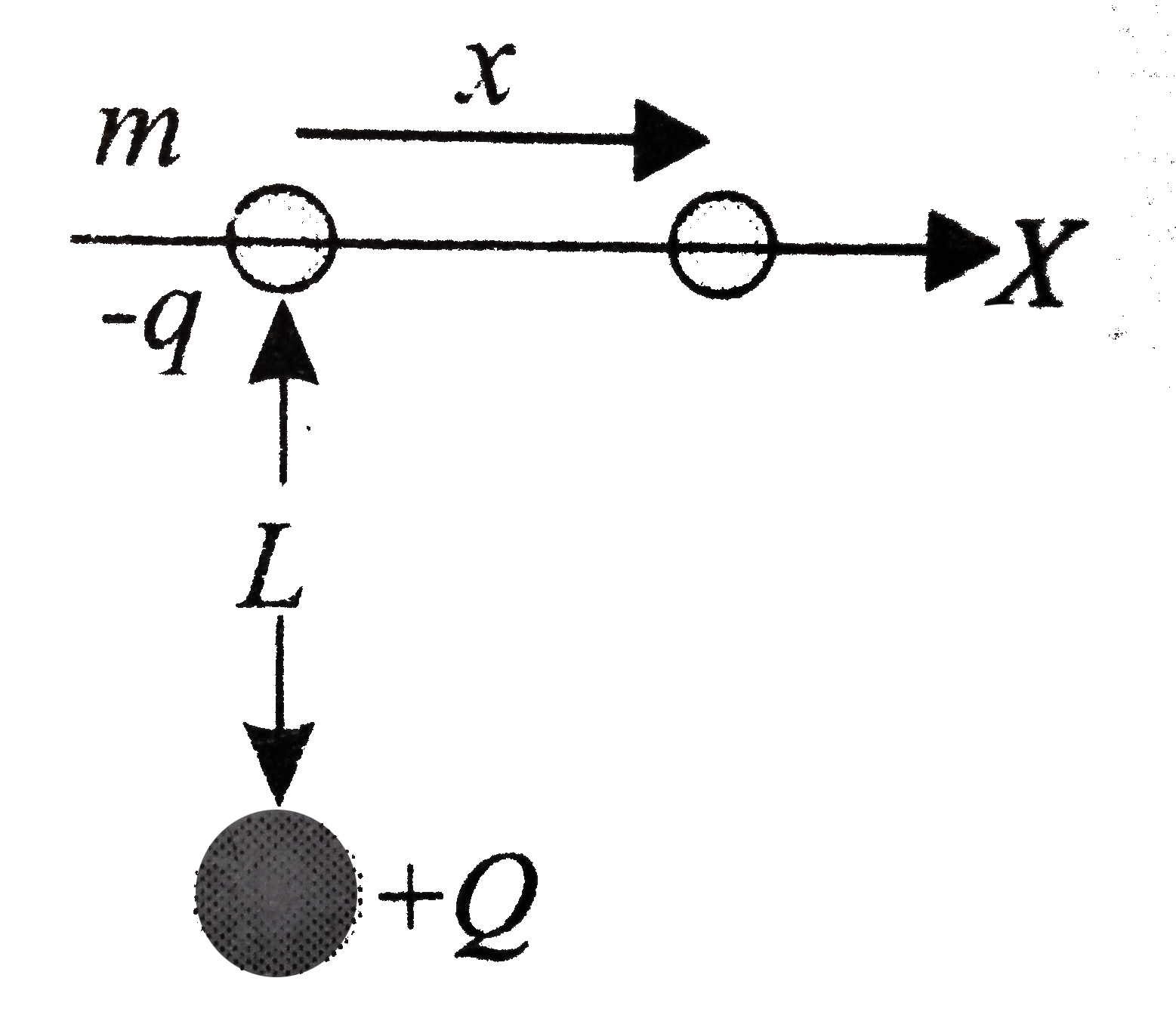
A small beads of mass ma having charge -q is constrained to move along a froctionless wire. A positive charges Q lies at a distance L from the wire. Initiallym the bead is just above charge +Q. Show that if the bead is displaced a distance x, where `xltltL`, and released, it will exhibit simple harmonic motion. obtain an expression for the tive period of simple harnonic motion.

Promotional Banner

Similar Questions

Explore conceptually related problems

A small point mass m has a charge q, which is constrained to move inside a narrow frictionless cylinder, At the bae of the cylinder is point mass of charge Q having the same sign as q. If the mass m is displaced by a small amount from its equilibrium position and released. it will exhibit simple harmonic motion. Find the angular frequency of the mass?

A small point mass m has a charge q, which is constrained to move inside a narrow frictionless cylinder, At the bae of the cylinder is point mass of charge Q having the same sign as q. If the mass m is displaced by a small amount from its equilibrium position and released. it will exhibit simple harmonic motion. Find the angular frequency of the mass?

A particle of mass m and charge q is located midway between two fixed charged particles each having a charge q and a distance 2l apart. Prove that the motion of the particle will be SHM if it is displaced slightly along the line connecting them and released. Also find its time period.

A particle of mass m and charge q is located midway between two fixed charged particles each having a charge q and a distance 2l apart. Prove that the motion of the particle will be SHM if it is displaced slightly along the line connecting them and released. Also find its time period.

Two identical charges +Q are kept at some fixed distance. A small particle P with charge q is placed midway between them. If P is given a small displacement Deltax , it will undergo simple harmonic motion if

A ring of radius R carries a uniformly distributed charge + Q. A point charge - q is placed on the axis of the ring at a distance 2R from its centre and than released. Will the charge -q execute a simple harmonic motion along the axis of the ring ?

An electric dipole had been formed by placing two particles each of mass m at the two ends of a light rod of length l. The charges of the two particles are +q and -q . This dipole is placed in a uniform electric field E in such a way that its axis is parallel to the direction of the field. The dipole is now deflected through a small angle. Show that for small angular displacement, the dipole will execute angular simple harmonic motion. Calculate the time period of the simple harmonic motion.

A ring of radius R carries a uniformly distributed charge +Q. A point charge -q is placed on the axis of the ring at a distance 2R from the centre of the ring and released from rest. The particle executes a ismple harmonic motion along the axis of the ring.

Three equal negative charges, -q_(1) each form the vertices of and equilateral triangle . A particle of mass m and a positive charge q_(2) is constrained to move along a line perpendicular to the plane of triangle and through its center, which at a distance r from each of the negative charges as shown in fig. The whole systen is kept in gravity-free space, Find the time period of vibration of the particle for small displacement from the equilibrium position.