

Home
Class 11
PHYSICS
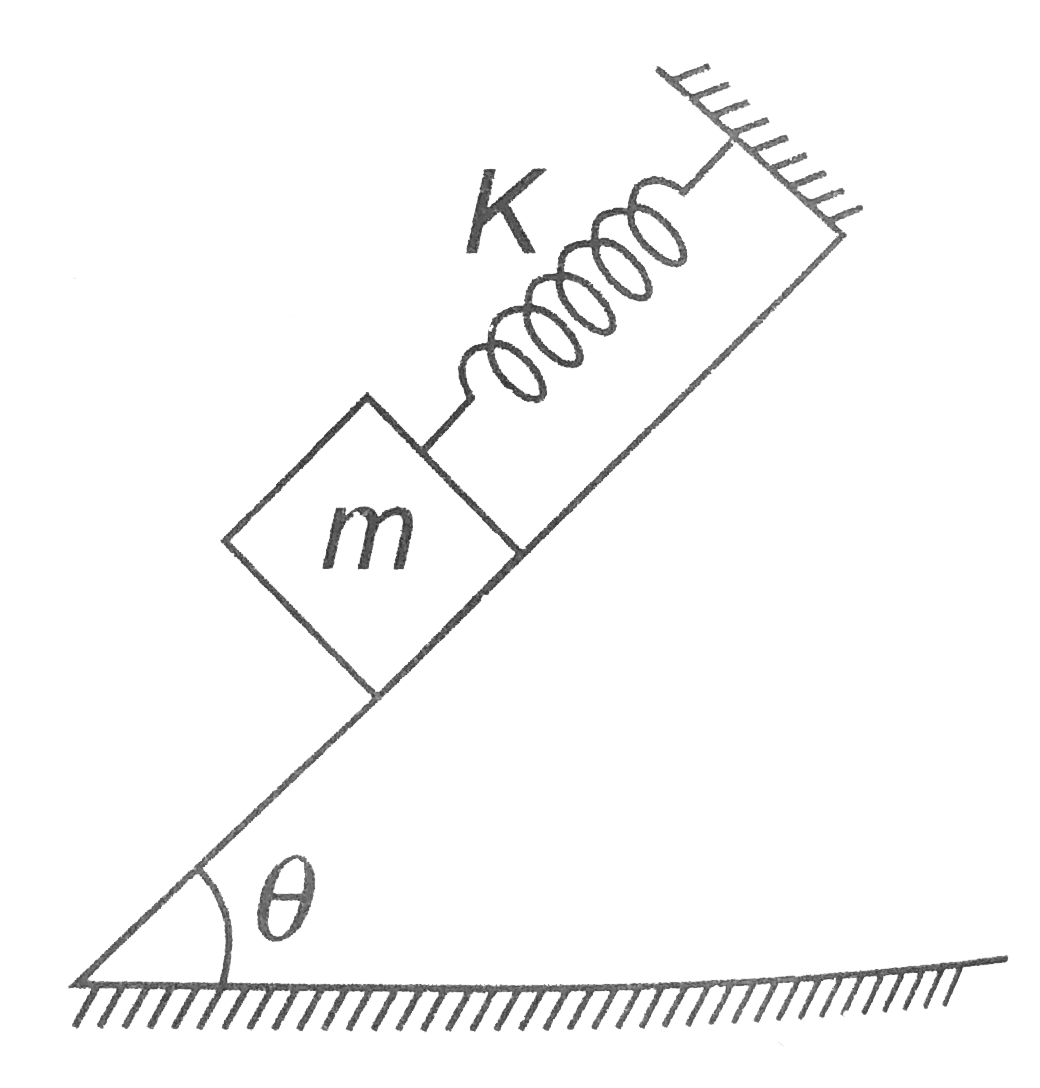
In the figure shown, a spring of spring ...

In the figure shown, a spring of spring constant `K` is fixed at on end and the other end is attached to the mass 'm' . The coefficient of friction between block and the inclined plane is `mu`. The block is released when the spring is in tis natural length. Assuming that the `theta gt mu`, the maximum speed of the block during the motion is.

Promotional Banner

Similar Questions

Explore conceptually related problems

The block of mass m is released when the spring was in its natrual length. Spring constant is k. Find the maximum elongation of the spring.

The block of mass m is released when the spring was in its natrual length. Spring constant is k. Find the maximum elongation of the spring.

In the system as shown in figure, the blocks have masses m_(1) and m_(2) , the spring constant is k, coefficient of friction between the block of mass m_(1) and the surface is mu . The system is released with zero initial speed from the position where the spring is in its natural length.

A block of mass m is attached to one end of a mass less spring of spring constant k. the other end of spring is fixed to a wall the block can move on a horizontal rough surface. The coefficient of friction between the block and the surface is mu then the compession of the spring for which maximum extension of the spring becomes half of maximum compression is .

A block of mass m is attached to one end of a mass less spring of spring constant k. the other end of spring is fixed to a wall the block can move on a horizontal rough surface. The coefficient of friction between the block and the surface is mu then the compession of the spring for which maximum extension of the spring becomes half of maximum compression is .

An ideal spring with spring - constant K is bung from the colling and a block of mass M is attached to its lower end the mass is released with the spring initally unstetched . Then the maximum exlemsion in the spring is

Two block of same mass'm' are joined with an dideal spring of spring constant k and sept on a rough surface as shown in figure. The spring is initially unstretched and coefficient of friction between the blocks and horizontal surface is mu and 2 mu respectively. What should be the maximum speed of block 'A' such that the block 'B' does not move ?

Two block of same mass'm' are joined with an dideal spring of spring constant k and sept on a rough surface as shown in figure. The spring is initially unstretched and coefficient of friction between the blocks and horizontal surface is mu and 2 mu respectively. What should be the maximum speed of block 'A' such that the block 'B' does not move ?