

Home
Class 11
PHYSICS
A solid ball rolls down a parabolic path...


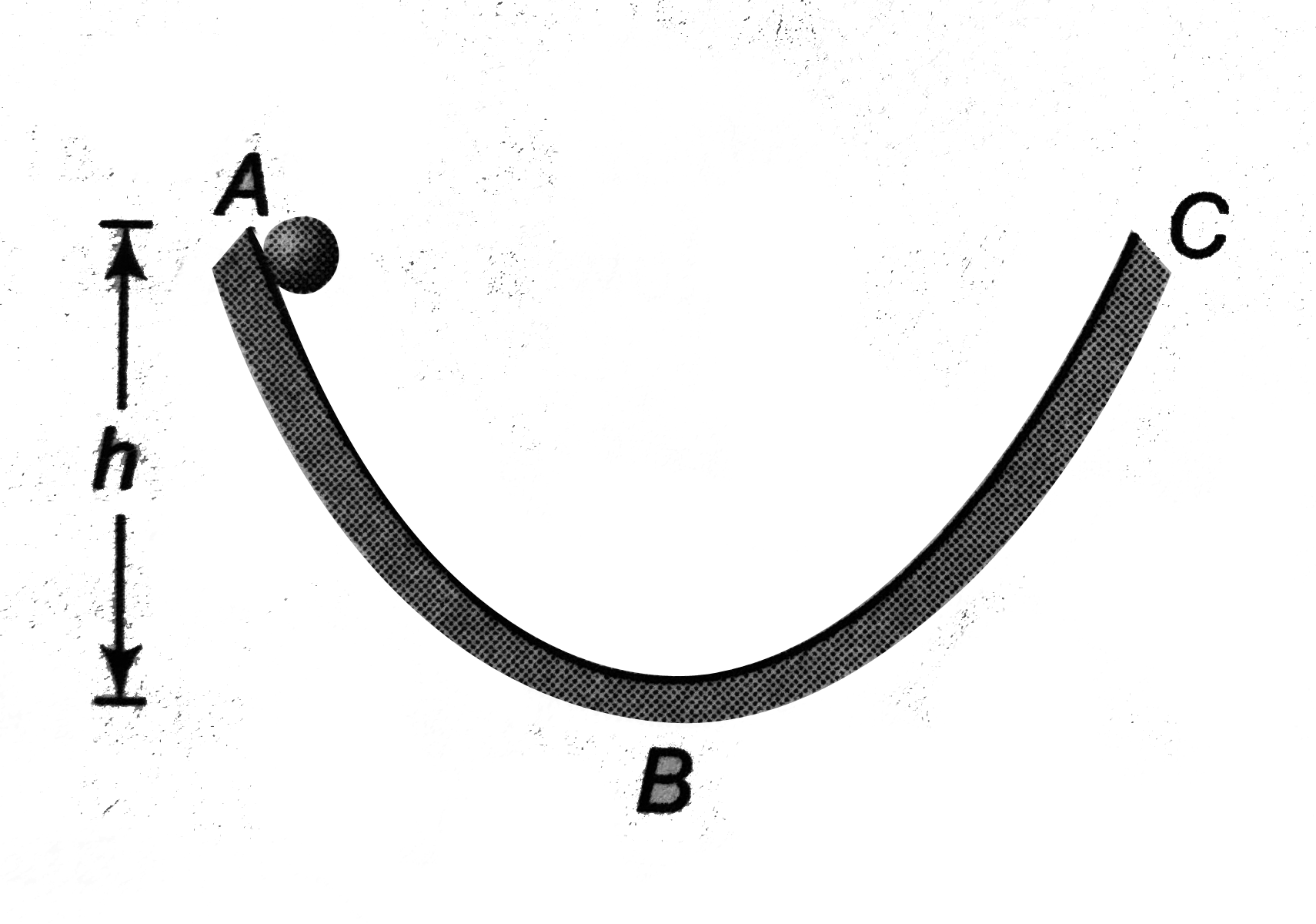
A solid ball rolls down a parabolic path ABC from a height h as shown in figure. Portion AB of the path is rough while BC is smooth. How high will the ball climb in BC?

Promotional Banner

Similar Questions

Explore conceptually related problems

A hollow spherical ball rolls down on a parabolic path AB from a height 'h' as shown in the figure. Path AB is rough enough to prevent slipping of ball and path BC is frictionless. The height to which the ball will climb in BC is

A ball is released from height h as shown in fig. Find the condition for the particle to complete the circular path.

A solid sphere is released from rest from the top of a curved surface as shown in figure. Half portion of surface is rough and another half is smooth. If sphere is released from rough side, then the maximum height attained by it on smooth side is (Rough surface has sufficient friction to roll the body)

A smooth ball is released from rest from a height h as shown in figure. It slides down the first inclined plane and collides with the second inclined plane. a. If e = 0 , find the speed of the ball just after leaving the inclined plane 1. b. If the particle mioves horizontally just after the collision find e .

A solid sphere rolls down a parabolic path , whose vertical dimension is given by y = kx^(2) and base of the parabola is at x = 0 . During the fall the sphere does not slip, but beyond the base the climb is frictionless. If the sphere falls through a height h, the height above the base that it would climb is

A spherical rigid ball is realeased from rest and starts rolling down an inclined plane from height h=7m, as shown in the figure. It hits a block at rest on the horizontal plane (assme elastic collision). If the mass of both the ball and the block is m and the ball is rolling without sliding, then the speed of the block after collision is close to

A solid sphere rolls down a smooth inclined plane of height h. If it stats from rest then the speed of the sphere when it reaches the bottom is given by