

Home
Class 11
PHYSICS
Three blocks of identical masses are pla...

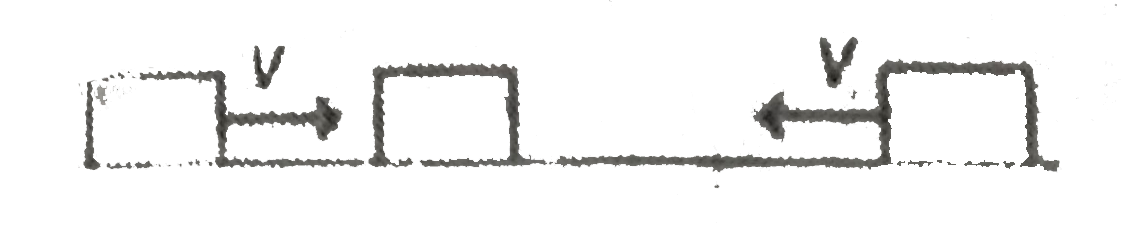
Three blocks of identical masses are placed on a frictionless table as shown . The centre block is at rest , whereas the other two blocks are moving directly towards the stationary block with identical speed v . The centre block is initially closer to the left block than the right one . All collisions are elastic . After long time , which of the following is true .

Promotional Banner

Similar Questions

Explore conceptually related problems

Three identical blocks, each having a mass m are pushed by a force F on the Frictionless table as shown in figure. What is the net force on the block A?

Three blocks are pushed with a force F across a frictionless table as shown in figure . Let N_1 be the contact force between the left two blocks and N_2 be the contact force between the right two blocks. Then

The right block in the figure moves at a speed v towards the left block placed in equilibrium. All the surfaces are smooth and all the collisions are elastic. Find the time period of the motion

Three identical blocks A, B and C are placed on horizontal frictionless surface. The blocks B and C are at rest. But A is approaching towards B with a speed of 10 ms^(-1) The coefficient of restitution for all collision is 0.5. The speed of the block C just after collision is

Three identical blocks A, B and C are placed on horizontal frictionless surface. The blocks B and C are at rest. But A is approaching towards B with a speed of 10 ms^(-1) The coefficient of restitution for all collision is 0.5. The speed of the block C just after collision is

Three identical blocks A, B and C are placed on horizontal frictionless surface. The blocks B and C are at rest. But A is approaching towards B with a speed of 10 ms^(-1) The coefficient of restitution for all collision is 0.5. The speed of the block C just after collision is

Three blocks are initially placed as shown in the figure. Block A has mass m and initial velocity v to the right. Block B with mass m and block C with mass 4m are both initially at rest. Neglect friction. All collisions are elastic. The final velocity of blocks A is

Three blocks are initially placed as shown in the figure. Block A has mass m and initial velocity v to the right. Block B with mass m and block C with mass 4 m are both initially at rest. Neglect friction. All collisions are elastic. The final velocity of block A is

Three blocks are initially placed as shown in the figure. Block A has mass m and initial velocity v to the right. Block B with mass m and block C with mass 4m are both initially at rest. Neglect friction. All collisions are elastic. The final velocity of blocks A is