Home
Class 12
PHYSICS
Light of wavelength 520nm passing throug...

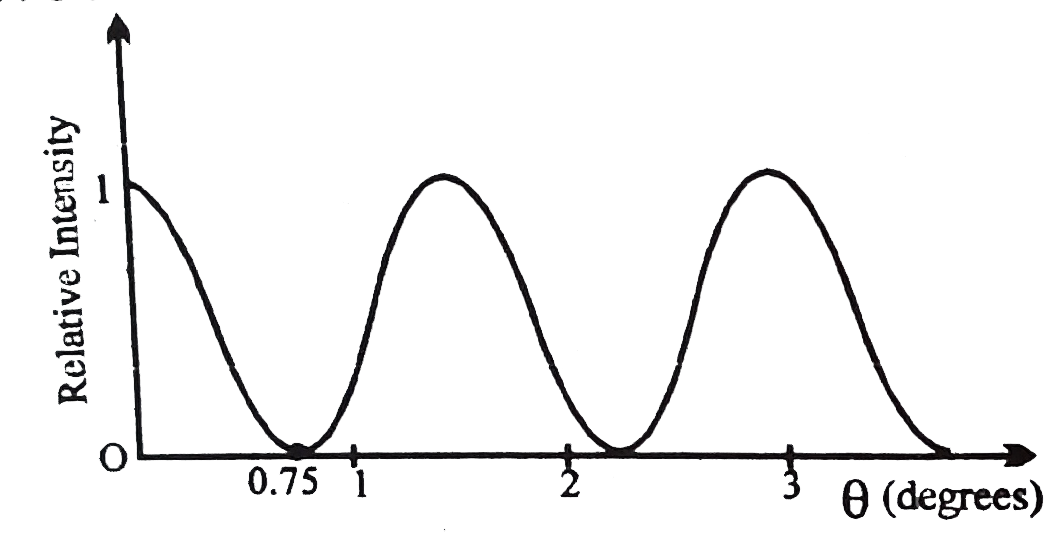
Light of wavelength `520nm` passing through a double slit,produced interference pattern of relative intensity versus deflection angle `theta` as shown in the figure.find the separation of between the slits.

Text Solution

Verified by Experts

The correct Answer is:
`1.99xx10^(-2)mm`


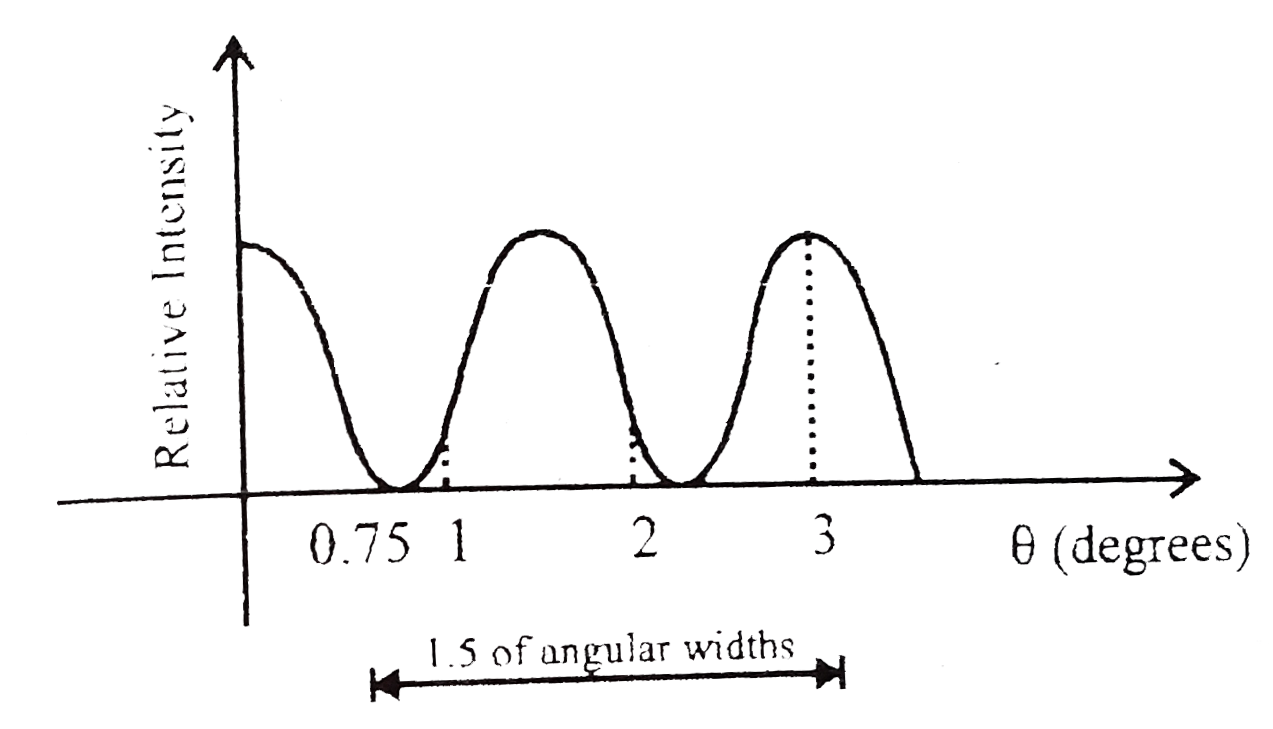
Angular width of frings `theta=(lambda)/(d)…(1)`
given that `theta=1.5^(@) rArr theta=(3^(@))/(2)`
from (1)&(2) `(lambda)/(d)=(3)/(2)xx(pi)/(180) ….(2)`
`d=(120lambda)/(pi) rArr d=(120xx520xx10^(-9))/(3.14)`
`d=1.98xx10^(-5)m rArr d=1.98xx10^(-2)mm`
Promotional Banner

Similar Questions

Explore conceptually related problems

In young's double slit experiment relative intensity at a point on the screen may be defined as ratio of intensity at that point to the maximum intensity on the screen. Light of wavelength 7500overset(@)A A passing through a double slit, produces interference pattern of relative intensity variation as shown in Fig. theta on horizontal axis represents the angular position of a point on the screen (a) Find separation d between the slits. (b) Find the ratio of amplitudes of the two waves producing interference pattern on the screen.

Suppose a monochromatic X-ray beam of wavelength 100 pm is sent through a Young's double slit and the interference pattern is observed on a photographic plate placed 40 cm away from the slit. What should be the separation between the slits so that the successive maxima on the screen are separated by a distance of 0*1 mm?

In a double-slit interference pattern, the first maxima for infrared light would be

Laser light of wavelength 630 nm incident on a pair of slits produces an interference pattern where bright fringes are separated by 8.1 mm . Another light produces the interference pattern, where the bright fringes are separated by 7.2 mm . Calculate the wavelength of second light.

In Young's double slit experiment the interference pattern is found to have an intensity ratio between bright and dark fringes as 9. This implies

A source emitting light of wavelengths 480 nm and 600 nm is used in a double slit interference experiment. The separation between the slits is 0.25 mm and the interference is observed on a screen placed at 150 cm from the slits. Find the linear separation between the first maximum (next to the central maximum) corresponding to the two wavelengths.

Laser light of wavelength 630 nm incident on a pair of slits produces an interference pattern in which the bright fringes are separated by 8.1 mm. A second laser light produces an interference pattern in which the fringes are separated by 7.2 mm. Calculate the wavelength of the second light.

Laser light of wave length 600 nm incident on a pair of slits produces an interference pattern in which the bright fringes are separated by 8mm. A second light produces an interference pattern in which the fringes are separated by 12 mm. Calculate the wavelength of the second light.

