Home
Class 12
PHYSICS
The young's double slit experiment is do...

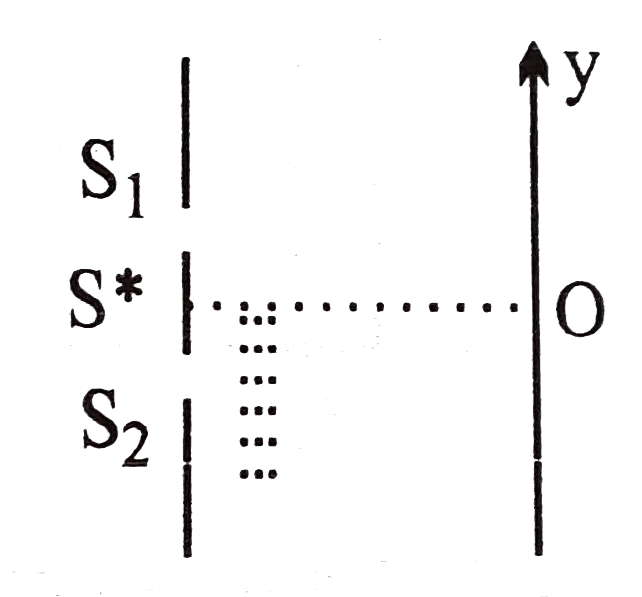
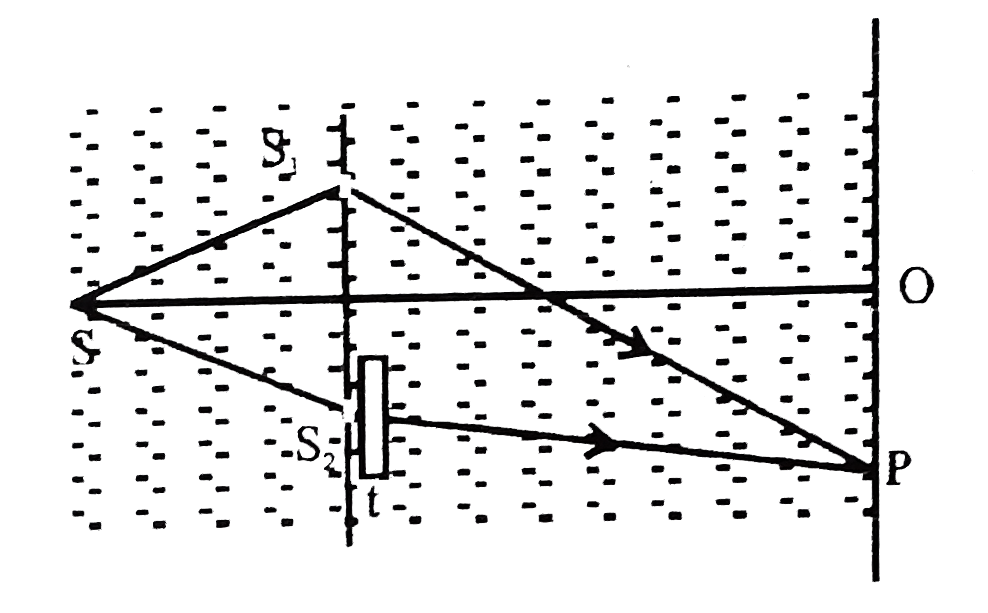
The young's double slit experiment is done in a medium of refractive index `4//3`.A light of `600nm`wavelength is falling on the slits having `0.45` mm separation .The lower slit `S_(2)` is covered by a thin glass sheet of thickness `10.4mu m` and refractive index`1.5`.the intereference pattern is observed ona screen placed `1.5m` from the slits are shown

(a) Find the location of the central maximum (bright fringe with zero path difference)on the y-axis.
(b) Find the light intensity at point `O`relative to the maximum fringe intensity.
(c )Now,if `600nm`light is replaced by white light of range 400 to700 nm find the wavelength of the light that from maxima exactly point `O`.[All wavelengths in this problem are for the given medium of refractive index `4//3` .Ignore dispersion]

Text Solution

Verified by Experts

The correct Answer is:
(a)`y=-13//3mm,(b) intensity atO =0.75I_(max) (c )650nm,433.33nm`


Path difference =`(S_(2)P-t+._(w)mu_(g)t)-S_(1)P` for central bright path difference is `0`.
`(S_(2)P-S_(1)P)-((mu_(g))/(mu_(w))-1)t=0 rArr (yd)/(D)=((mu_(g))/(mu_(w))-1)t`
`y=((mu_(g))/(mu_(w))-1)txx(D)/(d) rArr (((3//2)/(4//3)-1)xx10.4xx10^(-6)xx1.5)/(45xx10^(-5))`
`y=(1)/(8)xx(10.4xx1.5m)/(450)m rArr y=(104xx150)/(8xx450)mm rArr y=(13)/(3)mm`
(b)Path difference at O, `Deltax=(S_(2)O-t+._(w)mu_(g)t)-S_(1)O`
`Deltax=S_2O-t+(mu_g/mu_wt)-S_1OimpliesDeltax=(mu_g/mu_w-1)t`
`Deltax=((3//2)/(3//4)-1)t rArrDeltax=(t)/(8)`
`Deltax=(10.4xx10^(-6))/(8) rArr Deltax=13xx10^(-7)m`
`Deltaphi=(Deltax)/(lambda)xx2pi rArr Deltaphi=(13xx10^(-7))/(6xx10^(-7))xx2pi`
`Deltaphi=(13)/(3)pi`
`I_(R)=I_(1)+I_(2)+2sqrt(I_(1)I_(2))cosphi`,since `I_(1)=I_(2)=I_(0)`
`I_(R)=2I_(0)(1+"cos"phi) rArr I_(R)=4I_(0)"cos"^(2) (phi)/(2)`
`I_(R)=I_(max)"cos"^(2)(phi)/(2) rArr I_(R)=I_(max)"cos"^(2)(13pi)/(6)`
`I_(R)=I_(max)."cos"^(2)(2pi+(pi)/(6)) rArr I_(R)=I_(max)"cos"^(2)pi//6`
`I_(R)=(3)/(4)I_(max)`
(c ) for point to be of maximum intensity
path difference=`nlambda .........(1) `
path difference `=(t)/(8) `
Path difference =`1300nm....(2)`
from (1)&(2)
`nlambda=1300nm rArr lambda=1300nm,(1300)/(2)nm,(1300)/(3)nm`
`lambda` in the range of 400 to700nm is
`lambda=1300nm,650nm,(1300)/(3)nm`
Promotional Banner

Similar Questions

Explore conceptually related problems

A YDSE is performed in a medium of refractive index 4 // 3 , A light of 600 nm wavelength is falling on the slits having 0.45 nm separation . The lower slit S_(2) is covered b a thin glass plate of thickness 10.4 mm and refractive index 1.5. The interference pattern is observed on a screen placed 1.5 m from the slits as shown in figure. (All the wavelengths in this problem are for the given medium of refractive index 4 // 3 , ignore absorption.) Find the light intensity at point O relative t maximum fringe intensity.

A YDSE is performed in a medium of refractive index 4 // 3 , A light of 600 nm wavelength is falling on the slits having 0.45 nm separation . The lower slit S_(2) is covered b a thin glass plate of thickness 10.4 mm and refractive index 1.5. The interference pattern is observed on a screen placed 1.5 m from the slits as shown in figure. (All the wavelengths in this problem are for the given medium of refractive index 4 // 3 , ignore absorption.) The location of the central maximum (bright fringe with zero path difference) on the y-axis will be

A YDSE is performed in a medium of refractive index 4 // 3 , A light of 600 nm wavelength is falling on the slits having 0.45 nm separation . The lower slit S_(2) is covered b a thin glass plate of thickness 10.4 mm and refractive index 1.5. The interference pattern is observed on a screen placed 1.5 m from the slits as shown in figure. (All the wavelengths in this problem are for the given medium of refractive index 4 // 3 , ignore absorption.) Now, if 600 nm, find the wavelength of the ligth that forms maximum exactly at point O.

A monochromatic beam of bright of light of wavelength 5000 Å is used in Young's double slit experiment. If one of the slits is covered by a transparent sheet of thikness 1.4 xx 10^(-5) m , having refractive index of its medium 1.25. Then the number of fringes shifted is

