Home
Class 12
PHYSICS
A coherent parallel beam of microwaves o...

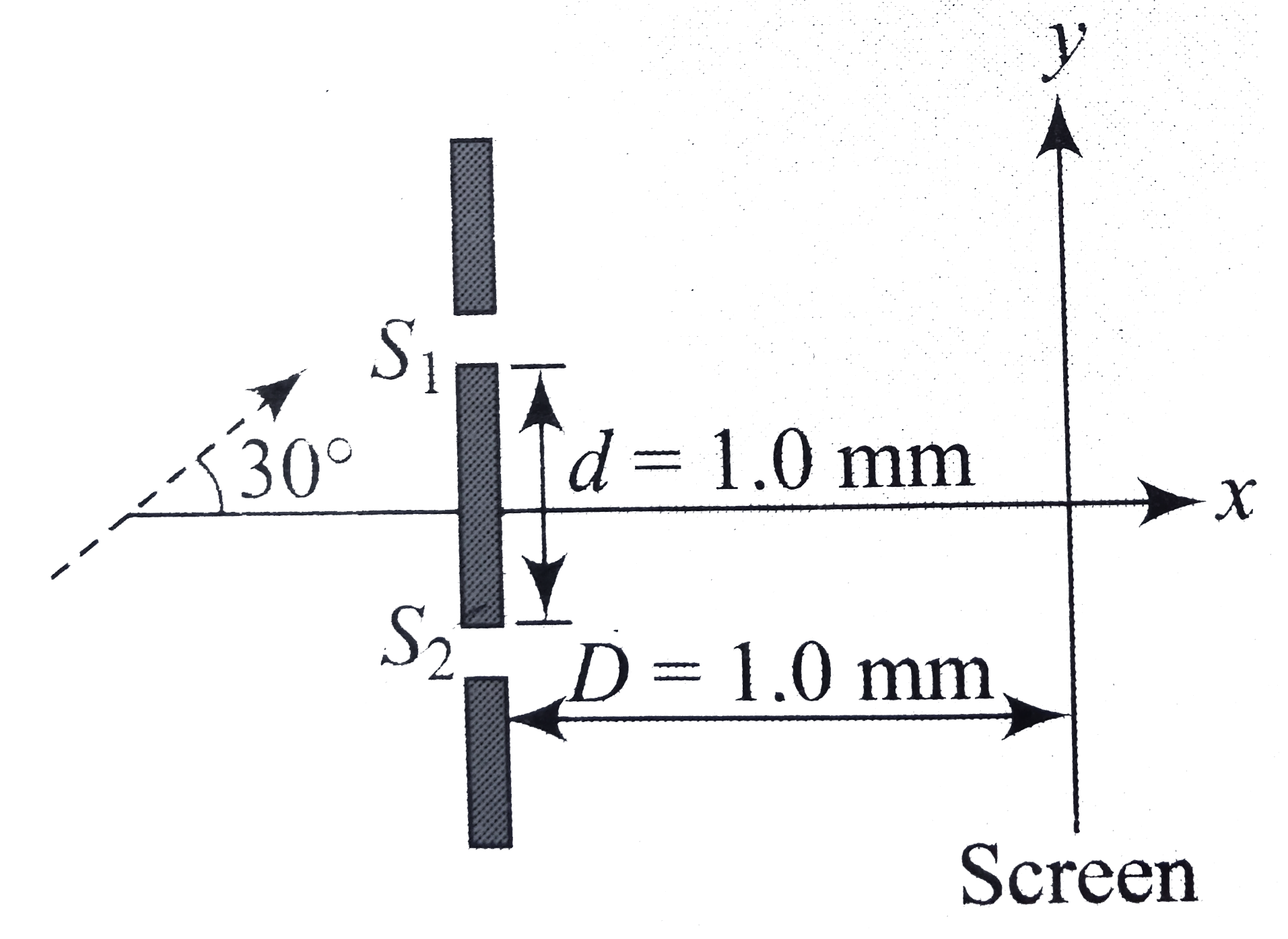
A coherent parallel beam of microwaves of wavelength `lambda = 0.5 mm` falls on aYoung's double- slit apparatus. The separation between the slits is 1.0 mm. The intensity of microwaves is measured on a screen placed parallel to the plane of the slits at a distance of 1.0 m from it as shown in Fig. 2.42.
If the incident beam makes an angle or `30^(@)` with the x-axis (as in the dotted arrow shown in the figure), find the y-coordinates of the first minima on either side of the central maximum.

Text Solution

Verified by Experts

The correct Answer is:
(a)`+-(1)/(sqrt(15))m +-(3)/(sqrt(7))m` (b)`(1)/(sqrt(15)),+(3)/(sqrt(17))m`

`d=sintheta=(2n-1)(lambda)/(2)`
`sintheta=((2n-1)lambda)/(2d) rArr sintheta=(2n-1)/(2)xx(0.5xx10^(-3))/(10^(-3)) rArr sintheta=((2n-1))/(4)`
For first minima `n=1`
`sintheta=+-(1)/(4) rArr tantheta=+-(1)/(sqrt(15)) rArr tantheta=(y_(1))/(D)=+-(1)/(sqrt(15)) rArr y_(1)=+-(1)/(sqrt(15))m`
for second minima `n=2`
`sintheta=+-(3)/(4) rArr tan theta=+-(3)/(sqrt(7)) rArr tantheta=(y_(2))/(D)=pm(3)/(sqrt(7)) rArr y_(2)=+-(3)/(sqrt(7))m` (b) For point`P`to be centeral maximum
`dsin30^(2)+S_(1)P-S_(2)P=0`
`dsin30^(@)=(S_(2)P-S_(1)P)`
`d sin30^(@)=d sintheta`
`theta=30^(@)`
`tan30^(@)=(y_(0))/(D) rArr y_(0)=(1)/(sqrt(3))m`
`P_(1)` and `P_(2)` to be minima
For `P_(1)` to be minima
`dsin30^(@)+S_(1)P_(1)-S_(2)P_(1)=(lambda)/(2) rArr dsin30^(@)+dsin theta=(lambda)/(2)`
`sintheta=sin30^(@)-(lambda)/(2d) rArr sintheta=(1)/(2)-(1)/(4)`
`sintheta=(1)/(4)`or `tantheta=(1)/(sqrt(15)) rArr (y_(1))/(D)=(1)/(sqrt(15)) rArr y_(1)=(1)/(sqrt(15))m`
For `P_(2)` to be minima
`S_(2)P-(dsin30^(@)+S_(1)P)=(lambda)/(2) rArr (S_(2)P-S_(1)P)-dsin 30^(@)=(lambda)/(2)`
`-dsin30^(@)+dsintheta=(lambda)/(2) rArr sin theta=(lambda)/(2d)+sin30^(@)`
`rArr sin theta=(3)/(4) rArr tantheta=(3)/(2sqrt(7)) rArr y_(2)=(3)/(sqrt(7))m`
Promotional Banner

Similar Questions

Explore conceptually related problems

In Young's double slit experiment, white light is used. The seperation between the slits is kept 1 mm and intensity is observed on screen distance 2m from the plane of the slits. At a point on the screen directly opposite to the either slit which of the following wavelength is not present

Light of wavelength lambda = 5890 Å fall on a double-slit arrangement having separation d = 0.2 mm . A thin lens of focal length f = 1 m is placed near the slits. The linear separation of fringes on a screen placed in the focal plane of the lens is

A parallel beam of monochromatic light is used in a Young's double slit experiment. The slits are separated by a distance d and the screen is placed parallel to the plane of the slits. Show that if the incident beam makes an angle theta=sin^-1(lamda/(2d)) with the normal to the plane of the slits, there will be a dark fringe at the centre Po of the pattern.

In Young's double slit experiment, the distance between the two slits is 0.1 mm and the wavelength of light used is 4 xx 10^(-7) m . If the width of the fringe on the screen is 4 mm , the distance between screen and slit is

White light of wavelength in range 400 nm to 700 nm is incident normaly on a young's double slit experiment apparatus. The distance betweenn slits is d=1 mm and distance between plane of the slits and screen in 0.8 m. At a point on the screen just in front of one of the slits the missing wavelength is (are)

A parallel beam of light of wavelength 600 nm is incident normally on a slit of width d. If the distance between the slits and the screen is 0.8 m and the distance of 2^(nd) order maximum from the centre of the screen is 15 mm. The width of the slit is

The Young's double slit experiment the wavelength of light lamda=4xx10^(-7)m and separation between the slits is d=0.1mm . If the frintge width is 4mm then the seperation between the slits and the screen will be

A parallel beam of monochromatic light of wacelength lambda used in a Young's double slit experiment. The siits are separated by a distance d and the screen is placed parallel to the plane of the slits. The incident beam makes an angle theta=sin^(-1)((lambda)/(2d)) with the normal to the slits. A transparent sheet of refractive index 'mu' and thickness t=(lambda)/(2(mu-1)) is introduced infront of one of the slit. find the intensity at the geometrical centre.

