Home
Class 12
PHYSICS
Radio waves coming at anglealpha to veti...

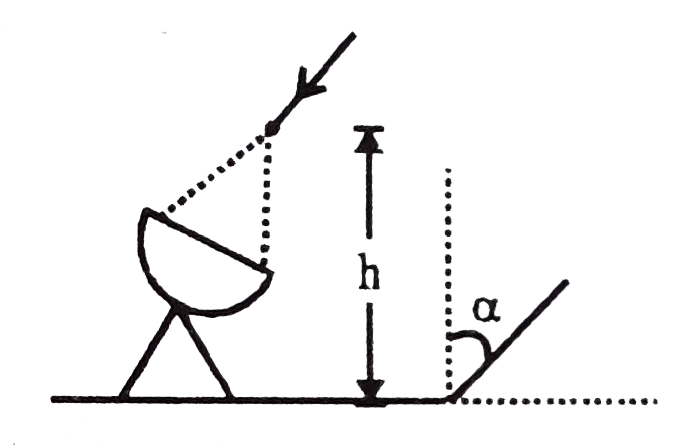
Radio waves coming at `angle_alpha` to vetical are received by a radar after reflection from a nearby water surface and directly .what should be height of antenna from water surface so that it records a maximum intensity.(Wavelength =`lambda`)

Text Solution

Verified by Experts

The correct Answer is:
`(lambda)/(4cos alpha)`

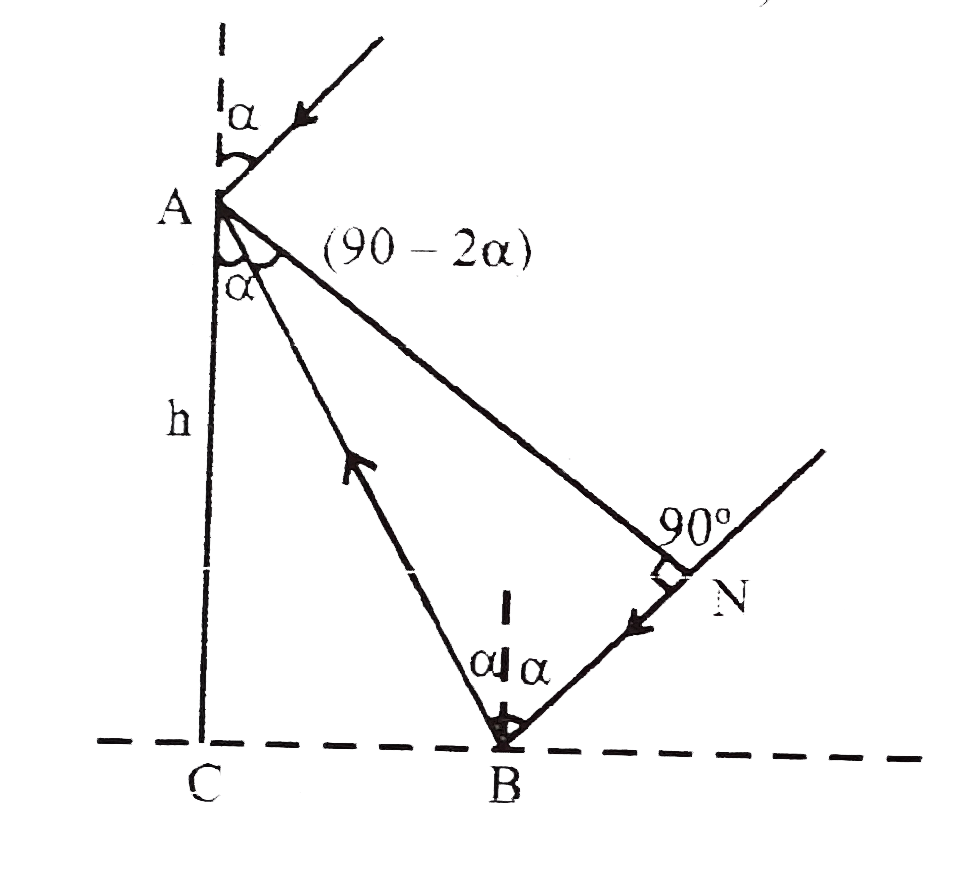
Path difference =`BN+BA+(lambda)/(2)`
(because reflection occurs from denser medium)

`DeltaACB`
`(h)/(AB)=cosalpha`
`AB=(h)/(cosalpha),…(1)`
from rightangle`DeltaANB`
`(BN)/(AB)=cos2alpha`
`BN=ABcos2 alpha...(2)`
path difference=`(AB+ABcos2alpha)+(lambda)/(2)`
`lambda=AB(1+cos2 alpha)+(lambda)/(2)`
`(lambda)/(2)=(h)/(cosalpha)xx2cos^(2)alpha`
`(lambda)/(2)=2hcosalpha`
`h=(lambda)/(4cosalpha)`
Promotional Banner

Similar Questions

Explore conceptually related problems

The wave reaching the receiving antenna will have maximum intensity if the direct wave & wave after reflection from earth's surface

Water is filled to a height in a long container. From what height below the free surface a hole should be bored in the wall of a container so that the horizontal range is maximum?

The light reflected from water surface (mu = 1.3) is completely polarised. The angle of incidence will be

A source S and a detector D are placed at a distance d apart. A big cardboard is placed at a distance sqrt(2) d from the source and the detector as shown in figure. The source emits a wave of wavelength = d//2 which is received by the detector after reflection from the cardboard. It is found to be in phase with the direct wave received from the source. By what minimum distance should the cardboard be shifted away so that the reflected wave becomes out of phase with the direct wave?

A person standing at a distance of 6 m from a source of sound receives sound wave in two ways, one directly from the source and other after reflection from a rigid boundary as shown in figure. The maximum wavelength for which, the person will receive maximum sound intensity, is

A source emits electromagnetic waves of wavelength 3 m . One beam reaches the observer directly and other after reflection from a watersurface, travelling 1.5 m extra distance and with intensity reduced to 1//4 as compared to intensity due to the direct beam alone. The resultant intensity will be :

A very thin prism has an apex angle A and its material has refractive index mu = 1.48 . Light is made to fall on one of the refracting faces at near normal incidence. Interference results from light reflected from the outer surface and that emerging after reflection at the inner surface. When violet light of wavelength lambda "= 400 nm" is used, the first construc- tive interference band is observed at a distance "d = 3.0 cm" from the apex of the prism. (a) Find the apex angle A. (b) If red light (lambda" = 800 nm") is used, at what distance from the apex will we observe the first constructive interfer- ence band.

At what value of the angle of incident theta_(1) is a shaft of light reflected from the surface of water perpendicular to the refracted shaft?

