Home
Class 12
PHYSICS
Plane parallel wavefornts encounter the ...

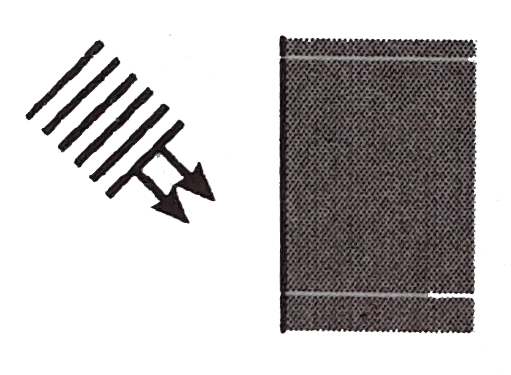
Plane parallel wavefornts encounter the interference one medium and another as shown below The wave speed is different in the two media.
what will happen to the distance between wavefront and the direction of travel wavefronts as the waves enter the second media?

A

the distance between wavefronts remains unchanged but the directionof wavefornt changes.

B

the distance between wavefronts and the direction of wavefront both remains unchanged

C

the distance between wavefronts and the direction of wavefront both changed.

D

the distance between wavefrontschanged but the directionof wavefornt unchanges.

Text Solution

Verified by Experts

The correct Answer is:

C

because wave length and direction of progation changes.
Promotional Banner

Similar Questions

Explore conceptually related problems

Two plane mirrors are placed parallel to each other. The distance between the mirrors is 10cm. An object is placed between the mirrors at a distance of 4cm from one of them, say M_(1) . What is the distance between the first time formed at M_(1) and the second image formed at M_(2) ?

A sound source, detector and a cardboard are arranged as shown in figure. The wave is reflected from the cardboard at the line symmetry of source edetector. Initially the path difference between the reflected wave and the direct wave is one third of the wavelength of sound. Find the minimum distance by which the cardboard should be moved upwards so that both waves are in phase.

Huygen was the figure scientist who proposed the idea of wave theory of light he said that the light propagates in form of wavelengths. A wavefront is a imaginary surface of every point of which waves are in the same. phase. For example the wavefront for a point source of light is collection of concentric spheres which have centre at the origin w_(1) is a wavefront w_(2) is another wavefront. The radius of the wavefront at time 't' is 'ct' in thic case where 'c' is the speed of light the direction of propagation of light is perpendicular to the surface of the wavelength. the wavefronts are plane wavefronts in case of a parallel beam of light. Huygen also said that every point of the wavefront acts as the source of secondary wavelets. The tangent drawn to all secondary wavelets at a time is the new wavefront at that time. The wavelets are to be considered only in the forward direction (i.e., the direction of propagation of light) and not in the reverse direction if a wavefront w_(1) and draw spheres of radius 'cDeltat' they are called secondary wavelets. Draw a surface w_(2) which is tangential to all these secondary wavelets w_(2) is the wavefront at time t+Deltat Huygen proved the laws of reflection and laws of refraction using concept of wavefront. Q. Wavefronts incident on an interface between the media are shown in the figure. the refracted wavefront will be as shown in

Two sine waves travel in the same direction in a medium. The amplitude of each wave is A and the phase difference between the two waves is 120^@ . The resultant amplitude will be

Huygen was the figure scientist who proposed the idea of wave theory of light he said that the light propagates in form of wavelengths. A wavefront is a imaginary surface of every point of which waves are in the same. phase. For example the wavefront for a point source of light is collection of concentric spheres which have centre at the origin w_(1) is a wavefront w_(2) is another wavefront. The radius of the wavefront at time 't' is 'ct' in thic case where 'c' is the speed of light the direction of propagation of light is perpendicular to the surface of the wavelength. the wavefronts are plane wavefronts in case of a parallel beam of light. Huygen also said that every point of the wavefront acts as the source of secondary wavelets. The tangent drawn to all secondary wavelets at a time is the new wavefront at that time. The wavelets are to be considered only in the forward direction (i.e., the direction of propagation of light) and not in the reverse direction if a wavefront w_(1) and draw spheres of radius 'cDeltat' they are called secondary wavelets. Draw a surface w_(2) which is tangential to all these secondary wavelets w_(2) is the wavefront at time t+Deltat Huygen proved the laws of reflection and laws of refraction using concept of wavefront. Q. Spherical wavefronts shown in figure, strike a plane mirror. reflected wavefront will be as shown in

Huygen was the figure scientist who proposed the idea of wave theory of light he said that the light propagates in form of wavelengths. A wavefront is a imaginary surface of every point of which waves are in the same. phase. For example the wavefront for a point source of light is collection of concentric spheres which have centre at the origin w_(1) is a wavefront w_(2) is another wavefront. The radius of the wavefront at time 't' is 'ct' in thic case where 'c' is the speed of light the direction of propagation of light is perpendicular to the surface of the wavelength. the wavefronts are plane wavefronts in case of a parallel beam of light. Huygen also said that every point of the wavefront acts as the source of secondary wavelets. The tangent drawn to all secondary wavelets at a time is the new wavefront at that time. The wavelets are to be considered only in the forward direction (i.e., the direction of propagation of light) and not in the reverse direction if a wavefront w_(1) and draw spheres of radius 'cDeltat' they are called secondary wavelets. Draw a surface w_(2) which is tangential to all these secondary wavelets w_(2) is the wavefront at time t+Deltat Huygen proved the laws of reflection and laws of refraction using concept of wavefront. Q. Plane are incident on a spherical mirror as shown in the figure. the reflected wavefronts will be
