

Home
Class 11
PHYSICS
A ring of mass m is attached to a horizo...


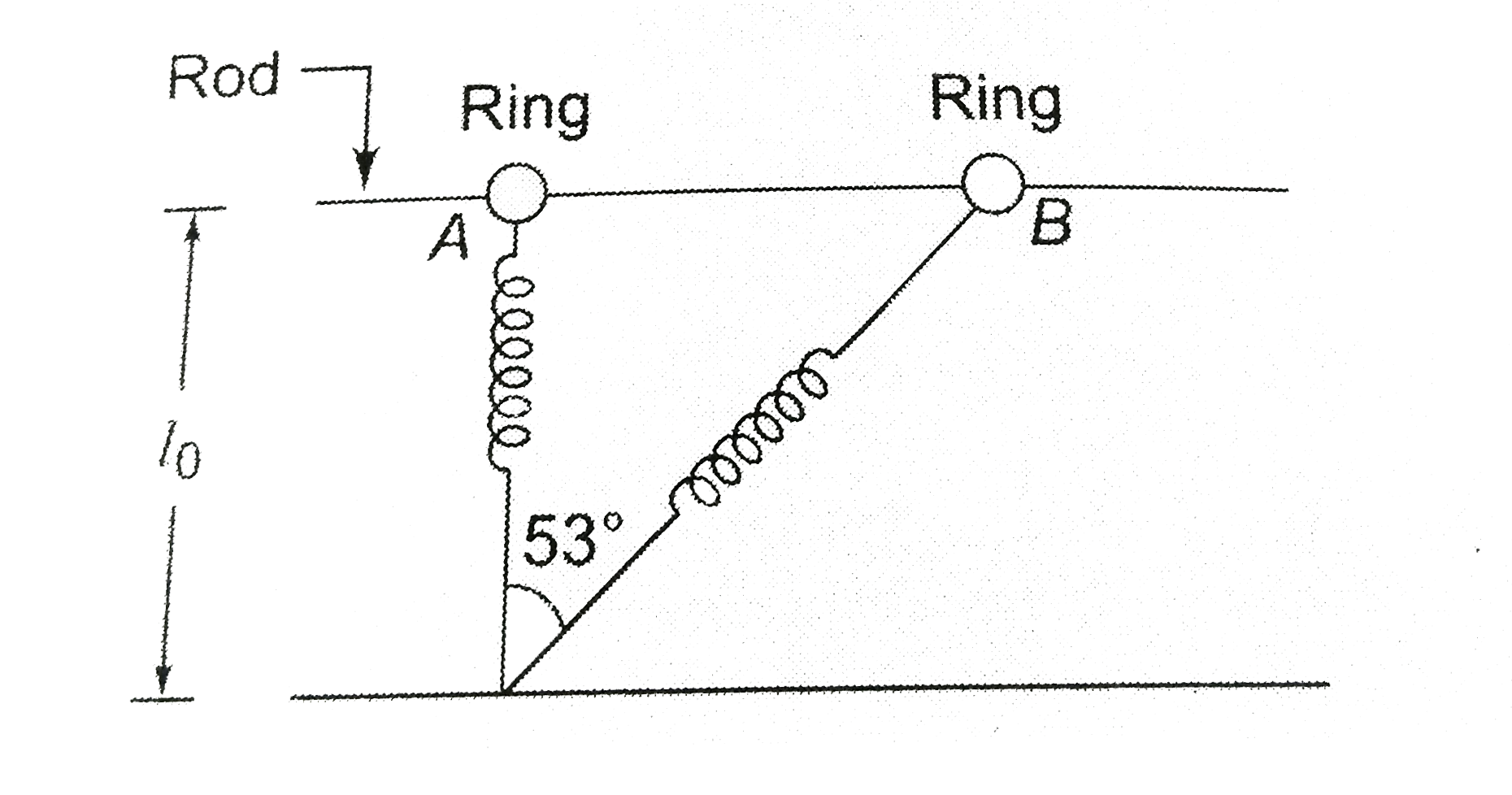
A ring of mass `m` is attached to a horizontal spring of spring constant `k` and natural length `l_0`. The other end of the spring is fixed and the ring can slide on a horizontal rod as shown. Now the ring is shifted to position B and released Find the speed of the ring when the spring attains its natural length.

Promotional Banner

Similar Questions

Explore conceptually related problems

A small block of mass m is fixed at upper end of a massive vertical spring of spring constant k=(2mg)/(L) and natural length 10L The lower end of spring is free and is at a height L from fixed horizontal floor as shown. The spring is initially unstressed and the spring block system is released from rest in the shown position. Q. As the block is coming down, the maximum speed attained by the block is

A small block of mass m is fixed at upper end of a massive vertical spring of spring constant k=(2mg)/(L) and natural length 10L The lower end of spring is free and is at a height L from fixed horizontal floor as shown. The spring is initially unstressed and the spring block system is released from rest in the shown position. Q. As the block is coming down, the maximum speed attained by the block is

A small block of mass m is fixed at upper end of a massive vertical spring of spring constant k=(2mg)/(L) and natural length 10L The lower end of spring is free and is at a height L from fixed horizontal floor as shown. The spring is initially unstressed and the spring block system is released from rest in the shown position. Q. Till the blocks reaches its lowest position for the first time, the time duration for which the spring remains compressed is

A small block of mass m is fixed at upper end of a massive vertical spring of spring constant k=(2mg)/(L) and natural length 10L The lower end of spring is free and is at a height L from fixed horizontal floor as shown. The spring is initially unstressed and the spring block system is released from rest in the shown position. Q. Till the blocks reaches its lowest position for the first time, the time duration for which the spring remains compressed is

A small block of mass m is fixed at upper end of a massive vertical spring of spring constant k=(2mg)/(L) and natural length 10L The lower end of spring is free and is at a height L from fixed horizontal floor as shown. The spring is initially unstressed and the spring block system is released from rest in the shown position. Q. At the instant the speed of block is maximum the magitude of force exeted by the spring on the block is

A small block of mass m is fixed at upper end of a massive vertical spring of spring constant k=(2mg)/(L) and natural length 10L The lower end of spring is free and is at a height L from fixed horizontal floor as shown. The spring is initially unstressed and the spring block system is released from rest in the shown position. Q. At the instant the speed of block is maximum the magitude of force exeted by the spring on the block is

A bead of mass m can slide without friction on a fixed circular horizontal ring of radius 3R having a centre at the point C. The bead is attached to one of the ends of spring of spring constant k. Natural length of spring is R and the other end of the spring is R and the other end of the spring is fixed at point O as shown in the figure. If the bead is released from position A, then the kinetic energy of the bead when it reaches point B is

A bead of mass m can slide without friction on a fixed circular horizontal ring of radius 3R having a centre at the point C. The bead is attached to one of the ends of spring of spring constant k. Natural length of spring is R and the other end of the spring is R and the other end of the spring is fixed at point O as shown in the figure. If the bead is released from position A, then the kinetic energy of the bead when it reaches point B is

A bead of mass 'm' is attached to one end of a spring of natural length R & spring constant k = ((sqrt3 + 1))/(R) . The other end of the spring is fixed at point A on a smooth vertical ring of radius R as shown. The normal reaction at B just after it is released to move is

A Bead of mass m is attached to one end of a spring of natural length 'R' and spring cosntant 'k=((sqrt3+1)mg)/R' . The other end of the spring is fixed at point 'A' on a smooth vertical ring of radius 'R' as shown