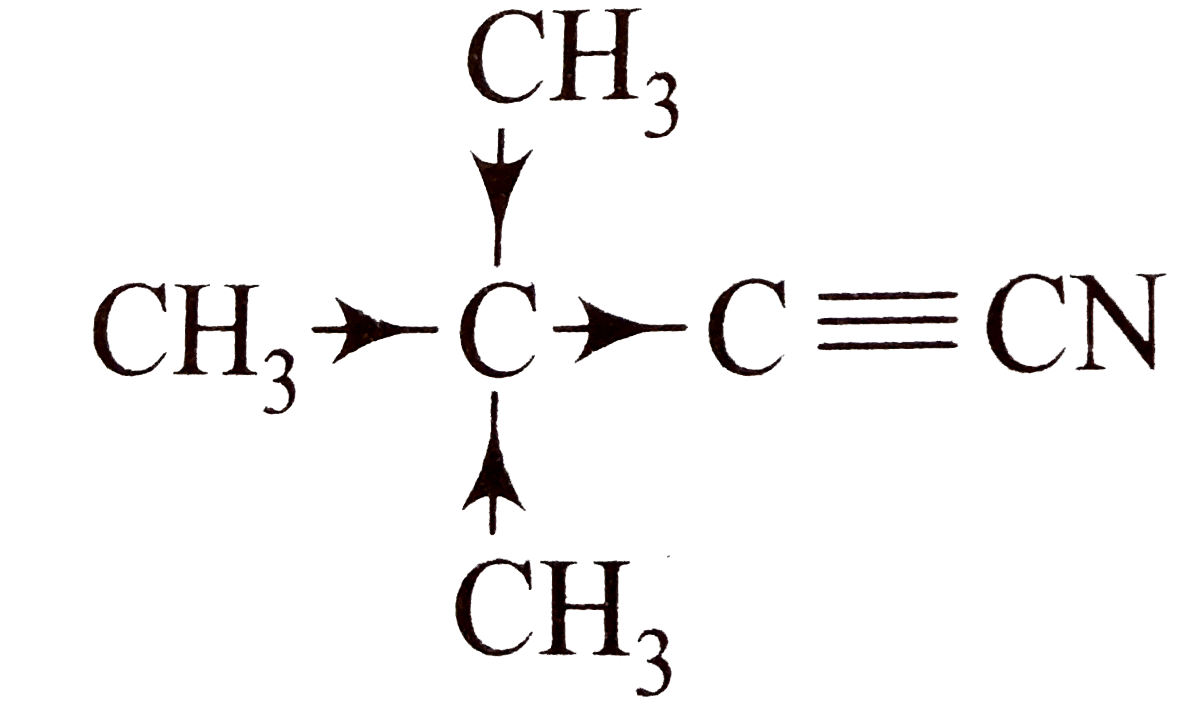
The `(CH_(3))_(3)C`- group in `t`-butylacetylene exerts
A
`-I` effect
B
`+I` effect
C
hyperconjugation
D
both (2) and (3)
Text Solution
Verified by Experts
The correct Answer is:
B
Hyperconjugation is not possible because `C-H` bond of `t` butyl group is not directly attached to `C-=C` bond.
Topper's Solved these Questions
GENERAL ORGANIC CHEMISTRY
R SHARMA|Exercise Level - III|6 Videos
GENERAL ORGANIC CHEMISTRY
R SHARMA|Exercise Level - IV|3 Videos
GENERAL ORGANIC CHEMISTRY
R SHARMA|Exercise Level - I|6 Videos
EQUILIBRIUM
R SHARMA|Exercise ARCHIVES|69 Videos
ISOMERISM
R SHARMA|Exercise Archives|11 Videos
Similar Questions
Explore conceptually related problems
The CH_(3)- group in propene exerts
When -CH_(3), CH_(3) - underset(CH_(3))underset(|)(CH) - " and " CH_(3) - underset(CH_(3))underset(|) overset(CH_(3))overset(|)C - groups are introduced on benzene ring then correct order of their inductive effect is
(CH_(3))_(3)C-OCH_(3) on reaction with HI gives (CH_(3))_(3)C-I and CH_(3)-OH as the main products and not (CH_(3))_(3)C-OH and CH_(3)-I . Explain.
CH_(3)-CH=C=CH-CH_(3)
A : C_(2)H_(5) -""^(+)CH —C_(2)H_(5) . is more stable than CH_(3)-""^(+)CH-CH_(3) R : Positive inductive effect of C_(2)H_(5) group is less than CH_(3) —group.
Arrangements of (CH_(3))_(3)C-,(CH_(3))_(2)CH-,CH_(3).CH_(2)- when attached to benzyl or n unsaturated group in increasing order of inductive effects is: