

Home
Class 12
PHYSICS
Three glass prisms A , B and C of same r...

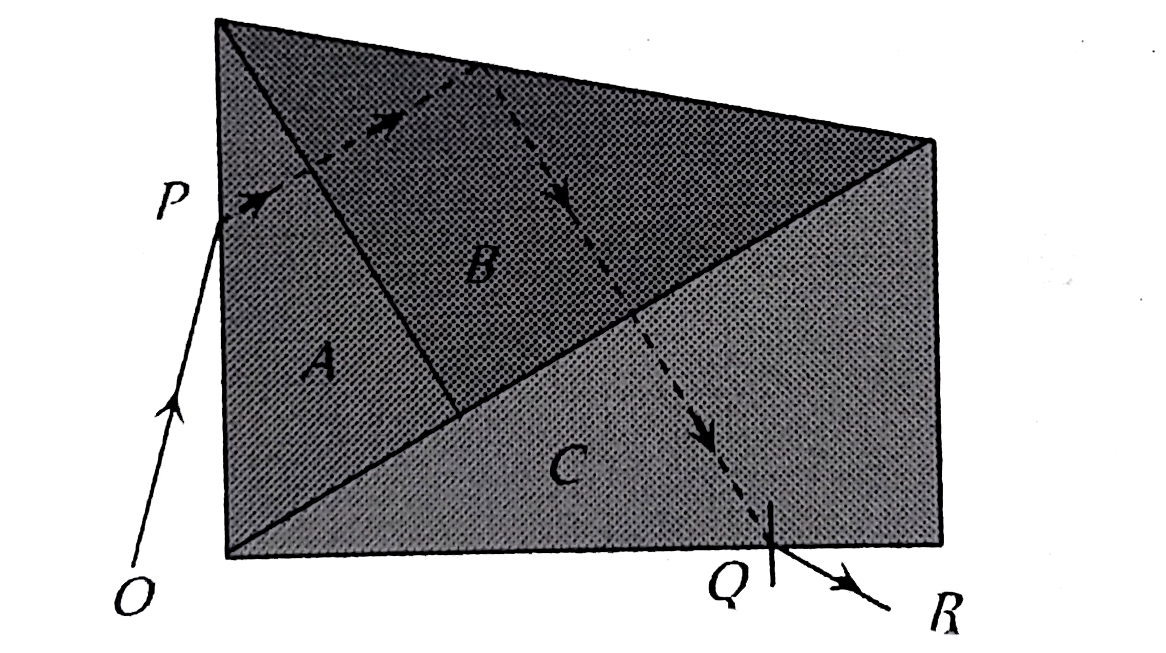
Three glass prisms A , B and C of same refractive index are placed in contact with each other as shown in figure, with no air gap between the prisms. Monochromatic ray of light OP passes through the prism assembly and emerges as QR . The conditions of minimum deviation is satisfied in the prisms

Promotional Banner

Similar Questions

Explore conceptually related problems

Three glass prism A,B and C of same refractive index are placed in contact with each other as shown in figure, with no air gap between the prisms. Monochormatic ray of light OP passes through the prism assembly and emerges as QR . The conditions of minimum deviation is satisfied in the prisms.

Monochromatic light passes through prism. Compared to that in air. Inside the prism the light's

Monochromatic light passes through a prism. Compared to that in air, inside the prism the light's

Monochromatic light passes through prism. Compared to that in air. Inside the prism the light's

A parallel glass slab of refractive index sqrt3 is placed in contact with an equilateral prism of refractive index sqrt2 . A ray is incident on left surface of slab as shown. The slab and prism combination is surrounded by air. The magnitude of minimum possible deviation of this ray by slab-prism combination is:

Refraction of light through Prism| condition of maximum and minimum deviation|Dispersion of light through Prism

A glass prism is immersed in a liquid of refractive index 1.4. If the refractive index of glass is 1.6 , find the limiting angle of the prism for emergence of ray through it.

Calculate the speed of light in the prism if a ray of light is passing through an equilateral triangular glass prism from air and undergoes minimum deviation when angle of incidence is 5//4 th of the angle of prism.