Home
Class 12
CHEMISTRY
The term adsorption refers strictly to t...

The term adsorption refers strictly to the existence of an concentration of any particular component (molecular species) at the surface of a liquid or solid phase than is present in the bulk.

A

higher

B

lower

C

higher or lower

D

equal

Text Solution

Verified by Experts

The correct Answer is:
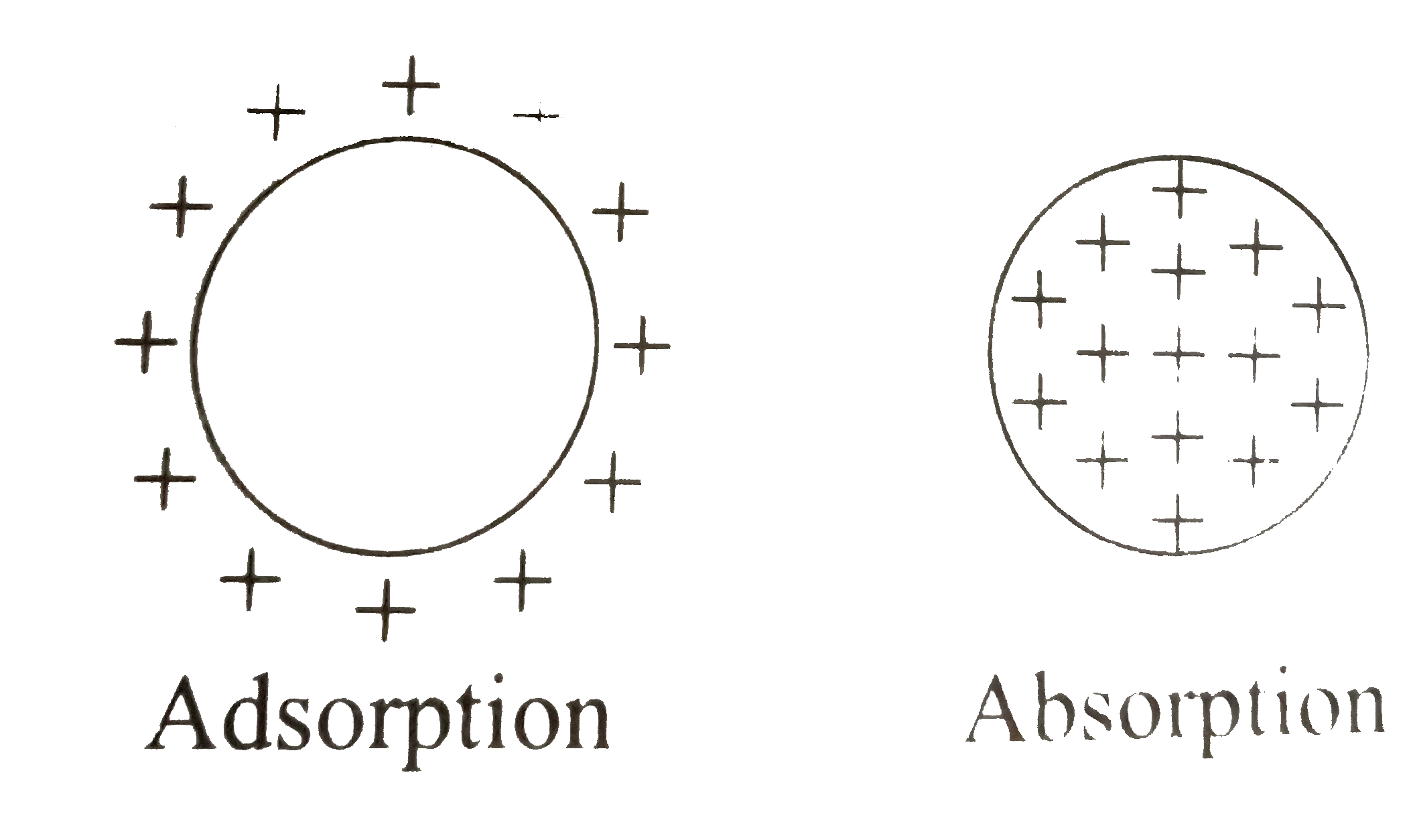
A

In adsorption the concentration of the adsorbate increases only at the surface of the adsorbent while inh absorption the concentration is uniform throughout the bulk of the solid.
When the concentration of the adsorbate is more on the surface of adsorbent relative to its concentration in the bulk, it is called positive adsorption. On the other hand, when the concentration of the adsorption is less on the surface relative to its concentration in the bulk, it is called negative adsorption. It happens rarely. In the case of some liquid solutions, it is observed that the concentration of the solution is less on the surface than in the bulk of the solution, a case of negative adsorption.
Promotional Banner

Topper's Solved these Questions

  • SURFACE CHEMISTRY

    R SHARMA|Exercise Follow-up Test 2|12 Videos
  • SURFACE CHEMISTRY

    R SHARMA|Exercise Follow-up Test 3|13 Videos
  • STEREOCHEMISTRY

    R SHARMA|Exercise Archives|17 Videos
  • THE D AND F BLOCK ELEMENTS

    R SHARMA|Exercise Archives|54 Videos

Similar Questions

Explore conceptually related problems

Adsorption is the presence of excess concentration of any particular component at the surface of liquid a solid phase as compared to bulk.This is due to presence of residual forces at the surface of body.In the adsorption of hydrogen gas over a sample of charcoal, 1.12cm^3 of H_2(g) measured over S.T.P was found to absorb per gram of charcoal.Consider only monolayer adsorption.Density of H_2 is 0.07gm/cc. In another experiment same 1 gm charcoal adsorbs 100 ml of 0.5M CH_3COOH to form monolayer and thereby the molarity of CH_3COOH reduces to 0.49. ((3xx47.43)/(4pi))^(1//3)=2.24 (2.24)^2=5 Specific surface are of charcoal is (cm^2//gm) -

Adsorption is the presence of excess concentration of any particular component at the surface of liquid a solid phase as compared to bulk.This is due to presence of residual forces at the surface of body.In the adsorption of hydrogen gas over a sample of charcoal, 1.12cm^3 of H_2(g) measured over S.T.P was found to absorb per gram of charcoal.Consider only monolayer adsorption.Density of H_2 is 0.07gm/cc. In another experiment same 1 gm charcoal adsorbs 100 ml of 0.5M CH_3COOH to form monolayer and thereby the molarity of CH_3COOH reduces to 0.49. ((3xx47.43)/(4pi))^(1//3)=2.24 (2.24)^2=5 Surface area of charcoal adsorbed by each molecule of (acetic soda) is-

Adsorption is the presence of excess concentration of any particular component at the surface of liquid a solid phase as compared to bulk.This is due to presence of residual forces at the surface of body.In the adsorption of hydrogen gas over a sample of charcoal, 1.12cm^3 of H_2(g) measured over S.T.P was found to absorb per gram of charcoal.Consider only monolayer adsorption.Density of H_2 is 0.07gm/cc. In another experiment same 1 gm charcoal adsorbs 100 ml of 0.5M CH_3COOH to form monolayer and thereby the molarity of CH_3COOH reduces to 0.49. ((3xx47.43)/(4pi))^(1//3)=2.24 (2.24)^2=5 Molecule of acetic acids adsorbed-

Adsorption is the presence of excess concentration of any particular component at the surface of liquid a solid phase as compared to bulk.This is due to presence of residual forces at the surface of body.In the adsorption of hydrogen gas over a sample of charcoal, 1.12cm^3 of H_2(g) measured over S.T.P was found to absorb per gram of charcoal.Consider only monolayer adsorption.Density of H_2 is 0.07gm/cc. In another experiment same 1 gm charcoal adsorbs 100 ml of 0.5M CH_3COOH to form monolayer and thereby the molarity of CH_3COOH reduces to 0.49. ((3xx47.43)/(4pi))^(1//3)=2.24 (2.24)^2=5 What is the radius of adsorb hydrogen molecule-

The accumulation of molecular species at the surface rather than in the bulk of a solid or liquid is termed as

R SHARMA-SURFACE CHEMISTRY-Archives
  1. The term adsorption refers strictly to the existence of an concentrati...

    Text Solution

    |

  2. The coagulation value in millimoles per litre of the electrolyes used ...

    Text Solution

    |

  3. Which one of the following chargcterisitic is associated with adsorpt...

    Text Solution

    |

  4. Which property of colloids is not dependent on the change on colloidal...

    Text Solution

    |

  5. Which of the following statements of correct for the spontaneous adsop...

    Text Solution

    |

  6. In frenudlich adsorption isotherm, the value of 1//n is

    Text Solution

    |

  7. Which one of the following statements is incorrect about enzyme catal...

    Text Solution

    |

  8. The ease of adsorption of the hydrated alkali metal ions om ion-exchan...

    Text Solution

    |

  9. The protcting power of lyophilic colloidal solution is expressed in te...

    Text Solution

    |

  10. If x is the amount of adsorbate and m is the amount of adsorbent, whic...

    Text Solution

    |

  11. The Langmuir adsorption isotherm is deduced using the assumption.

    Text Solution

    |

  12. A plt of log X/m vs. log P for the adsorption of a gasd on a solid giv...

    Text Solution

    |

  13. Which one of the following forms micells in aqueous solution above cer...

    Text Solution

    |

  14. which of the following forms cationic micelles above certain concentra...

    Text Solution

    |

  15. Which of the following statements about the zeolites is false?

    Text Solution

    |

  16. According to the adsorption theory of catalysis the speed of the react...

    Text Solution

    |

  17. Position of nonpolar and parts in micells is

    Text Solution

    |

  18. Which is not correct regarding the adsorption of a gas on surface of a...

    Text Solution

    |

  19. The method usually employed for the precipitation of a colloidal solut...

    Text Solution

    |

