Home
Class 12
CHEMISTRY
For the octahedral complex of Fe^(+) in ...

For the octahedral complex of `Fe^(+)` in `SCN^(-)` (thiocyanato-S) and in `CN^(-)` ligand environments, the difference between the spin - only magnetic moments in Bohr magneton (when approximated to the nerest integer) is `[At. No . of Fe = 26]`

A

3

B

6

C

4

D

5

Text Solution

Verified by Experts

The correct Answer is:

C

We have complex:
`[Fe(SCN)_(6)]^(3-)` and `[Fe(CN)_(6)]^(3-)`
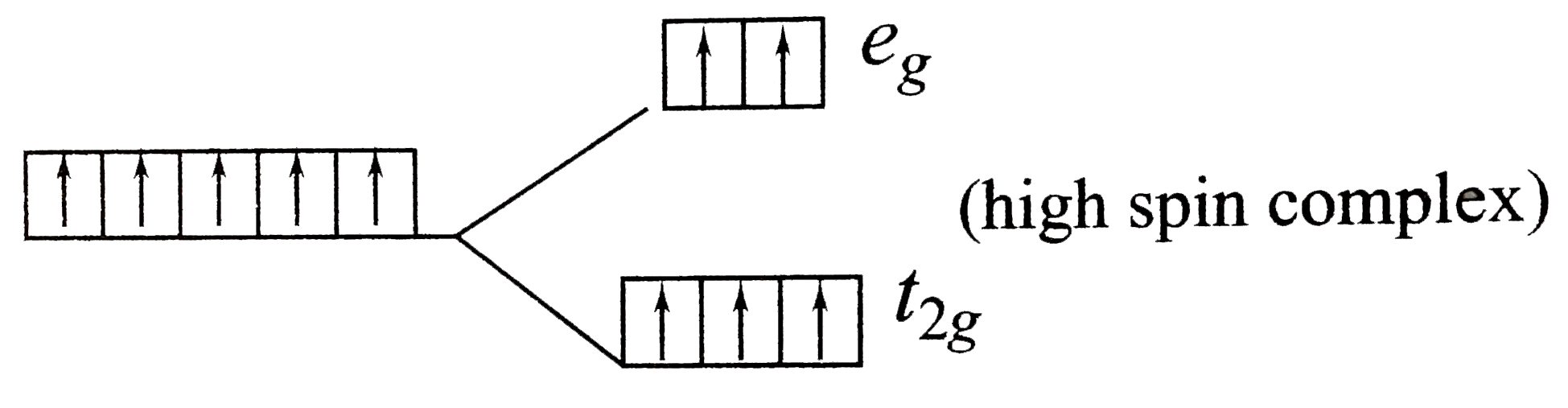
In both the complexes, the oxidation number of Fe is `+3` which has the configuration `[Ar]3d^(5)` . Since `SCN^(-)` is a weak field ligand while `CN^(-)` is a strong field ligand, the pairing will take place only in cyanide complex.
`[Fe(SCN)_(6)]^(3-)`

`mu = sqrt(n(n +2)) = sqrt(5(5+2)) = sqrt(35) = 5.91` BM
`[Fe(CN)_(6)]^(3-)`

`mu = sqrt(n(n+)) = sqrt(1(1+2)) = sqrt(3) = 1.73` BM
Difference spin only magnetic moment `=5.91 - 1.73 = 4.18~~4`
Promotional Banner

Topper's Solved these Questions

  • COORDINATION COMPOUNDS

    R SHARMA|Exercise Archives|56 Videos
  • COORDINATION COMPOUNDS

    R SHARMA|Exercise Archives|56 Videos
  • CHEMISTRY IN EVERYDAY LIFE

    R SHARMA|Exercise Archives|11 Videos
  • ELECTROCHEMISTRY

    R SHARMA|Exercise Follow-up Test 11|7 Videos

Similar Questions

Explore conceptually related problems

For the octahedral complexes of Fe^(3+) in SCN^(-) (thiocyanato -S) and in CN^(-) ligand environments, the difference between the spin only magnetic moments in Bohr magnetons (when approximated to the nearest integer) is [atomic number of Fe = 26 ]

For the octahedral complexes of Fe^(3+) is SCN^(-) ( thiocyanato-S) and in CN^(-) ligand environments , the difference between the spin only magnetic moments in Bohr magnetons (when approximated to the nearest integer ) is [atomic number of Fe = 26]

The spin only magnetic moment of Fe^(3+) ion (inBM) is approximately

The spin only magnetic moment of Fe^(2+) ion (in BM) is approximately

R SHARMA-COORDINATION COMPOUNDS-Question Bank (Building the knowledge)
  1. The number of geometric isomers that can exist for square planner comp...

    Text Solution

    |

  2. If the freezing point of a 0.01 molal aqueous solution of a cobalt (II...

    Text Solution

    |

  3. In the complex ion [Fe(H(2)O)(5)NO]^(2+)

    Text Solution

    |

  4. Which of the following statements is incorrect regarding the stereisom...

    Text Solution

    |

  5. Which of the following coordination entities are more stable for stron...

    Text Solution

    |

  6. The total number possible isomers for the complex compound [Cu^(II)(NH...

    Text Solution

    |

  7. Which of the folloiwng complexes in not expected to exhibit optical is...

    Text Solution

    |

  8. The octahedral complex of a metal ion M^(3+) with four monodentate lig...

    Text Solution

    |

  9. The equation which is balanced and represents the correct product(s) i...

    Text Solution

    |

  10. In the complex acetylbromidodicarbonyl bis (triethyphospine) iron (II)...

    Text Solution

    |

  11. Among the complex ions, [Co(en)(2)CI(2)]^(+) , [CrCI(2)(C(2)O(4))(2)...

    Text Solution

    |

  12. Which of the following is a bidentate ligand ? (i) Acetylacetonate ...

    Text Solution

    |

  13. The IUPAC name of the complex [Cu(C(5)H(7)O(2))(2)] formed bby the rea...

    Text Solution

    |

  14. The IUPAC name for [(NH(3))(5)Cr - (OH) - Cr(NH(3))(5)] is

    Text Solution

    |

  15. The pair(s) of coordination complexes/ion exhibiting the same kind of ...

    Text Solution

    |

  16. EDTA^(4-) i9s ethylenediamine tetraacetate ion The total number of N-C...

    Text Solution

    |

  17. Which of the following compounds is not yellow coloured ?

    Text Solution

    |

  18. For the octahedral complex of Fe^(+) in SCN^(-) (thiocyanato-S) and in...

    Text Solution

    |

  19. An aqueous solution of metal ion MI reacts separately with reagents Q ...

    Text Solution

    |

  20. AIF(3) is soluble in HF only in presence of KF. It is due to the forma...

    Text Solution

    |